

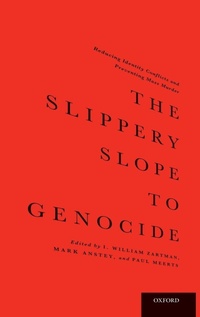
The Slippery Slope to Genocide
Reducing Identity Conflicts and Preventing Mass Murder
Published on 16. February 2012
Book
Hardback
432 pages
978-0-19-979174-3 (ISBN)
Description
Genocide results from the culmination of conflicts over identity. A group of people that feels threatened by extinction resorts to genocide as a pathologically defensive reaction. This poses a security dilemma that can only be broken by quelling the feelings of threat and fear that prompt mass violence. In order to prevent genocide, it is essential to understand the internal dynamics of identity conflict. It is also important to intervene at the early stages of identity conflict; the parties involved require external help to ease tensions.
In this volume, noted thinkers and practitioners of conflict management, who hail from ten different countries, present ideas on how to prevent identity issues from causing fear and escalating into genocide. They focus on measures for handling the internal dynamics of parties facing identity conflicts, as well as considerations for arranging external assistance. Contributors address the problem of outbidders, actors whose non-conciliatory attitudes put them in positions of leadership in their identity groups. Since political extremism and violence can signal resolve and commitment to a group cause, moderates give way to hardliners. Spoilers, who believe that peace undermines their interests and power, also play a key role in the dynamics of conflicts. Careful attention is necessary to select appropriate third parties who can pull conflicting parties off the course of conflict. The authors discuss the concepts and practices involved in changing structures and attitudes to ease tensions, as well as the measures interveners must take to work in the midst of conflicting groups.
In this volume, noted thinkers and practitioners of conflict management, who hail from ten different countries, present ideas on how to prevent identity issues from causing fear and escalating into genocide. They focus on measures for handling the internal dynamics of parties facing identity conflicts, as well as considerations for arranging external assistance. Contributors address the problem of outbidders, actors whose non-conciliatory attitudes put them in positions of leadership in their identity groups. Since political extremism and violence can signal resolve and commitment to a group cause, moderates give way to hardliners. Spoilers, who believe that peace undermines their interests and power, also play a key role in the dynamics of conflicts. Careful attention is necessary to select appropriate third parties who can pull conflicting parties off the course of conflict. The authors discuss the concepts and practices involved in changing structures and attitudes to ease tensions, as well as the measures interveners must take to work in the midst of conflicting groups.
Reviews / Votes
In this theoretically rigorous edited volume, prominent scholars of conflict resolution and violence prevention offer insight as to how and under what conditions negotiation can be used as an effective tool for combating violent identity conflicts in different sociocultural settings. This erudite book is a valuable resource for students and scholars of conflict management and resolution. * N. Entessar, CHOICE *More details
Language
English
Place of publication
New York
United States
Target group
Graduate and advanced undergraduate students in International Relations, Ethnic Studies, and Conflict Studies
Dimensions
Height: 240 mm
Width: 161 mm
Thickness: 27 mm
Weight
801 gr
ISBN-13
978-0-19-979174-3 (9780199791743)
Copyright in bibliographic data and cover images is held by Nielsen Book Services Limited or by the publishers or by their respective licensors: all rights reserved.
Schweitzer Classification
Other editions
Additional editions
I. William Zartman | Mark Anstey | Paul Meerts
The Slippery Slope to Genocide
Reducing Identity Conflicts and Preventing Mass Murder
E-Book
05/2011
1st Edition
OUP eBook
€65.99
Available for download
Persons
Mark Anstey is Professor at Michigan State University in Dubai. He is also Emeritus Professor at Nelson Mandela Metropolitan University, and has taught in several other South African universities. Involved in promoting peace in South Africa, he served as Director of Monitoring (Eastern Cape) for the Independent Electoral Commission in the country's historic 1994 elections.
Paul Meerts is Advisor to the Director of the Netherlands Institute of International Relations at Clingendael. He is a visiting professor at the College of Europe (Bruges), the University of Economics (Prague), and the UNESCO Institute for Water Education (Delft).
I. William Zartman is Jacob Blaustein Professor Emeritus at The Johns Hopkins University School of Advanced International Studies (SAIS) in Washington DC. His books include Cowardly Lions: Missed Opportunities to Prevent Deadly Conflict and State Collapse and Negotiation and Conflict Management.
Paul Meerts is Advisor to the Director of the Netherlands Institute of International Relations at Clingendael. He is a visiting professor at the College of Europe (Bruges), the University of Economics (Prague), and the UNESCO Institute for Water Education (Delft).
I. William Zartman is Jacob Blaustein Professor Emeritus at The Johns Hopkins University School of Advanced International Studies (SAIS) in Washington DC. His books include Cowardly Lions: Missed Opportunities to Prevent Deadly Conflict and State Collapse and Negotiation and Conflict Management.
Content
Part I. Introduction ; Chapter 1: The Problem: Preventing Identity Conflicts and Genocide ; Mark Anstey and I. William Zartman ; Chapter 2: The Roots and Prevention of Genocide and Related Mass Violence ; Ervin Staub ; Part II. Internal Dynamics: The Parties ; Chapter 3: The Identity Trap: Managing Paradox in Crisis Bargaining ; William A. Donohue ; Chapter 4: The Identity Narratives ; Jesus Romero-Trillo ; Chapter 5: Negotiating Memories and Justice in the Philippines ; Ariel Macaspac Penetrante ; Chapter 6: Diasporas and the Politics of Identity in International Negotiations ; Fen Osler Hampson ; Chapter 7: Outbidding and the Decision to Negotiate ; Jannie Liljia ; Chapter 8: The Insides of Identity and Intragroup Conflict ; Jay Rothman ; Chapter 9: Handling Spoilers and the Prospect of Violence ; Marie-Joelle Zahar ; Part III. Intervention Dynamics: The Mediator ; Chapter 10: Mediation and Identity Conflicts ; Joshua Smilovitz ; Chapter 11: The Challenge of Partnerism ; Moty Cristal ; Chapter 12: Conditions for Internal Conflict Resolution through External Intervention ; Frank Pfetsch ; Chapter 13: Who Gets What in Peace Agreements? ; David Cunningham ; Chapter 14: Evolving International Law of Intervention and Prevention ; Franz Cede, University of Budapest ; Chapter 15: The International Community Response ; Peter Wallensteen, Frida Moller, and Erik Melander ; Chapter 16: OSCE HCNM: Strategies of the Legitimate Intervener in Internal Identity Conflicts ; Fedor Meerts and Tassos Coulaloglou ; Chapter 17: Negotiating Out of Conflict: External Interventions in Africa ; Mark Anstey ; Part IV. Conclusions ; Chapter 18: Lessons for Theory ; I. William Zartman and Mark Anstey ; Chapter 19:Lessons for Practice ; Mart Anstey and Paul Meerts