

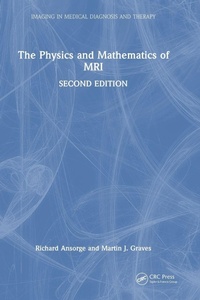
The Physics and Mathematics of MRI
2nd Edition
Will be published approx. on 9. July 2026
Book
Hardback
256 pages
978-1-041-15915-5 (ISBN)
Description
Magnetic resonance imaging (MRI) remains one of the most versatile and powerful diagnostic tools in modern medicine, yet its underlying physics and mathematics form a subtle and elegant synthesis of quantum mechanics, engineering principles and signal processing. The first edition of The Physics and Mathematics of MRI provided a clear, rigorous bridge between abstract theory and practical MRI applications, making it a trusted resource for physical science and engineering students entering medical physics programs.
This second edition builds on that foundation with updated content and expanded coverage of recent advances in MRI hardware, pulse-sequence design, and clinical and research applications. New chapters introduce cutting-edge developments in hyperpolarisation, advanced functional imaging, cardiac MRI, deep-learning-based reconstruction methods and contemporary safety considerations - all while preserving the accessible, equation-driven exposition that defined the original text. A new section explains the mathematics of artificial intelligence (AI), and how its application can enhance multiple aspects of MRI. Whether you are an undergraduate or a graduate student, a researcher, or a clinical physicist seeking deeper understanding, this revised edition offers a comprehensive, mathematically grounded exploration of how MRI works - from the behaviour of nuclear spins to the formation of high-quality clinical images. Open the book and discover the rich scientific complexity behind every scan.
Key Features:
Presents a complete account of physical and mathematical principles used in MRI, including rigorous derivations of the key steps in signal generation and image formation
Provides expanded and up-to-date coverage of modern MRI technologies, including advanced pulse-sequence design, hyperpolarisation, functional and cardiac MRI, deep-learning-based reconstruction and contemporary safety considerations
Bridges theory, technology and clinical practice, making the book suitable as a core graduate-level text and as a reference for researchers and practising clinical MRI physicists
This second edition builds on that foundation with updated content and expanded coverage of recent advances in MRI hardware, pulse-sequence design, and clinical and research applications. New chapters introduce cutting-edge developments in hyperpolarisation, advanced functional imaging, cardiac MRI, deep-learning-based reconstruction methods and contemporary safety considerations - all while preserving the accessible, equation-driven exposition that defined the original text. A new section explains the mathematics of artificial intelligence (AI), and how its application can enhance multiple aspects of MRI. Whether you are an undergraduate or a graduate student, a researcher, or a clinical physicist seeking deeper understanding, this revised edition offers a comprehensive, mathematically grounded exploration of how MRI works - from the behaviour of nuclear spins to the formation of high-quality clinical images. Open the book and discover the rich scientific complexity behind every scan.
Key Features:
Presents a complete account of physical and mathematical principles used in MRI, including rigorous derivations of the key steps in signal generation and image formation
Provides expanded and up-to-date coverage of modern MRI technologies, including advanced pulse-sequence design, hyperpolarisation, functional and cardiac MRI, deep-learning-based reconstruction and contemporary safety considerations
Bridges theory, technology and clinical practice, making the book suitable as a core graduate-level text and as a reference for researchers and practising clinical MRI physicists
More details
Series
Edition
2nd edition
Language
English
Place of publication
London
United Kingdom
Publishing group
Taylor & Francis Ltd
Target group
College/higher education
Professional and scholarly
Postgraduate, Professional Reference, and Undergraduate Advanced
Illustrations
19 s/w Photographien bzw. Rasterbilder, 38 Farbfotos bzw. farbige Rasterbilder, 18 s/w Zeichnungen, 49 farbige Zeichnungen, 18 s/w Tabellen, 37 s/w Abbildungen, 87 farbige Abbildungen
18 Tables, black and white; 49 Line drawings, color; 18 Line drawings, black and white; 38 Halftones, color; 19 Halftones, black and white; 87 Illustrations, color; 37 Illustrations, black and white
Dimensions
Height: 254 mm
Width: 178 mm
ISBN-13
978-1-041-15915-5 (9781041159155)
Copyright in bibliographic data and cover images is held by Nielsen Book Services Limited or by the publishers or by their respective licensors: all rights reserved.
Schweitzer Classification
Other editions
Additional editions
Richard Ansorge | Martin J. Graves
The Physics and Mathematics of MRI
E-Book
approx. 07/2026
2nd Edition
CRC Press
€69.99
Available for download
Richard Ansorge | Martin J. Graves
The Physics and Mathematics of MRI
Book
approx. 07/2026
2nd Edition
CRC Press
€66.00
Not yet published
Richard Ansorge | Martin J. Graves
The Physics and Mathematics of MRI
E-Book
approx. 07/2026
2nd Edition
CRC Press
€69.99
Available for download
Persons
Richard Ansorge is a retired senior lecturer at the Cavendish Laboratory, Cambridge, and a former fellow and tutor of Fitzwilliam College, Cambridge. He has extensive experience in experimental high-energy physics, and has contributed to the CERN UA5 experiment on the proton-antiproton collider in the 1980s. More recently, he has collaborated with research groups on the Cambridge Biomedical campus in several areas including improving 3D medical imaging methods, such as MRI and positron emission tomography (PET). He is the author of more than 150 scientific publications in these fields and the book Programming in Parallel with CUDA (2022).
Martin J. Graves is Professor of Magnetic Resonance Physics at the University of Cambridge and Honorary Consultant Clinical Scientist at Cambridge University Hospitals. He is a Fellow of the Institute of Physics and Engineering in Medicine (IPEM), a Fellow of the Higher Education Academy, a Senior Fellow of the International Society for Magnetic Resonance in Medicine (ISMRM), an Honorary Member of the Royal College of Radiologists, a Fellow of the British Institute of Radiology and a member of the International Society for Strategic Studies in Radiology (IS3R). He has served on several national and international committees for the British Institute of Radiology, ISMRM and European Society for Magnetic Resonance in Medicine and Biology. With more than 40 years' experience in both clinical and research MRI, he has published over 200 articles on a range of MRI topics.
Martin J. Graves is Professor of Magnetic Resonance Physics at the University of Cambridge and Honorary Consultant Clinical Scientist at Cambridge University Hospitals. He is a Fellow of the Institute of Physics and Engineering in Medicine (IPEM), a Fellow of the Higher Education Academy, a Senior Fellow of the International Society for Magnetic Resonance in Medicine (ISMRM), an Honorary Member of the Royal College of Radiologists, a Fellow of the British Institute of Radiology and a member of the International Society for Strategic Studies in Radiology (IS3R). He has served on several national and international committees for the British Institute of Radiology, ISMRM and European Society for Magnetic Resonance in Medicine and Biology. With more than 40 years' experience in both clinical and research MRI, he has published over 200 articles on a range of MRI topics.
Content
1. The Basics. 2. Magnetic Field Generation. 3. Radiofrequency transmit/receive, parallel imaging and X-nuclei 4. Pulse sequences and image reconstruction. 5. Applications. 6. High and low field and hybrid MRI. 7. Conclusions. Appendix A: Essential quantum mechanics. Appendix B: Laplace's equation in polar coordinates. Appendix C: The birdcage coil. Appendix D: Fourier transforms. Appendix E: Multiple echoes. Appendix F: AI and MRI. Index.