

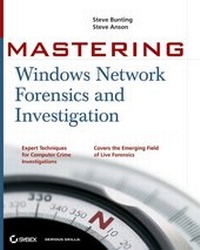
Mastering Windows Network Forensics and Investigation
1st Edition
Published on 30. March 2007
Book
Paperback/Softback
552 pages
978-0-470-09762-5 (ISBN)
Description
Conduct Cutting-Edge Forensic Investigations of Computer Crimes.
Whether it's phishing, bank fraud, or unlawful hacking, computer crimes are on the rise, and law enforcement personnel who investigate these crimes must learn how to properly gather forensic evidence in the computer age.
Now you can get the training you need in this comprehensive guide from two seasoned law enforcement professionals. From recognizing high-tech criminal activity and collecting evidence to presenting it in a way that judges and juries can understand, this book covers the range of skills, standards, and step-by-step procedures you'll need to conduct a criminal investigation in a Windows environment and make your evidence stand up in court.
The book also covers the emerging field of "live forensics," where investigators examine a system to obtain evidence while it is still running, thus preserving live data that may be lost if the system is shut down.
COVERAGE INCLUDES:
* Responding to a reported computer intrusion
* Conducting the initial interview with the victims
* Understanding how attackers exploit Windows networks
* Deciphering Windows file systems, registries, and more
* Analyzing data rapidly using live analysis techniques
* Examining suspects' computers
* Using EnCase(r) for Windows event log analysis
* Presenting technically complicated material to juries
More details
Edition
1., Auflage
Language
English
Place of publication
Chichester
United Kingdom
Publishing group
John Wiley and Sons Ltd
Target group
Professional and scholarly
Dimensions
Height: 23.4 cm
Width: 18.7 cm
Thickness: 27 mm
Weight
771 gr
ISBN-13
978-0-470-09762-5 (9780470097625)
Schweitzer Classification
Other editions
New editions
Steven Anson | Steve Bunting | Ryan Johnson
Mastering Windows Network Forensics and Investigation
Book
06/2012
2nd Edition
Sybex Inc.,U.S.
€56.00
Article not available at the moment
Persons
Steve Anson, CISSP, MCSE, is a special agent with the Pentagon's Defense Criminal Investigative Service. He has a master's degree in computer science as well as numerous industry certifications. As a former contract instructor for the FBI, he has taught hundreds of veteran federal agents, state and local police officers, and intelligence agency employees techniques for conducting computerintrusion investigations. He also founded and supervised a local police department computer crime and information services unit and served as a task force agent for the FBI. He has conducted investigations involving large-scale computer intrusions, counterterrorism, crimes against children, and many other offenses involving the substantive use of computers.
Steve Bunting is a captain with the University of Delaware Police Department, where he is responsible for computer forensics, video forensics, and investigations involving computers. He has more than thirty years experience in law enforcement, and his background in computer forensics is extensive. He is a Certified Computer Forensics Technician (CCFT) and an EnCase Certified Examiner (EnCE). He was the recipient of the 2002 Guidance Software Certified Examiner Award of Excellence. He has a bachelor's degree in applied professions/business management from Wilmington College and a computer applications certificate in network environments from the University of Delaware. He has conducted computer forensic examinations for numerous local, state, and federal agencies on a variety of cases, including extortion, homicide, embezzlement, child exploitation, intellectual property theft, and unlawful intrusions into computer systems. He has testified in court on numerous occasions as a computer forensics expert. He has taught computer forensics for Guidance Software, makers of EnCase, and taught as a lead instructor at all course levels. He has been a presenter at several seminars and workshops, is the author of numerous white papers, and is the primary author of the book EnCase Computer Forensics: The Official EnCE: EnCase Certified Examiner Study Guide, which was published by Sybex in early 2006. You can reach him at sbunting@udel.edu.
Content
Introduction.
Part 1: Understanding and Exploiting Windows Networks.
Chapter 1: Network Investigation Overview.
Chapter 2: The Microsoft Network Structure.
Chapter 3: Beyond the Windows GUI.
Chapter 4: Windows Password Issues.
Chapter 5: Windows Ports and Services.
Part 2: Analyzing the Computer.
Chapter 6: Live-Analysis Techniques.
Chapter 7: Windows File Systems.
Chapter 8: The Registry Structure.
Chapter 9: Registry Evidence.
Chapter 10: Tool Analysis.
Part 3: Analyzing the Logs.
Chapter 11: Text-Based Logs.
Chapter 12: Windows Event Logs.
Chapter 13: Logon and Account Logon Events.
Chapter 14: Other Audit Events.
Chapter 15: Forensic Analysis of Event Logs.
Chapter 16: Presenting the Results.
Appendix A: The Bottom Line.
Index.