

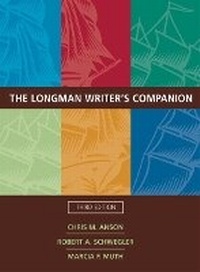
The Longman Writer's Companion (with MyCompLab)
3rd Edition
Published on 15. November 2006
Book
Paperback/Softback
512 pages
978-0-321-32348-4 (ISBN)
Description
Comprehensive, friendly, and easy to use, The Longman Writer's Companion is the perfect tutorial or reference tool for writers of any level. The handbook provides complete coverage of writing, style, grammar, punctuation, mechanics, documenting sources, avoiding plagiarism, business writing, and research writing. Whether you need help writing a resume, e-mail, or paper, renowned professors Chris Anson and Robert Schwegler's friendly writing style will help you improve your writing. Featuring clear explanations, examples, and writing samples, this handbook is a "must have" for any writer.
More details
Edition
3rd edition
Language
English
Place of publication
New Jersey
United States
Publishing group
Pearson Education (US)
Target group
College/higher education
Weight
700 gr
ISBN-13
978-0-321-32348-4 (9780321323484)
Copyright in bibliographic data and cover images is held by Nielsen Book Services Limited or by the publishers or by their respective licensors: all rights reserved.
Schweitzer Classification
Content
I. JOINING COMMUNITIES: PARTICIPATING AS CRITICAL READERS AND WRITERS.
1. Readers, Writers, and Communities.
a. Recognizing academic, work, and public communities of readers and writers.
b. Joining communities of readers and writers.
c. Recognizing myths and realities about the writing process.2. Reading Critically.
a. Reading for understanding.
b. Reading analytically and critically.
c. Turning reading into writing.3. Planning.
a. Generating ideas.
b. Structuring ideas and information.4. Defining Your Purpose, Thesis, and Audience.
a. Analyzing your purpose.
b. Creating a thesis.
c. Considering your readers.5. Drafting.
a. Moving from planning to drafting.
b. Drafting collaboratively.6. Revising.
a. Making major revisions.
b. Making minor revisions.
c. Revising collaboratively.7. Shaping Paragraphs.
a. Recognizing unfocused paragraphs.
b. Revising for paragraph focus.
c. Recognizing incoherent paragraphs.
d. Revising for paragraph coherence.
e. Recognizing poorly developed paragraphs.
f. Revising for paragraph development.
g. Using special-purpose paragraphs.8. Editing and Proofreading.
a. Writing correctly.
b. Editing your own writing.
c. Editing collaboratively.
d. Editing on the computer.
e. Proofreading.II. REPRESENTING YOURSELF: CREATING YOUR PLACE IN A COMMUNITY.
9. Making Language Choices.
a. Choosing a style.
b. Recognizing home and community language varieties.
c. Meeting language expectations.10. Reasoning Critically.
a. Recognizing critical reasoning.
b. Building a chain of reasoning.
c. Representing your reasoning.11. Writing in Online Communities.
a. Recognizing online conventions.
b. Recognizing email conventions.
c. Participating in online communities.
d. Writing for the World Wide Web.
e. Avoiding plagiarism online.12. Designing Documents.
a. Recognizing goals of document design.
b. Planning a design.
c. Laying out your document.
d. Using type.
e. Using visuals.
f. Sample documents.13. Speaking Effectively.
a. Recognizing types of oral presentations.
b. Transferring skills from writing to speaking.
c. Preparing an effective oral presentation.
d. Managing speech anxiety.
e. Fielding questions.III. WRITING IN ACTION: ADDRESSING ACADEMIC, WORK, AND PUBLIC COMMUNITIES.
14. Making Persuasive Arguments.
a. Recognizing an occasion for argument.
b. Recognizing and developing your stance.
c. Developing reasons and evidence.
d. Acknowledging other perspectives.
e. Arguing logically.
f. Writing a position paper.15. Understanding Academic Writing.
a. Recognizing the goals of academic writing.
b. Analyzing academic audiences.
c. Understanding academic writing tasks.
d. Recognizing types of academic writing.
e. Writing a short documented paper.
f. Writing a lab report.
g. Writing an essay exam. h. Writing an annotated bibliography. i. Writing a literature review. j. Speaking in the academic community.16. Reading and Writing about Literature.
a. Reading literary texts.
b. Writing about literary texts. c. Sample literary analysis.17. Understanding Workplace Writing.
a. Recognizing the goals of workplace writing.
b. Analyzing workplace audiences.
c. Understanding workplace writing tasks.
d. Recognizing types of workplace writing.
e. Writing a business letter. f. Writing a memo.
g. Writing a resume and application letter.
h. Speaking in the workplace community.18. Understanding Public Writing.
a. Recognizing the goals of public writing.
b. Analyzing public audiences. c. Recognizing types of public writing.
d. Writing a public flyer.
e. Writing a letter to the editor.
f. Speaking in the public community.IV. USING RESEARCH STRATEGIES: READING AND WRITING WITHIN A RESEARCH COMMUNITY.
19. Getting Started: Research and Writing.
a. Beginning your research.
b. Recognizing different kinds of research writing.
c. Developing a research question.
d. Developing a preliminary thesis.
e. Creating a research file and timeline.
f. Reading and notetaking.
g. Summarizing, paraphrasing, and synthesizing.20. Using Library Resources and Research Databases.
a. Developing search strategies.
b. Searching library resources and databases.
c. General resources.
d. Books and online catalogs.
e. Periodicals, print or electronic indexes, and government documents.
f. Online databases.
g. Evaluating library resources.21. Using Web and Internet Resources.
a. Developing Web and Internet search strategies.
b. Using search engines.
c. Consulting Websites and Internet resources.
d. Evaluating Internet and Web sources.22. Doing Fieldwork.
a. Conducting an interview.
b. Using a survey, poll, or questionnaire.
c. Conducting an ethnographic study.
d. Obtaining consent and approval for reseach on human subjects.23. Avoiding Plagiarism.
a. Recognizing plagiarism.
b. The problem of intention.
c. Recognizing when to document sources.
d. Working with common knowledge.
e. Citing sources responsibly.
f. Learning how to cite sources in context.24. Integrating Sources.
a. Choosing purposes for your sources.
b. Summarizing, paraphrasing, and synthesizing.25. Writing, Revising, and Presenting Your Research.
a. Reviewing your research questions.
b. Reviewing your purpose.
c. Building from a thesis to a draft.
d. Revising and editing.
e. Presenting your research.V. DOCUMENTING SOURCES: MLA STYLE.
26. Using MLA Documentation Style.
a. Using MLA in-text (parenthetical) citations.
b. Creating an MLA list of works cited.
c. Sample MLA paper.VI. DOCUMENTING SOURCES: APA STYLE.
27. Using APA Documentation Style.
a. Using APA in-text citations.
b. Creating an APA reference list.
c. Sample APA paper.VII. DOCUMENTING SOURCES: CMS AND CSE STYLES.
28. Using CMS Documentation Style.
a. Using CMS endnotes or Footnotes.
b. Creating CMS endnotes or Footnotes.
c. Creating a CMS bibliography.29. Using CSE Documentation Style.
a. Using CSE in-text citations.
b. Creating a CSE reference list.VIII. EDITING GRAMMAR: MEETING COMMUNITY EXPECTATIONS.
30. Recognizing Words Working in Sentences.
a. Recognizing nouns and articles.
b. Recognizing pronouns.
c. Recognizing verbs.
d. Recognizing adjectives.
e. Recognizing adverbs.
f. Recognizing prepositions.
g. Recognizing conjunctions.
h. Recognizing interjections.31. Recognizing Sentence Parts and Patterns.
a. Recognizing subjects and predicates.
b. Recognizing phrases.
c. Recognizing subordinate clauses.
d. Recognizing different sentence types.32. Using Verbs.
a. Recognizing simple present and past tense verbs.
b. Editing present tense verbs.
c. Editing past tense verbs.
d. Recognizing complex tenses and helping verbs.
e. Editing progressive and perfect tenses.
f. Editing troublesome verbs (lie, lay, sit, set).
g. Recognizing clear tense sequence.
h. Recognizing the subjunctive mood.
i. Recognizing active and passive voice.33. Using Pronouns.
a. Recognizing pronoun forms.
b. Editing common pronoun problems.34. Making Sentence Parts Agree.
a. Recognizing agreement.
b. Creating subject-verb agreement (simple).
c. Creating subject-verb agreement (complex)
d. Creating pronoun-antecedent agreement.35. Using Adjectives and Adverbs.
a. Recognizing what adjectives and adverbs do.
b. Editing adjectives and adverbs.IX. EDITING SENTENCE PROBLEMS: UNDERSTANDING COMMUNITY OPTIONS.
36. Editing Sentence Fragments.
a. Recognizing sentence fragments.
b. Editing sentence fragments.
c. Using partial sentences.37. Editing Comma Splices and Fused Sentences.
a. Recognizing comma splices.
b. Recognizing fused sentences.
c. Editing comma splices and fused sentences.38. Creating Pronoun Reference.
a. Recognizing unclear pronoun reference.
b. Editing for clear pronoun reference.39. Editing Misplaced, Dangling, and Disruptive Modifiers.
a. Recognizing misplaced, dangling, and disruptive modifiers.
b. Editing misplaced, dangling, and disruptive modifiers.40. Making Shifts Consistent.
a. Recognizing and editing shifts in person and number.
b. Recognizing and editing shifts in tense and mood.
c. Recognizing and editing shifts in active or passive voice.
d. Recognizing and editing shifts between direct and indirect quotations.41. Editing Mixed and Incomplete Sentences.
a. Recognizing mixed sentences.
b. Editing mixed sentences.
c. Recognizing and editing incomplete sentences.42. Creating Parallelism.
a. Recognizing faulty parallelism.
b. Editing for parallelism.43. Using Coordination and Subordination.
a. Recognizing and creating coordination.
b. Recognizing and creating subordination.
c. Editing for coordination and subordination.44. Creating Clear and Emphatic Sentences.
a. Recognizing unclear sentences.
b. Editing for clear sentences.X. EDITING WORD CHOICE: MATCHING WORDS TO COMMUNITIES.
45. Being Concise.
a. Recognizing common types of wordiness.
b. Editing for conciseness.46. Choosing Appropriate Words.
a. Recognizing incorrect or inappropriate word choice.
b. Editing for precise diction.47. Using Respectful Language.
a. Recognizing and editing gender stereotypes.
b. Recognizing and editing racial, ethnic, and cultural stereotypes.48. Building Your Language Resources.
a. Recognizing your language resources as a writer.
b. Turning to the dictionary and thesaurus.XI. EDITING PUNCTUATION: FOLLOWING COMMUNITY GUIDELINES.
49. Using Commas.
a. Using commas that join sentences.
b. Using commas that set off sentence elements.
c. Recognizing commas that set off nonessential modifiers.
d. Using commas that separate items in a series.
e. Using commas that separate adjectives in a sequence.
f. Using commas with dates, numbers, addresses, place names, people's titles, and letters.
g. Using commas with quotations.
h. Using commas to make your meaning clearer.
i. Eliminating commas that do not belong.50. Using Semicolons and Colons.
a. Using semicolons.
b. Using colons.51. Using Apostrophes.
a. Using apostrophes that mark possession.
b. Using apostrophes that mark contractions and omissions.52. Marking Quotations.
a. Using quotation marks.
b. Indicating titles of short works.
c. Highlighting words, special terms, and tone of voice.53. Using Periods, Question Marks, and Exclamation Points.
a. Using periods.
b. Using question marks.
c. Using exclamation points.54. Using Other Punctuation Marks.
a. Using parentheses.
b. Using brackets.
c. Using dashes.
d. Using ellipses.
e. Using slashes.
f. Using symbols in electronic addresses.
g. Combining punctuation marks.XII. PROOFREADING FOR MECHANICS AND SPELLING: RESPECTING COMMUNITY CONVENTIONS.
55. Capitalizing.
a. Capitalizing to begin sentences.
b. Capitalizing proper names and titles.56. Italicizing (Underlining).
a. Using italics (underlining) in titles.
b. Using italics for specific terms.
c. Underlining for emphasis.57. Hyphenating.
a. Hyphenating to join words.
b. Hyphenating to divide words.58. Using Numbers.
a. Spelling out numbers.
b. Using numerals.59. Abbreviating.
a. Using familiar abbreviations.
b. Proofreading for appropriate abbreviations.60. Spelling.
a. Recognizing spelling errors.
b. Proofreading for commonly misspelled words.Glossary of Usage.
Index.
Guide to ESL Advice.
Symbols for Revising and Editing.
1. Readers, Writers, and Communities.
a. Recognizing academic, work, and public communities of readers and writers.
b. Joining communities of readers and writers.
c. Recognizing myths and realities about the writing process.2. Reading Critically.
a. Reading for understanding.
b. Reading analytically and critically.
c. Turning reading into writing.3. Planning.
a. Generating ideas.
b. Structuring ideas and information.4. Defining Your Purpose, Thesis, and Audience.
a. Analyzing your purpose.
b. Creating a thesis.
c. Considering your readers.5. Drafting.
a. Moving from planning to drafting.
b. Drafting collaboratively.6. Revising.
a. Making major revisions.
b. Making minor revisions.
c. Revising collaboratively.7. Shaping Paragraphs.
a. Recognizing unfocused paragraphs.
b. Revising for paragraph focus.
c. Recognizing incoherent paragraphs.
d. Revising for paragraph coherence.
e. Recognizing poorly developed paragraphs.
f. Revising for paragraph development.
g. Using special-purpose paragraphs.8. Editing and Proofreading.
a. Writing correctly.
b. Editing your own writing.
c. Editing collaboratively.
d. Editing on the computer.
e. Proofreading.II. REPRESENTING YOURSELF: CREATING YOUR PLACE IN A COMMUNITY.
9. Making Language Choices.
a. Choosing a style.
b. Recognizing home and community language varieties.
c. Meeting language expectations.10. Reasoning Critically.
a. Recognizing critical reasoning.
b. Building a chain of reasoning.
c. Representing your reasoning.11. Writing in Online Communities.
a. Recognizing online conventions.
b. Recognizing email conventions.
c. Participating in online communities.
d. Writing for the World Wide Web.
e. Avoiding plagiarism online.12. Designing Documents.
a. Recognizing goals of document design.
b. Planning a design.
c. Laying out your document.
d. Using type.
e. Using visuals.
f. Sample documents.13. Speaking Effectively.
a. Recognizing types of oral presentations.
b. Transferring skills from writing to speaking.
c. Preparing an effective oral presentation.
d. Managing speech anxiety.
e. Fielding questions.III. WRITING IN ACTION: ADDRESSING ACADEMIC, WORK, AND PUBLIC COMMUNITIES.
14. Making Persuasive Arguments.
a. Recognizing an occasion for argument.
b. Recognizing and developing your stance.
c. Developing reasons and evidence.
d. Acknowledging other perspectives.
e. Arguing logically.
f. Writing a position paper.15. Understanding Academic Writing.
a. Recognizing the goals of academic writing.
b. Analyzing academic audiences.
c. Understanding academic writing tasks.
d. Recognizing types of academic writing.
e. Writing a short documented paper.
f. Writing a lab report.
g. Writing an essay exam. h. Writing an annotated bibliography. i. Writing a literature review. j. Speaking in the academic community.16. Reading and Writing about Literature.
a. Reading literary texts.
b. Writing about literary texts. c. Sample literary analysis.17. Understanding Workplace Writing.
a. Recognizing the goals of workplace writing.
b. Analyzing workplace audiences.
c. Understanding workplace writing tasks.
d. Recognizing types of workplace writing.
e. Writing a business letter. f. Writing a memo.
g. Writing a resume and application letter.
h. Speaking in the workplace community.18. Understanding Public Writing.
a. Recognizing the goals of public writing.
b. Analyzing public audiences. c. Recognizing types of public writing.
d. Writing a public flyer.
e. Writing a letter to the editor.
f. Speaking in the public community.IV. USING RESEARCH STRATEGIES: READING AND WRITING WITHIN A RESEARCH COMMUNITY.
19. Getting Started: Research and Writing.
a. Beginning your research.
b. Recognizing different kinds of research writing.
c. Developing a research question.
d. Developing a preliminary thesis.
e. Creating a research file and timeline.
f. Reading and notetaking.
g. Summarizing, paraphrasing, and synthesizing.20. Using Library Resources and Research Databases.
a. Developing search strategies.
b. Searching library resources and databases.
c. General resources.
d. Books and online catalogs.
e. Periodicals, print or electronic indexes, and government documents.
f. Online databases.
g. Evaluating library resources.21. Using Web and Internet Resources.
a. Developing Web and Internet search strategies.
b. Using search engines.
c. Consulting Websites and Internet resources.
d. Evaluating Internet and Web sources.22. Doing Fieldwork.
a. Conducting an interview.
b. Using a survey, poll, or questionnaire.
c. Conducting an ethnographic study.
d. Obtaining consent and approval for reseach on human subjects.23. Avoiding Plagiarism.
a. Recognizing plagiarism.
b. The problem of intention.
c. Recognizing when to document sources.
d. Working with common knowledge.
e. Citing sources responsibly.
f. Learning how to cite sources in context.24. Integrating Sources.
a. Choosing purposes for your sources.
b. Summarizing, paraphrasing, and synthesizing.25. Writing, Revising, and Presenting Your Research.
a. Reviewing your research questions.
b. Reviewing your purpose.
c. Building from a thesis to a draft.
d. Revising and editing.
e. Presenting your research.V. DOCUMENTING SOURCES: MLA STYLE.
26. Using MLA Documentation Style.
a. Using MLA in-text (parenthetical) citations.
b. Creating an MLA list of works cited.
c. Sample MLA paper.VI. DOCUMENTING SOURCES: APA STYLE.
27. Using APA Documentation Style.
a. Using APA in-text citations.
b. Creating an APA reference list.
c. Sample APA paper.VII. DOCUMENTING SOURCES: CMS AND CSE STYLES.
28. Using CMS Documentation Style.
a. Using CMS endnotes or Footnotes.
b. Creating CMS endnotes or Footnotes.
c. Creating a CMS bibliography.29. Using CSE Documentation Style.
a. Using CSE in-text citations.
b. Creating a CSE reference list.VIII. EDITING GRAMMAR: MEETING COMMUNITY EXPECTATIONS.
30. Recognizing Words Working in Sentences.
a. Recognizing nouns and articles.
b. Recognizing pronouns.
c. Recognizing verbs.
d. Recognizing adjectives.
e. Recognizing adverbs.
f. Recognizing prepositions.
g. Recognizing conjunctions.
h. Recognizing interjections.31. Recognizing Sentence Parts and Patterns.
a. Recognizing subjects and predicates.
b. Recognizing phrases.
c. Recognizing subordinate clauses.
d. Recognizing different sentence types.32. Using Verbs.
a. Recognizing simple present and past tense verbs.
b. Editing present tense verbs.
c. Editing past tense verbs.
d. Recognizing complex tenses and helping verbs.
e. Editing progressive and perfect tenses.
f. Editing troublesome verbs (lie, lay, sit, set).
g. Recognizing clear tense sequence.
h. Recognizing the subjunctive mood.
i. Recognizing active and passive voice.33. Using Pronouns.
a. Recognizing pronoun forms.
b. Editing common pronoun problems.34. Making Sentence Parts Agree.
a. Recognizing agreement.
b. Creating subject-verb agreement (simple).
c. Creating subject-verb agreement (complex)
d. Creating pronoun-antecedent agreement.35. Using Adjectives and Adverbs.
a. Recognizing what adjectives and adverbs do.
b. Editing adjectives and adverbs.IX. EDITING SENTENCE PROBLEMS: UNDERSTANDING COMMUNITY OPTIONS.
36. Editing Sentence Fragments.
a. Recognizing sentence fragments.
b. Editing sentence fragments.
c. Using partial sentences.37. Editing Comma Splices and Fused Sentences.
a. Recognizing comma splices.
b. Recognizing fused sentences.
c. Editing comma splices and fused sentences.38. Creating Pronoun Reference.
a. Recognizing unclear pronoun reference.
b. Editing for clear pronoun reference.39. Editing Misplaced, Dangling, and Disruptive Modifiers.
a. Recognizing misplaced, dangling, and disruptive modifiers.
b. Editing misplaced, dangling, and disruptive modifiers.40. Making Shifts Consistent.
a. Recognizing and editing shifts in person and number.
b. Recognizing and editing shifts in tense and mood.
c. Recognizing and editing shifts in active or passive voice.
d. Recognizing and editing shifts between direct and indirect quotations.41. Editing Mixed and Incomplete Sentences.
a. Recognizing mixed sentences.
b. Editing mixed sentences.
c. Recognizing and editing incomplete sentences.42. Creating Parallelism.
a. Recognizing faulty parallelism.
b. Editing for parallelism.43. Using Coordination and Subordination.
a. Recognizing and creating coordination.
b. Recognizing and creating subordination.
c. Editing for coordination and subordination.44. Creating Clear and Emphatic Sentences.
a. Recognizing unclear sentences.
b. Editing for clear sentences.X. EDITING WORD CHOICE: MATCHING WORDS TO COMMUNITIES.
45. Being Concise.
a. Recognizing common types of wordiness.
b. Editing for conciseness.46. Choosing Appropriate Words.
a. Recognizing incorrect or inappropriate word choice.
b. Editing for precise diction.47. Using Respectful Language.
a. Recognizing and editing gender stereotypes.
b. Recognizing and editing racial, ethnic, and cultural stereotypes.48. Building Your Language Resources.
a. Recognizing your language resources as a writer.
b. Turning to the dictionary and thesaurus.XI. EDITING PUNCTUATION: FOLLOWING COMMUNITY GUIDELINES.
49. Using Commas.
a. Using commas that join sentences.
b. Using commas that set off sentence elements.
c. Recognizing commas that set off nonessential modifiers.
d. Using commas that separate items in a series.
e. Using commas that separate adjectives in a sequence.
f. Using commas with dates, numbers, addresses, place names, people's titles, and letters.
g. Using commas with quotations.
h. Using commas to make your meaning clearer.
i. Eliminating commas that do not belong.50. Using Semicolons and Colons.
a. Using semicolons.
b. Using colons.51. Using Apostrophes.
a. Using apostrophes that mark possession.
b. Using apostrophes that mark contractions and omissions.52. Marking Quotations.
a. Using quotation marks.
b. Indicating titles of short works.
c. Highlighting words, special terms, and tone of voice.53. Using Periods, Question Marks, and Exclamation Points.
a. Using periods.
b. Using question marks.
c. Using exclamation points.54. Using Other Punctuation Marks.
a. Using parentheses.
b. Using brackets.
c. Using dashes.
d. Using ellipses.
e. Using slashes.
f. Using symbols in electronic addresses.
g. Combining punctuation marks.XII. PROOFREADING FOR MECHANICS AND SPELLING: RESPECTING COMMUNITY CONVENTIONS.
55. Capitalizing.
a. Capitalizing to begin sentences.
b. Capitalizing proper names and titles.56. Italicizing (Underlining).
a. Using italics (underlining) in titles.
b. Using italics for specific terms.
c. Underlining for emphasis.57. Hyphenating.
a. Hyphenating to join words.
b. Hyphenating to divide words.58. Using Numbers.
a. Spelling out numbers.
b. Using numerals.59. Abbreviating.
a. Using familiar abbreviations.
b. Proofreading for appropriate abbreviations.60. Spelling.
a. Recognizing spelling errors.
b. Proofreading for commonly misspelled words.Glossary of Usage.
Index.
Guide to ESL Advice.
Symbols for Revising and Editing.