

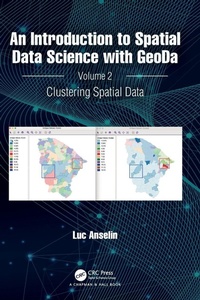
An Introduction to Spatial Data Science with GeoDa
Volume 2: Clustering Spatial Data
1st Edition
Published on 29. May 2024
Book
Hardback
210 pages
978-1-032-71302-1 (ISBN)
Description
This book is the second in a two-volume series that introduces the field of spatial data science. It moves beyond pure data exploration to the organization of observations into meaningful groups, i.e., spatial clustering. This constitutes an important component of so-called unsupervised learning, a major aspect of modern machine learning.
The distinctive aspects of the book are both to explore ways to spatialize classic clustering methods through linked maps and graphs, as well as the explicit introduction of spatial contiguity constraints into clustering algorithms. Leveraging a large number of real-world empirical illustrations, readers will gain an understanding of the main concepts and techniques and their relative advantages and disadvantages. The book also constitutes the definitive user's guide for these methods as implemented in the GeoDa open source software for spatial analysis.
It is organized into three major parts, dealing with dimension reduction (principal components, multidimensional scaling, stochastic network embedding), classic clustering methods (hierarchical clustering, k-means, k-medians, k-medoids and spectral clustering), and spatially constrained clustering methods (both hierarchical and partitioning). It closes with an assessment of spatial and non-spatial cluster properties.
The book is intended for readers interested in going beyond simple mapping of geographical data to gain insight into interesting patterns as expressed in spatial clusters of observations. Familiarity with the material in Volume 1 is assumed, especially the analysis of local spatial autocorrelation and the full range of visualization methods.
The distinctive aspects of the book are both to explore ways to spatialize classic clustering methods through linked maps and graphs, as well as the explicit introduction of spatial contiguity constraints into clustering algorithms. Leveraging a large number of real-world empirical illustrations, readers will gain an understanding of the main concepts and techniques and their relative advantages and disadvantages. The book also constitutes the definitive user's guide for these methods as implemented in the GeoDa open source software for spatial analysis.
It is organized into three major parts, dealing with dimension reduction (principal components, multidimensional scaling, stochastic network embedding), classic clustering methods (hierarchical clustering, k-means, k-medians, k-medoids and spectral clustering), and spatially constrained clustering methods (both hierarchical and partitioning). It closes with an assessment of spatial and non-spatial cluster properties.
The book is intended for readers interested in going beyond simple mapping of geographical data to gain insight into interesting patterns as expressed in spatial clusters of observations. Familiarity with the material in Volume 1 is assumed, especially the analysis of local spatial autocorrelation and the full range of visualization methods.
More details
Language
English
Place of publication
Boca Raton
United Kingdom
Publishing group
Taylor & Francis Ltd
Target group
College/higher education
Professional and scholarly
Postgraduate and Professional Practice & Development
Illustrations
48 s/w Abbildungen, 146 farbige Abbildungen, 14 Farbfotos bzw. farbige Rasterbilder, 48 s/w Zeichnungen, 132 farbige Zeichnungen
132 Line drawings, color; 48 Line drawings, black and white; 14 Halftones, color; 146 Illustrations, color; 48 Illustrations, black and white
Dimensions
Height: 260 mm
Width: 183 mm
Thickness: 17 mm
Weight
650 gr
ISBN-13
978-1-032-71302-1 (9781032713021)
Copyright in bibliographic data and cover images is held by Nielsen Book Services Limited or by the publishers or by their respective licensors: all rights reserved.
Schweitzer Classification
Other editions
Additional editions
E-Book
05/2024
1st Edition
Chapman and Hall
€73.99
Available for download
E-Book
05/2024
1st Edition
Chapman and Hall
€73.99
Available for download
Person
Luc Anselin is the Founding Director of the Center for Spatial Data Science at the University of Chicago, where he is also Stein-Freiler Distinguished Service Professor of Sociology and the College, as well as a member of the Committee on Data Science. He is the creator of the GeoDa software and an active contributor to the PySAL Python open source software library for spatial analysis. He has written widely on topics dealing with the methodology of spatial data analysis, including his classic 1988 text on Spatial Econometrics. His work has been recognized by many awards, such as his election to the U.S. National Academy of Science and the American Academy of Arts and Science.
Content
1. Introduction
Part 1: Dimension Reduction
2. Principal Component Analysis (PCA)
3. Multidimensional Scaling (MDS)
4. Stochastic Neighbor Embedding (SNE)
Part 2: Classic Clustering
5. Hierarchical Clustering Methods
6. Partioning Clustering Methods
7. Advanced Clustering Methods
8. Spectral Clustering
Part 3: Spatial Clustering
9. Spatializing Classic Clustering Methods
10. Spatially Constrained Clustering - Hierarchical Methods
11. Spatially Constrained Clustering - Partitioning Methods
Part 4: Assessment
12. Cluster Validation
Part 1: Dimension Reduction
2. Principal Component Analysis (PCA)
3. Multidimensional Scaling (MDS)
4. Stochastic Neighbor Embedding (SNE)
Part 2: Classic Clustering
5. Hierarchical Clustering Methods
6. Partioning Clustering Methods
7. Advanced Clustering Methods
8. Spectral Clustering
Part 3: Spatial Clustering
9. Spatializing Classic Clustering Methods
10. Spatially Constrained Clustering - Hierarchical Methods
11. Spatially Constrained Clustering - Partitioning Methods
Part 4: Assessment
12. Cluster Validation