

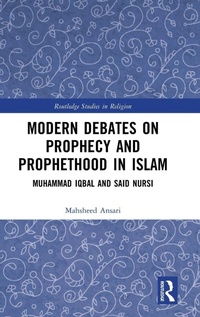
Modern Debates on Prophecy and Prophethood in Islam
Muhammad Iqbal and Said Nursi
1st Edition
Published on 17. July 2023
Book
Hardback
276 pages
978-1-032-21972-1 (ISBN)
Description
While prophethood is the backbone of the Islamic tradition and an uncompromised tenet of faith, the impact of modernity with its ambivalent status afforded to the prophet and institution of prophethood shook many Muslim scholars. Through analysis of these modern debates on prophethood in Islam, this book situates Muhammad Iqbal's (1877-1938) and Said Nursi's (1877-1960) discourses within it and assesses their implications on the modern period. This book introduces the "what, who and how" of the prophets in the Islamic tradition. It unveils the rich Islamic literature of both the classical and modern periods and analyses the construction of their philosophies and theologies. Concise in both historical and textual analyses, this book makes an important contribution to our understanding of contemporary debates on prophecy and prophethood in Islam and will be of great interest to postgraduate students and researchers of Islam, religious studies, medieval studies and contemporary studies of Islam and religion.
Reviews / Votes
"Mahsheed Ansari offers a rigorous study of prophethood in Islam, focusing on the twentieth century responses of two major thinkers, Said Nursi and Muhammad Iqbal. The potential for the continued development of constructive contemporary Islamic approaches to this topic is enriched through Ansari's detailed exposition of classical doctrines on prophecy as well as the South Asian and Turkish contexts during this period of challenges from modernity. Through its presentation of the creative responses of Nursi and Iqbal, who employed both critical intellectual analysis and mystical sensitivities in understanding both the historical human and the cosmic significance of the Prophet for their age, this work provides an important contribution in the field of Islamic religious thought and a resource for interfaith dialogue and understanding." - Marcia Hermansen, Loyola University Chicago, USAMore details
Series
Language
English
Place of publication
London
United Kingdom
Publishing group
Taylor & Francis Ltd
Target group
College/higher education
Academic and Postgraduate
Dimensions
Height: 240 mm
Width: 161 mm
Thickness: 20 mm
Weight
602 gr
ISBN-13
978-1-032-21972-1 (9781032219721)
Copyright in bibliographic data and cover images is held by Nielsen Book Services Limited or by the publishers or by their respective licensors: all rights reserved.
Schweitzer Classification
Other editions
Additional editions
Book
11/2024
1st Edition
Routledge
€63.40
Shipment within 10-20 days
E-Book
07/2023
1st Edition
Routledge
€55.49
Available for download
E-Book
07/2023
1st Edition
Routledge
€55.49
Available for download
Person
Mahsheed Ansari is a Senior Lecturer at the Centre for Islamic Studies and Civilisation and a Senior Research Fellow at the Centre for Religion and Ethics and Society (CRES), Charles Sturt University. She is a community activist working in the areas of interfaith dialogue, education, social harmony and leadership-mentoring programmes with Muslim youth and women. Her research interests include the history of Islamic thought, spirituality and culture. She has been working on the Australian Muslim Heritage Project, that captures the contributions of Muslim Pioneers Post World War II, and she is currently writing a book on the Institutional integration of the Muslim community in Australia and Dr Ashfaq Ahmad's contributions to it.
Content
Introduction
1 Demystifying the Prophetic Vocation in Islam
2 Theologising Resurgence of Prophetology in the Modern Muslim World
3 Iqbal's and Nursi's Methodology in Context of Their Global and Local Histories.
4 Rational Challenges and New Understandings of Prophethood
5 Traditional and Metaphysical Tensions of Prophethood
6 Conclusion: Towards a New Philosophy of Prophethood in Islam
1 Demystifying the Prophetic Vocation in Islam
2 Theologising Resurgence of Prophetology in the Modern Muslim World
3 Iqbal's and Nursi's Methodology in Context of Their Global and Local Histories.
4 Rational Challenges and New Understandings of Prophethood
5 Traditional and Metaphysical Tensions of Prophethood
6 Conclusion: Towards a New Philosophy of Prophethood in Islam