

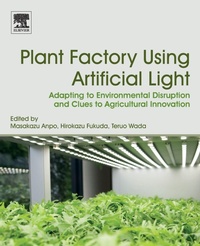
Plant Factory Using Artificial Light
Adapting to Environmental Disruption and Clues to Agricultural Innovation
Published on 16. October 2018
Book
Paperback/Softback
434 pages
978-0-12-813973-8 (ISBN)
Description
Plant Factory Using Artificial Light: Adapting to Environmental Disruption and Clues to Agricultural Innovation features interdisciplinary scientific advances as well as cutting-edge technologies applicable to plant growth in plant factories using artificial light. The book details the implementation of photocatalytic methods that ensure the safe and sustainable production of vegetables at low cost and on a commercial scale, regardless of adverse natural or manmade influences such as global warming, climate change, pollution, or other potentially damaging circumstances. Plant Factory Using Artificial Light is an essential resource for academic and industry researchers in chemistry, chemical/mechanical/materials engineering, chemistry, agriculture, and life/environmental/food sciences concerned with plant factories.
More details
Language
English
Place of publication
United States
Target group
Professional and scholarly
(Graduate) students, scientists and researchers in academia and industry in Chemical, Mechanical and Materials Engineering, Chemistry, Agriculture, Life Science, Environment Science, and Food Science
Product notice
Paperback (trade)
Dimensions
Height: 235 mm
Width: 191 mm
Thickness: 23 mm
Weight
746 gr
ISBN-13
978-0-12-813973-8 (9780128139738)
Copyright in bibliographic data and cover images is held by Nielsen Book Services Limited or by the publishers or by their respective licensors: all rights reserved.
Schweitzer Classification
Other editions
Additional editions
Masakazu Anpo | Hirokazu Fukuda | Teruo Wada
Plant Factory Using Artificial Light
Adapting to Environmental Disruption and Clues to Agricultural Innovation
E-Book
10/2018
Elsevier
€190.00
Available for download
Persons
Masakazu Anpo is a Professor Emeritus of Osaka Prefecture University (ex-Vice President & Executive Director) since 2015 (Osaka, Japan) and a Special Honored Professor & International Advisor at Fuzhou University (Fuzhou, China) since 2015. He is a pioneer in the research of photochemical reactions on solid surfaces, the design of highly efficient visible-light-responsive TiO2 photocatalysts, and single-site transition metal oxide photocatalysts constructed within the framework of zeolites and mesoporous materials for the issues of environment and energy. He is the editor-in-chief of the international journal Res. Chem. Intermed. (Springer), and has published many books such as "Photochemistry on Solid Surfaces? (1989, Elsevier), "Environmentally Bengin Photocatalysis? (2014, Springer) and reviews such as Chem. Rev., 114 (2014), Adv. Inorg. Chem., 72 (2018). He is a member of Academia Europaea and Science Council of Japan. Dr. Hirokazu Fukuda is a professor at Osaka Prefecture University in Course of Bio-Production Engineering Systems, Department of Mechanical Engineering in Graduate School of Engineering. He is also affiliated with the Research and Development Center for Plant Factories, Osaka Prefecture University. His research has focused on the development of plant diagnosis systems, using modeling and bioinformatics to find a way to increase productivity in plant factories. His unique prediction model and bioinformatics for biological clocks have been installed in commercial plant factories. Currently, he is studying instability in plant production caused by the nonlinearity of plant environmental responses. Dr. Teruo Wada is an associate professor at Osaka Prefecture University in Course in Plant Production Science, Division of Applied Life Sciences in Graduate School of Life and Environmental Sciences. He is also affiliated with the Research and Development Center for Plant Factories, Osaka Prefecture University. His research has focused on year-round production of high-value vegetables through hydroponic systems in greenhouses and plant factories. More specifically, he studies technologies to control mineral composition in nutrient solutions and optimize growth environments for vegetables. Recently, he is working on aquaponics applied to lettuce and loach, and postharvest technologies for vegetables and fruits using hydrogen water.
Content
Part I: Efficient and effective vegetable cultivation technologies to enhance productivity and quality
1. Fundamentals and Practices of Cultivation Technology
2. Advanced Technologies for Control of Plant Growth
3. Safety, Security and Nutritional Assessment of Vegetables Harvested in Plant Factories
Part II: New science and technologies for low cost production and IT control systems
4. Advanced engineering technologies
5. Novel technology fusion and development using IT technologies
Part III: Various technological approaches and business strategies for plant factories
6. Introduction of advanced technologies
7. Various approaches to spreading and expanding plant factories
8. Current situation of plant factories around the world
9. Prospective developments in plant factories
10. Plant Factory and New Renewable Energy Technology
1. Fundamentals and Practices of Cultivation Technology
2. Advanced Technologies for Control of Plant Growth
3. Safety, Security and Nutritional Assessment of Vegetables Harvested in Plant Factories
Part II: New science and technologies for low cost production and IT control systems
4. Advanced engineering technologies
5. Novel technology fusion and development using IT technologies
Part III: Various technological approaches and business strategies for plant factories
6. Introduction of advanced technologies
7. Various approaches to spreading and expanding plant factories
8. Current situation of plant factories around the world
9. Prospective developments in plant factories
10. Plant Factory and New Renewable Energy Technology