

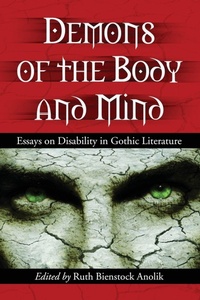
Demons of the Body and Mind
Essays on Disability in Gothic Literature
Published on 26. July 2010
Book
Paperback/Softback
244 pages
978-0-7864-3322-3 (ISBN)
Description
The Gothic mode, typically preoccupied by questions of difference and otherness, consistently imagines the Other as a source of grotesque horror. The sixteen critical essays in this collection examine the ways in which those suffering from mental and physical ailments are refigured as Other, and how they are imagined to be monstrous. Together, the essays highlight the Gothic inclination to represent all ailments as visibly monstrous, even those, such as mental illness, which were invisible. Paradoxically, the Other also becomes a pitiful figure, often evoking empathy. This exploration of illness and disability represents a strong addition to Gothic studies.
Reviews / Votes
"recommended"-Choice.More details
Language
English
Place of publication
Jefferson, NC
United States
Target group
College/higher education
Interest Age: From 18 years
Product notice
Paperback (trade)
Illustrations
notes, bibliographies, index
Dimensions
Height: 229 mm
Width: 152 mm
Thickness: 15 mm
Weight
405 gr
ISBN-13
978-0-7864-3322-3 (9780786433223)
Copyright in bibliographic data and cover images is held by Nielsen Book Services Limited or by the publishers or by their respective licensors: all rights reserved.
Schweitzer Classification
Person
Ruth Bienstock Anolik teaches at Villanova University and writes extensively on the Gothic mode. Her articles have been published in Modern Language Studies, Studies in Jewish Literature,, and other journals and collections.
Content
Table of Contents
Acknowledgments
Introduction: Diagnosing Demons: Creating and Disabling the Discourse of Difference in the Gothic Text
RUTH BIENSTOCK ANOLIK
PART I: MONSTROUS DEFORMITY: THE HORRIFYING SPECTACLE OF DIFFERENCE
A Space, a Place: Visions of a Disabled Community in Mary Shelley's Frankenstein and The Last Man
PAUL MARCHBANKS
"Colossal Vices" and "Terrible Deformities" in George Lippard's Gothic Nightmare
CYNTHIA HALL
Ominous Signs or False Clues? Difference and Deformity in Wilkie Collins's Sensation Novels
TAMARA S. WAGNER
The Dangerous Mr. Casaubon: Gothic Husband and Gothic Monster in Middlemarch
ELIZABETH HALE
Folk Medicine, Cunning-Men and Superstition in Thomas Hardy's "The Withered Arm"
SIMON J. WHITE
Lucas Malet's Subversive Late-Gothic: Humanizing the Monster in The History of Sir Richard Calmady
CATHERINE DELYFER
Encounters with the Monster: Self-Haunting in Virginia Woolf 's "Street Haunting"
TARA SURRY
PART II. VISIBLE SPECTERS: HORRIFYING REPRESENTATIONS OF INVISIBLE PATHOLOGY
Revising Ophelia: Representing Madwomen in Baillie's Orra and Witchcraft
MELISSA WEHLER
The Case of the Malnourished Vampyre: The Perils of Passion in John Cleland's Memoirs of a Coxcomb
CAROLYN D. WILLIAMS
"The Monster Vice": Masturbation, Malady, and Monstrosity in Frankenstein
CHRISTINE M. CROCKETT
Invasion and Contagion: The Spectacle of the Diseased Indian in Poe's "The Masque of the Red Death"
RUTH BIENSTOCK ANOLIK
Knights of the Seal: Mad Doctors and Maniacs in A.J.H. Duganne's Romance of Reform
LISA M. HERMSEN
"The Secret of My Mother's Madness": Mary Elizabeth Braddon and Gothic Instability
CARLA T. KUNGL
"Don't Look Now": Disguised Danger and Disabled Women in Daphne du Maurier's Macabre Tales
MARIA PURVES
Deviled Eggs: Teratogenesis and the Gynecological Gothic in the Cinema of Monstrous Birth
ANDREW SCAHILL
"Journeys into Lands of Silence": The Wasp Factory and Mental Disorder
MARTYN COLEBROOK
Contributors
Index
Acknowledgments
Introduction: Diagnosing Demons: Creating and Disabling the Discourse of Difference in the Gothic Text
RUTH BIENSTOCK ANOLIK
PART I: MONSTROUS DEFORMITY: THE HORRIFYING SPECTACLE OF DIFFERENCE
A Space, a Place: Visions of a Disabled Community in Mary Shelley's Frankenstein and The Last Man
PAUL MARCHBANKS
"Colossal Vices" and "Terrible Deformities" in George Lippard's Gothic Nightmare
CYNTHIA HALL
Ominous Signs or False Clues? Difference and Deformity in Wilkie Collins's Sensation Novels
TAMARA S. WAGNER
The Dangerous Mr. Casaubon: Gothic Husband and Gothic Monster in Middlemarch
ELIZABETH HALE
Folk Medicine, Cunning-Men and Superstition in Thomas Hardy's "The Withered Arm"
SIMON J. WHITE
Lucas Malet's Subversive Late-Gothic: Humanizing the Monster in The History of Sir Richard Calmady
CATHERINE DELYFER
Encounters with the Monster: Self-Haunting in Virginia Woolf 's "Street Haunting"
TARA SURRY
PART II. VISIBLE SPECTERS: HORRIFYING REPRESENTATIONS OF INVISIBLE PATHOLOGY
Revising Ophelia: Representing Madwomen in Baillie's Orra and Witchcraft
MELISSA WEHLER
The Case of the Malnourished Vampyre: The Perils of Passion in John Cleland's Memoirs of a Coxcomb
CAROLYN D. WILLIAMS
"The Monster Vice": Masturbation, Malady, and Monstrosity in Frankenstein
CHRISTINE M. CROCKETT
Invasion and Contagion: The Spectacle of the Diseased Indian in Poe's "The Masque of the Red Death"
RUTH BIENSTOCK ANOLIK
Knights of the Seal: Mad Doctors and Maniacs in A.J.H. Duganne's Romance of Reform
LISA M. HERMSEN
"The Secret of My Mother's Madness": Mary Elizabeth Braddon and Gothic Instability
CARLA T. KUNGL
"Don't Look Now": Disguised Danger and Disabled Women in Daphne du Maurier's Macabre Tales
MARIA PURVES
Deviled Eggs: Teratogenesis and the Gynecological Gothic in the Cinema of Monstrous Birth
ANDREW SCAHILL
"Journeys into Lands of Silence": The Wasp Factory and Mental Disorder
MARTYN COLEBROOK
Contributors
Index