

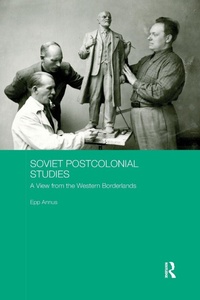
Soviet Postcolonial Studies
A View from the Western Borderlands
1st Edition
Published on 4. February 2019
Book
Paperback/Softback
300 pages
978-0-367-23454-6 (ISBN)
Description
Postcolonial studies is a well-established academic field, rich in theory, but it is based mostly on postcolonial experiences in former West European colonial empires. This book takes a different approach, considering postcolonial theory in relation to the former Soviet bloc. It both applies existing postcolonial theory to this different setting, and also uses the experiences of former Soviet bloc countries to refine and advance theory. Drawing on a wide range of sources, and presenting insights and material of relevance to scholars in a wide range of subjects, the book explores topics such as Soviet colonality as co-constituted with Soviet modernity, the affective structure of identity-creation in national and imperial subjects, and the way in which cultural imaginaries and everyday materialities were formative of Soviet everyday experience.
More details
Series
Language
English
Place of publication
London
United Kingdom
Publishing group
Taylor & Francis Ltd
Target group
College/higher education
Professional and scholarly
Illustrations
1 s/w Tabelle, 50 s/w Abbildungen, 50 s/w Photographien bzw. Rasterbilder
1 Tables, black and white; 50 Halftones, black and white; 50 Illustrations, black and white
Dimensions
Height: 234 mm
Width: 156 mm
Thickness: 16 mm
Weight
459 gr
ISBN-13
978-0-367-23454-6 (9780367234546)
Copyright in bibliographic data and cover images is held by Nielsen Book Services Limited or by the publishers or by their respective licensors: all rights reserved.
Schweitzer Classification
Other editions
Additional editions
E-Book
09/2017
Routledge
€69.99
Available for download
E-Book
09/2017
Routledge
€69.99
Available for download
Book
09/2017
1st Edition
Routledge
€206.80
Shipment within 15-20 days
Person
Epp Annus is a senior researcher with the Estonian Literature Museum. She also lectures at Ohio State University.
Content
Introduction: Colonialism in camouflage 1. Methodological theses about the Soviet empire 2. The location of knowledge: Soviet area studies facing the postcolonial question 3. Can a modern nation-state be colonized? Reformulating the framework of postcolonial studies 4. Modernity with a smiley face: Soviet modernity, Soviet coloniality 5. Colonial layers and hybridization of the past: layers of national modernity in the Baltics 6. From colonial fear to decolonizing laughter: deconstructing the colonial binarisms of 'us' and 'them', 'the colonizer' and 'the colonized' 7. Cultural imaginaries and everyday materialities: living in a Soviet home Conclusion: Everyday dissensus and the end of empire