


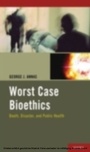
Worst Case Bioethics
Death, Disaster, and Public Health
1st Edition
Published on 1. March 2010
Book
Hardback
360 pages
978-0-19-539173-2 (ISBN)
Description
Bioethics, still in its infancy, is routinely called on by the government to provide political cover for controversial public health decisions involving the life and death of Americans. Doomsday or worst-case scenarios are often at the heart of these biopolitical decisions. A central feature of science fiction, these scenarios can impart useful insights. But worst-case scenarios, like Frankenstein's monster, can also be unpredictably destructive, undermining both preparedness and the very values bioethics seeks to promote. Discovering a new flu strain, for example, leads immediately to visions of the 1918 flu pandemic, the worst in human history. Likewise, a "ticking time bomb" scenario leads to the use of the "saving lives" rationale that permits lawyers to justify it and physicians to carry it out. The worst case charge of "death panels" continues to threaten meaningful healthcare reform in the US. Fundamental change in American healthcare, Annas argues, will require fundamental change in American, including confronting our obsession with technology and our denial of death, and replacing our over-reliance on the military and market metaphors in medicine.
"A combination of the ecological and rights metaphors could help us successfully navigate the waters of change." In Worst Case Bioethics, George Annas employs contemporary disputes involving death and disaster to explore the radical changes underway in public health practice, the application of constitutional law to medicine, and human rights discourse to promote human health and wellbeing. Worst-case scenarios, especially worst-case bioethics scenarios, distort debate, limit options, rationalize human rights abuses, and undermine equality and social justice. It is, nonetheless, possible to temper worst-case scenarios in ways that promote both the development of a meaningful American bioethics, and a life and liberty affirming global health and human rights movement. Written at the intersection of law, bioethics, public health, and human rights, Worst Case Bioethics will interest not only bioethicists but scholars in public health, public policy, and human rights law, as well as members of the public who want to participate in these policy debates.
"A combination of the ecological and rights metaphors could help us successfully navigate the waters of change." In Worst Case Bioethics, George Annas employs contemporary disputes involving death and disaster to explore the radical changes underway in public health practice, the application of constitutional law to medicine, and human rights discourse to promote human health and wellbeing. Worst-case scenarios, especially worst-case bioethics scenarios, distort debate, limit options, rationalize human rights abuses, and undermine equality and social justice. It is, nonetheless, possible to temper worst-case scenarios in ways that promote both the development of a meaningful American bioethics, and a life and liberty affirming global health and human rights movement. Written at the intersection of law, bioethics, public health, and human rights, Worst Case Bioethics will interest not only bioethicists but scholars in public health, public policy, and human rights law, as well as members of the public who want to participate in these policy debates.
Reviews / Votes
In short, Worst Case Bioethics offers a valuable consideration of how public health policy is sometimes shaped by fear in a counterproductive manner. The book is well written, well reasoned, and persuasive. I recommend it highly to all who are interested in bioethics, public health policy, or national security policy. Science Annas persuasively argues in Worst Case Bioethics that basing policy on extreme nightmare possibilities leads to a distortion of fundamental ethical principles and legal protections. Lancet Most readers interested in these topics will find this a creative and insightful rubric for examining different aspects of U.S. healthcare and law. Dr R MacDougall, Saint Louis UniversityMore details
Language
English
Place of publication
New York
United States
Target group
Professional and scholarly
Professors and students of bioethics, human rights, law, medicine, and health law. Also, public health professionals and NGOS, government official and legislators, global public health readers, and human rights advocates.
Dimensions
Height: 235 mm
Width: 156 mm
Thickness: 28.5 mm
Weight
640 gr
ISBN-13
978-0-19-539173-2 (9780195391732)
Copyright in bibliographic data and cover images is held by Nielsen Book Services Limited or by the publishers or by their respective licensors: all rights reserved.
Schweitzer Classification
Other editions
Additional editions
E-Book
03/2010
1st Edition
OUP eBook
€27.49
Available for download

E-Book
03/2010
1st Edition
OUP eBook
€27.49
Available for download
Person
George J. Annas, Professor & Chair, Boston University School of Public Health