

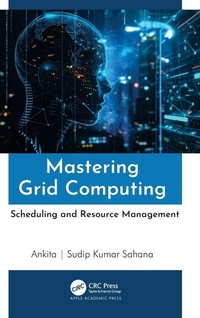
Mastering Grid Computing
Scheduling and Resource Management
1st Edition
Published on 9. May 2025
Book
Hardback
206 pages
978-1-77491-875-3 (ISBN)
Description
Grid computing, a computing infrastructure that combines computer resources spread over different geographical locations to achieve a common goal, is seen as an efficient solution to solve complex real-world computer problems in a shorter time. Grid computing makes it easier to collaborate with other organizations, makes better use of existing hardware, and reduces transmission congestion, leading to more efficient electricity markets, improved power quality, and a reduced environmental impact.
Highlighting the salient features of grid computing, this new book begins with the basic definition of grid and its architecture and also discusses advances to the complex hybridized model of grid computing, grid scheduling, and grid resource management. The chapters address different problems causing grid bottlenecks, the formulation of solution strategies, implementation of grid scheduling, along with case studies of grid computing. It introduces several scheduling algorithms and evaluates the efficiency of these algorithms using comparative analysis while also discussing grid simulators.
The book will be a valuable guide for new and experienced researchers and will advance their understanding of the concept of grid computing in a broader perspective. Starting from the basic definition of grid and its architecture to the complex hybridized model of scheduling, this book is a comprehensive resource on grid computing, grid scheduling, and grid resource management.
Highlighting the salient features of grid computing, this new book begins with the basic definition of grid and its architecture and also discusses advances to the complex hybridized model of grid computing, grid scheduling, and grid resource management. The chapters address different problems causing grid bottlenecks, the formulation of solution strategies, implementation of grid scheduling, along with case studies of grid computing. It introduces several scheduling algorithms and evaluates the efficiency of these algorithms using comparative analysis while also discussing grid simulators.
The book will be a valuable guide for new and experienced researchers and will advance their understanding of the concept of grid computing in a broader perspective. Starting from the basic definition of grid and its architecture to the complex hybridized model of scheduling, this book is a comprehensive resource on grid computing, grid scheduling, and grid resource management.
More details
Language
English
Place of publication
Oakville
Canada
Target group
College/higher education
Professional and scholarly
Academic and Postgraduate
Illustrations
97 s/w Abbildungen, 12 farbige Abbildungen, 97 s/w Zeichnungen, 12 farbige Zeichnungen
12 Line drawings, color; 97 Line drawings, black and white; 12 Illustrations, color; 97 Illustrations, black and white
Dimensions
Height: 235 mm
Width: 157 mm
Thickness: 17 mm
Weight
479 gr
ISBN-13
978-1-77491-875-3 (9781774918753)
Copyright in bibliographic data and cover images is held by Nielsen Book Services Limited or by the publishers or by their respective licensors: all rights reserved.
Schweitzer Classification
Other editions
Additional editions
E-Book
05/2025
Apple Academic Press Inc.
€158.99
Available for download
E-Book
05/2025
Apple Academic Press Inc.
€158.99
Available for download
Persons
Ankita, PhD, is Assistant Professor of Computer Science and Engineering at the Pranveer Singh Institute of Technology (PSIT), Kanpur, India. Her fields of interest are grid computing, artificial intelligence, and computational intelligence. She has authored research papers on computer science and has been assigned as a reviewer for several SCI-indexed journals and IEEE conferences.
Sudip Kumar Sahana, PhD, is Associate Professor of Computer Science and Engineering at the Birla Institute of Technology, Mesra, India. His major field of study is in computer science. His research and teaching interests include soft computing, computational intelligence, distributed computing, and artificial intelligence. He has authored numerous articles, research papers, and books in the field of computer science and has been assigned as an editorial team member and reviewer for several reputed journals. He also holds several patents. He is a lifetime member of the Indian Society for Technical Education (ISTE) and fellow of the Institution of Electronics and Telecommunication Engineers (IETE), India.
Sudip Kumar Sahana, PhD, is Associate Professor of Computer Science and Engineering at the Birla Institute of Technology, Mesra, India. His major field of study is in computer science. His research and teaching interests include soft computing, computational intelligence, distributed computing, and artificial intelligence. He has authored numerous articles, research papers, and books in the field of computer science and has been assigned as an editorial team member and reviewer for several reputed journals. He also holds several patents. He is a lifetime member of the Indian Society for Technical Education (ISTE) and fellow of the Institution of Electronics and Telecommunication Engineers (IETE), India.
Content
Introduction PART 1: FOUNDATIONS 1. Introduction to Grid Computing 2. Scheduling: Conventional and Bio-Inspired Algorithms 3. Work Done Using Conventional and Bio-Inspired Algorithms 4. Scheduling Algorithms: Modified and Hybrid Algorithms PART 2: IMPLEMENTATION OF SCHEDULING ALGORITHMS 5. Research-Based Case Study to Solve Grid-Scheduling Problems Using FCFS, SJF, ACO, PSO, and GA 6. Research-Based Case Study to a Solve Grid Scheduling Problem Using Modified and Hybrid Algorithms: ACOthresh, SJF- ACOthresh, and SJF-GA PART 3: PERFORMANCE COMPARISON OF ALGORITHMS 7. Comparison of Conventional, Bio-Inspired and Hybrid Algorithms: A Review 8. New Computing Platforms for Solving Convoluted Engineering Problems: A Review