

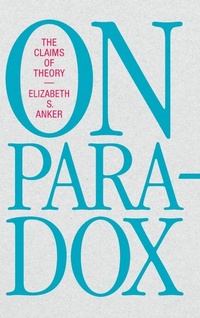
On Paradox
The Claims of Theory
Published on 9. December 2022
Book
Hardback
376 pages
978-1-4780-1633-5 (ISBN)
Description
In On Paradox literary and legal scholar Elizabeth S. Anker contends that faith in the logic of paradox has been the cornerstone of left intellectualism since the second half of the twentieth century. She attributes the ubiquity of paradox in the humanities to its appeal as an incisive tool for exposing and dismantling hierarchies. Tracing the ascent of paradox in theories of modernity, in rights discourse, in the history of literary criticism and the linguistic turn, and in the transformation of the liberal arts in higher education, Anker suggests that paradox not only generates the very exclusions it critiques but also creates a disempowering haze of indecision. She shows that reasoning through paradox has become deeply problematic: it engrains a startling homogeneity of thought while undercutting the commitment to social justice that remains a guiding imperative of theory. Rather than calling for a wholesale abandonment of such reasoning, Anker argues for an expanded, diversified theory toolkit that can help theorists escape the seductions and traps of paradox.
Reviews / Votes
"The novelty of [Anker's] approach is to identify theory's style of thought with a fatal attraction to paradox, to something that appears absurd or contradictory but is actually true. . . . Anker illuminates both why theory has migrated so effectively beyond the academy and also how its self-replicating endlessness gives a startling large-scale intellectual uniformity to the pronouncements of elite institutions and right-wing conspiracists alike." - Michael W. Clune (Los Angeles Review of Books) "As an intellectual and institutional history of critique, On Paradox offers a compelling explanation for the contemporary malaise of theory and critique." - J Daniel Elam (Law & Literature) "What happens when you try to critique a paradox by using a paradox? This is the mesmerizingly encyclopedic project of Elizabeth Anker's On Paradox. Reading her book is like entering a haunted hall of mirrors: You get sudden insights down infinite hallways, deep into some tangle of theology, aesthetics, and politics-you run after them, and then you turn around to find them right behind you. Paradoxes are weirdly charismatic and slippery in this book." - Eleanor Courtemanche (Public Books)More details
Language
English
Place of publication
North Carolina
United States
Target group
Professional and scholarly
Product notice
Cloth over boards
Dimensions
Height: 235 mm
Width: 157 mm
Thickness: 25 mm
Weight
692 gr
ISBN-13
978-1-4780-1633-5 (9781478016335)
Copyright in bibliographic data and cover images is held by Nielsen Book Services Limited or by the publishers or by their respective licensors: all rights reserved.
Schweitzer Classification
Person
Elizabeth S. Anker is Professor of Law and Associate Professor of Literatures in English at Cornell University, coeditor of Critique and Postcritique, also published by Duke University Press, and author of Fictions of Dignity: Embodying Human Rights in World Literature.
Content
Acknowledgments ix
Introduction: On Paradox 1
1. All That Is Solid Melts into Paradox: The Idea of Modernity 29
2. Ontologizing the Paradoxes of Rights, or the Anti-legalism of Theory 73
Interlude. Anatomy of Paradox, or a Brief History of Aesthetic Theory 112
3. Redeeming Rights, or the Ethics and Politics of Paradox 138
4. The Politics of Exclusion 181
5. The Pedagogy of Paradox 221
Interlude. A Different Kind of Theory 261
6. What Holds Things Together: Toward an Integrative Criticism 266
Notes 313
Bibliography 335
Index
Introduction: On Paradox 1
1. All That Is Solid Melts into Paradox: The Idea of Modernity 29
2. Ontologizing the Paradoxes of Rights, or the Anti-legalism of Theory 73
Interlude. Anatomy of Paradox, or a Brief History of Aesthetic Theory 112
3. Redeeming Rights, or the Ethics and Politics of Paradox 138
4. The Politics of Exclusion 181
5. The Pedagogy of Paradox 221
Interlude. A Different Kind of Theory 261
6. What Holds Things Together: Toward an Integrative Criticism 266
Notes 313
Bibliography 335
Index