

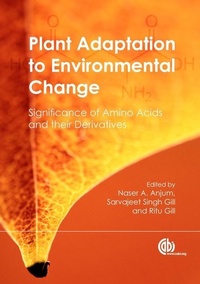
Plant Adaptation to Environmental Change
Significance of Amino Acids and their Derivatives
Published on 22. October 2019
Book
Paperback/Softback
344 pages
978-1-78639-525-2 (ISBN)
Description
Plants constantly cope with unfavourable ecosystem conditions, which often prevent them reaching their full genetic potential in terms of growth, development and productivity. This book covers plants' responses to these environmental changes, namely, the modulation of amino acids, peptides and amines to combat both biotic and abiotic stress factors. Bringing together the most recent developments, this book is an important resource for researchers and students of crop stress and plant physiology.
More details
Language
English
Place of publication
Wallingford
United Kingdom
Target group
Professional and scholarly
College/higher education
Product notice
Paperback (trade)
Unsewn / adhesive bound
Dimensions
Height: 244 mm
Width: 173 mm
Thickness: 15 mm
Weight
635 gr
ISBN-13
978-1-78639-525-2 (9781786395252)
Copyright in bibliographic data and cover images is held by Nielsen Book Services Limited or by the publishers or by their respective licensors: all rights reserved.
Schweitzer Classification
Other editions
Additional editions
Naser A. Anjum | Sarvajeet Singh Gill | Ritu Gill
Plant Adaptation to Environmental Change
Significance of Amino Acids and their Derivatives
E-Book
01/2014
CABI Publishing
€89.99
Available for download
Persons
Dr. Masayuki Fujita is Professor in the Laboratory of Plant Stress Responses, Faculty of Agriculture, Kagawa University, Kagawa, Japan. He received his B.Sc. in Chemistry from Shizuoka University, Shizuoka, and M.Agr. and Ph.D. in plant biochemistry from Nagoya University, Nagoya, Japan. His research interests include physiological, biochemical, and molecular biological responses based on secondary metabolism in plants under various abiotic and biotic stresses; phytoalexin, cytochrome P450, glutathione S-transferase, and phytochelatin; and redox reaction and antioxidants. In the last decade, his works were focused on oxidative stress and antioxidant defense in plants under environmental stress. His group investigates the role of different exogenous protectants in enhancing antioxidant defense and methylglyoxal detoxification systems in plants. He has supervised 4 M.S. students and 13 PhD students as the main supervisor. He has about 150 publications in journal and books and has edited 10 books.
Editor
University of Aveiro, Portugal
MD University, India
MD University, India
Contributions
Bhabha Atomic Research Center. India
Hiroshima Institute of Technology, Japan
Universidad de Sevilla, Spain
University of Barcelona, Spain
Universite de Reims Champagne-Ardenne, France
IIB-INTECH (UNSAM-CONICET), Argentina
Bulgarian Academy of Sciences, Bulgaria
Content
Part I: Introduction 1: Environmental Change, and Plant Amino Acids and their Derivatives - An Introduction Part II: Amino Acids and Peptides, and Plant Stress Adaptation 2: 5-Aminolevulinic Acid (5-ALA) - A Multifunctional Amino Acid as a Plant Growth Stimulator and Stress Tolerance Factor 3: Cysteine - Jack of All Glutathione-based Plant Stress Defence Trades 4: Amino Acids and Drought Stress in Lotus: Use of Transcriptomics and Plastidic Glutamine Synthetase Mutants for New Insights in Proline Metabolism 5: Modulation of Proline: Implications in Plant Stress Tolerance and Development 6: Target Osmoprotectants for Abiotic Stress Tolerance in Crop Plants - Glycine Betaine and Proline Part III: Amines and Brassinosteroids, and Plant Stress Adaptation 7: Polyamines as Indicators and as Modulators of the Abiotic Stress in Plants 8: Polyamines in Stress Protection - Applications in Agriculture 9: Functional Role of Polyamines and Polyamine-metabolizing Enzymes during Salinity, Drought and Cold Stresses 10: Regulatory Role of Polyamines in Growth, Development and Abiotic Stress Tolerance in Plants 11: Polyamines - Involvement in Plant Stress Tolerance and Adaptation 12: Role of Polyamines in Plant-Pathogen Interactions 13: Role of Polyamines in Stress Management 14: Polyamines in Plant In Vitro Culture 15: Betaines and Related Osmoprotectants - Significance in Metabolic Engineering of Plant Stress Resistance 16: Brassinosteroids' Role for Amino Acids, Peptides and Amines Modulation in Stressed Plants - A Review Part IV: Appraisal and Perspectives 17: Plant Adaptation to Environmental Change, and Significance of Amino Acids and their Derivatives - Appraisal and Perspectives"