

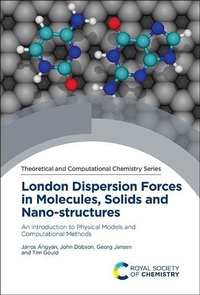
London Dispersion Forces in Molecules, Solids and Nano-structures
An Introduction to Physical Models and Computational Methods
Published on 8. April 2020
Book
Hardback
434 pages
978-1-78262-045-7 (ISBN)
Description
London dispersion interactions are responsible for numerous phenomena in physics, chemistry and biology. Recent years have seen the development of new, physically well-founded models, and dispersion-corrected density functional theory (DFT) is now a hot topic of research. This book is an overview of current understanding of the physical origin and modelling of London dispersion forces manifested at an atomic level. It covers a wide range of system, from small intermolecular complexes, to organic molecules and crystalline solids, through to biological macromolecules and nanostructures. In presenting a broad overview of the of the physical foundations of dispersion forces, the book provides theoretical, physical and synthetic chemists, as well as solid-state physicists, with a systematic understanding of the origins and consequences of these ubiquitous interactions. The presentation is designed to be accessible to anyone with intermediate undergraduate mathematics, physics and chemistry.
More details
Series
Language
English
Place of publication
Cambridge
United Kingdom
Target group
Professional and scholarly
Product notice
Unsewn / adhesive bound
Dimensions
Height: 234 mm
Width: 155 mm
Thickness: 33 mm
Weight
839 gr
ISBN-13
978-1-78262-045-7 (9781782620457)
DOI
10.1039/9781782623861
Copyright in bibliographic data and cover images is held by Nielsen Book Services Limited or by the publishers or by their respective licensors: all rights reserved.
Schweitzer Classification
Other editions
Additional editions
Janos Angyan | John Dobson | Georg Jansen
London Dispersion Forces in Molecules, Solids and Nano-structures
An Introduction to Physical Models and Computational Methods
E-Book
04/2020
1st Edition
Royal Society of Chemistry
€231.99
Available for download
Janos Angyan | John Dobson | Georg Jansen
London Dispersion Forces in Molecules, Solids and Nano-structures
An Introduction to Physical Models and Computational Methods
E-Book
04/2020
1st Edition
Royal Society of Chemistry
€231.99
Available for download
Persons
Janos Angyan (1956-2017) was a Director of Research with the CNRS, France, based at the University of Lorraine. His main research interests were intermolecular interactions and the electronic structure of solids.
John Dobson is an Emeritus Professor at Griffith University, Australia. His research interests are in theoretical condensed matter physics, chemical physics and nanoscience.
Georg Jansen is Professor for Theoretical Organic Chemistry at the University of Duisburg-Essen, Germany. His research focusses on the calculation and interpretation of intermolecular interactions.
Tim Gould is a Senior Lecturer in Applied Mathematics at Griffith University, Australia. His research interests include quantum chemistry method development, chemical physics and electronic structure theory of molecules and solids.
John Dobson is an Emeritus Professor at Griffith University, Australia. His research interests are in theoretical condensed matter physics, chemical physics and nanoscience.
Georg Jansen is Professor for Theoretical Organic Chemistry at the University of Duisburg-Essen, Germany. His research focusses on the calculation and interpretation of intermolecular interactions.
Tim Gould is a Senior Lecturer in Applied Mathematics at Griffith University, Australia. His research interests include quantum chemistry method development, chemical physics and electronic structure theory of molecules and solids.
Content
Introduction;
Basic Concepts from Toy Models;
Macroscopic Lifshitz Approach;
Supermolecular Wavefunction Methods;
Intermolecular Perturbation Theory;
Adiabatic Connection, Fluctuation-Dissipation Approach: RPA and Related Correlation Energy Methods;
Dispersion Energy From Groundstate Electron "Densities" ?( r?), ??( r?), ?( r?), etc.: Explicit Functionals;
Dispersion Energies via Division Into Atoms or Larger Units;
Some Chemical Effects of Dispersion Interactions;
Periodic Solids;
Low-dimensional Systems: Nanolayers, Nanotubes, Nanowires, etc.;
Interaction of Molecules with Surfaces and Layers;
Summary of Recommended Methods;
Many-electron Quantum Mechanics;
Linear Response and the Fluctuation-Dissipation Theorem;
Basics of Groundstate Density Functional Theory;
Some Useful Mathematics;
Partitioning Into Atoms;
Polarisation Approximation: Higher-order and Many-body Contributions
Basic Concepts from Toy Models;
Macroscopic Lifshitz Approach;
Supermolecular Wavefunction Methods;
Intermolecular Perturbation Theory;
Adiabatic Connection, Fluctuation-Dissipation Approach: RPA and Related Correlation Energy Methods;
Dispersion Energy From Groundstate Electron "Densities" ?( r?), ??( r?), ?( r?), etc.: Explicit Functionals;
Dispersion Energies via Division Into Atoms or Larger Units;
Some Chemical Effects of Dispersion Interactions;
Periodic Solids;
Low-dimensional Systems: Nanolayers, Nanotubes, Nanowires, etc.;
Interaction of Molecules with Surfaces and Layers;
Summary of Recommended Methods;
Many-electron Quantum Mechanics;
Linear Response and the Fluctuation-Dissipation Theorem;
Basics of Groundstate Density Functional Theory;
Some Useful Mathematics;
Partitioning Into Atoms;
Polarisation Approximation: Higher-order and Many-body Contributions