

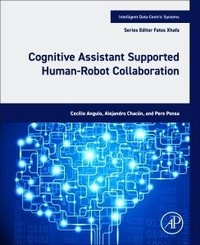
Cognitive Assistant Supported Human-Robot Collaboration
Published on 16. May 2024
Book
Paperback/Softback
300 pages
978-0-443-22135-4 (ISBN)
Description
Cognitive Assistant Supported Human-Robot Collaboration covers the design and development of cognitive assistants in the smart factory era, its application domains, challenges, and current state-of-the-art in assistance systems with collaborative robotics and IoT technologies, standards, platforms, and solutions. This book also provides a sociotechnical view of collaborative work in human-robot teams, investigating specific methods and techniques to analyze assistance systems. This provides readers with a comprehensive overview of how cognitive assistants function and work in human-robot teams.
More details
Series
Language
English
Place of publication
San Diego
United States
Publishing group
Elsevier Science Publishing Co Inc
Target group
Professional and scholarly
Product notice
Paperback (trade)
Unsewn / adhesive bound
Dimensions
Height: 233 mm
Width: 191 mm
Thickness: 14 mm
Weight
490 gr
ISBN-13
978-0-443-22135-4 (9780443221354)
Copyright in bibliographic data and cover images is held by Nielsen Book Services Limited or by the publishers or by their respective licensors: all rights reserved.
Schweitzer Classification
Other editions
Additional editions
Cecilio Angulo | Alejandro Chacón | Pere Ponsa
Cognitive Assistant Supported Human-Robot Collaboration
E-Book
05/2024
Academic Press
€170.00
Available for download
Persons
Cecilio Angulo received his BSc and MSc degrees in mathematics from the University of Barcelona, and PhD in sciences from Universitat Politecnica de Catalunya (UPC), Spain. He is the founder of the Research Centre on Intelligent Data Science and Artificial Intelligence (IDEAI-UPC) and is currently a full professor of artificial intelligence and robotics at UPC, and President of the Catalan Association for Artificial Intelligence (ACIA). Dr. Angulo has worked on applications on recommender systems, cognitive social robots, and assistive technologies. He has authored books on machine learning and robots, and published more than 275 papers in international and national journals and conferences. He has led and participated in 40 R&D competitive projects, 15 of them funded by the European Commission. Alejandro Chacon received his MSc degree in automatic control and robotics and PhD degree in Automatic Control, Robotics, and Vision from Universitat Politecnica Catalunya Barcelona Tech, Spain. He is currently a professor and researcher at Universidad de las Fuerzas Armadas ESPE, in Ecuador. His research interests include cognitive assistants, industrial internet of things, artificial intelligence, human-centered design, and collaborative robotics. Pere Ponsa received his PhD degree from Universitat Politecnica Catalunya Barcelona Tech, in Spain. He is currently an assistant professor at Barcelona East School of Engineering and member of the Automatic Control Department. He has published more than 150 refereed publications, including conferences, journals, a book, and book chapters. His research interests include automation, smart control systems, human-centred design, and robotics. He is a member of the Smart Control Systems research group, and member of the Human-Computer Interaction Association (AIPO). He served as conference chair of Interaccion'15 XVI International Conference on Human-Computer Interaction (Vilanova i la Geltru, Spain). Fatos Xhafa, PhD in Computer Science, is Full Professor at the Technical University of Catalonia (UPC), Barcelona, Spain. He has held various tenured and visiting professorship positions. He was a Visiting Professor at the University of Surrey, UK (2019/2020), Visiting Professor at the Birkbeck College, University of London, UK (2009/2010) and a Research Associate at Drexel University, Philadelphia, USA (2004/2005). He was a Distinguished Guest Professor at Hubei University of Technology, China, for the duration of three years (2016-2019). Prof. Xhafa has widely published in peer reviewed international journals, conferences/workshops, book chapters, edited books and proceedings in the field (H-index 55). He has been awarded teaching and research merits by the Spanish Ministry of Science and Education, by IEEE conferences and best paper awards. Prof. Xhafa has an extensive editorial service. He is founder and Editor-In-Chief of Internet of Things - Journal - Elsevier (Scopus and Clarivate WoS Science Citation Index) and of International Journal of Grid and Utility Computing, (Emerging Sources Citation Index), and AE/EB Member of several indexed Int'l Journals. Prof. Xhafa is a member of IEEE Communications Society, IEEE Systems, Man & Cybernetics Society and Founder Member of Emerging Technical Subcommittee of Internet of Things.
His research interests include IoT and Cloud-to-thing continuum computing, massive data processing and collective intelligence, optimization, security and trustworthy computing and machine learning, among others. He can be reached at fatos@cs.upc.edu. Please visit also http://www.cs.upc.edu/~fatos/ and at http://dblp.uni-trier.de/pers/hd/x/Xhafa:Fatos
His research interests include IoT and Cloud-to-thing continuum computing, massive data processing and collective intelligence, optimization, security and trustworthy computing and machine learning, among others. He can be reached at fatos@cs.upc.edu. Please visit also http://www.cs.upc.edu/~fatos/ and at http://dblp.uni-trier.de/pers/hd/x/Xhafa:Fatos
Content
1. Introduction
2. Human Cyber-Physical Systems
3. Workspace's Requirements and Design
4. Workspace's Metrics and Evaluation
5. Results of Experimentation
6. Discussion, Challenges and Lessons Learned
7. Conclusions and Future Lines
8. Appendices
2. Human Cyber-Physical Systems
3. Workspace's Requirements and Design
4. Workspace's Metrics and Evaluation
5. Results of Experimentation
6. Discussion, Challenges and Lessons Learned
7. Conclusions and Future Lines
8. Appendices