

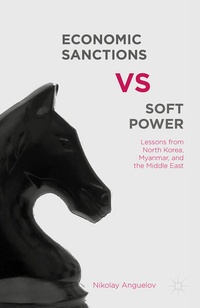
Economic Sanctions vs. Soft Power
Lessons from North Korea, Myanmar, and the Middle East
Published on 1. July 2015
Book
Hardback
IX, 192 pages
978-1-137-52375-4 (ISBN)
Description
The book examines the industrial growth of sanctioned nations in terms of their ability to foster trade partnerships with countries that choose to evade or not comply with sanctions. When those "black knight" nations find strong local market competitive advantages in the absence of firms from sender nations, incentives develop to support local political status quos. For those reasons, the political resilience of rogue and repressive regimes is analyzed in terms of their economic incentives to remain repressive. The resilience is based on the fact that the local politicians are also the local businessmen. Through the growth of international production networks, their business opportunities augment and the rents associated with that growth also increase. As business opportunities grow in the absence of competition, so does the amount of rent extraction and protection. Rent protecting leads to strengthening economic and political leadership, because the wealth is used for creating further rents by providing economic benefits to the regime supporters. Economic Sanctions vs. Soft Power shows how the system of self-enforcing economic rents builds political rents and lowers opportunities for the development of viable political oppositions.
More details
Edition
2015 edition
Language
English
Place of publication
New York
United States
Target group
Professional and scholarly
Product notice
sewn/stitched
Cloth over boards
With dust jacket
Illustrations
IX, 192 p.
Dimensions
Height: 234 mm
Width: 157 mm
Thickness: 15 mm
Weight
431 gr
ISBN-13
978-1-137-52375-4 (9781137523754)
DOI
10.1057/9781137523761
Schweitzer Classification
Other editions
Additional editions
E-Book
07/2015
1st Edition
Palgrave MacMillan
€53.49
Available for download

Nikolay Anguelov | Nick Anguelov | N. Anguelov
Economic Sanctions vs. Soft Power
Lessons from North Korea, Myanmar, and the Middle East
Book
01/2014
Palgrave MacMillan
€90.94
The article will not be published
Person
Bradley J. Hornback
Tiffany Kaschel
Content
Introduction 1. Economic Sanctions: An Overview 2. Myanmar Twenty Years of Sanctions and their lasting Effect 3. Myanmar's Sanction Legacy: The Results of Non-Engagement 4. Absorb and Control: How North Korean Responds to Economic Sanctions 5. Alternatives to Sanctions 6. Sanctions or Soft Power: Implications for Competitiveness 7. Engage or Not? Conclusions and Policy Implications References