

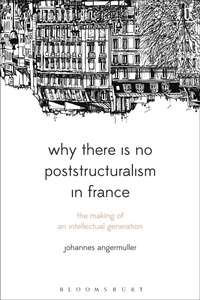
Why There Is No Poststructuralism in France
The Making of an Intellectual Generation
Published on 26. July 2018
Book
Paperback/Softback
144 pages
978-1-350-09447-5 (ISBN)
Description
French thinkers such as Lacan and Derrida are often labelled as representatives of 'poststructuralism' in the Anglophone world. However in France, where their work originated, they use no such category; this group of theorists - 'the poststructuralists' - were never perceived as a coherent intellectual group or movement.
Outlining the institutional contexts, affinities, and rivalries of, among others, Althusser, Barthes, Foucault, Irigaray, and Kristeva, Angermuller - drawing from Bourdieu's concepts of cultural capital and the academic field - insightfully explores post-structuralism as a phenomenon. By tracing the evolution of the French intellectual field after the war, Why There is No Poststructuralism in France places French Theory both in the specific material conditions of its production and the social and historical contexts of its reception, accounting for a particularly creative moment in French intellectual life which continues to inform the theoretical imaginary of our time.
Outlining the institutional contexts, affinities, and rivalries of, among others, Althusser, Barthes, Foucault, Irigaray, and Kristeva, Angermuller - drawing from Bourdieu's concepts of cultural capital and the academic field - insightfully explores post-structuralism as a phenomenon. By tracing the evolution of the French intellectual field after the war, Why There is No Poststructuralism in France places French Theory both in the specific material conditions of its production and the social and historical contexts of its reception, accounting for a particularly creative moment in French intellectual life which continues to inform the theoretical imaginary of our time.
Reviews / Votes
Angermuller is deft in cross-cutting between developments in French intellectual life and their often very partial, biased or distorted reception-history outside France. His shrewdly selective deployment of concepts from Bourdieu offers a number of striking insights into the formative conditions of (so-called) 'French Theory' and its uptake among critics and commentators in other national/cultural traditions. It is certainly the most comprehensive and thoroughly researched study of its kind to date and unlikely to be superseded as a standard work on the subject. * Christopher Norris, Distinguished Research Professor of Philosophy, Cardiff University, UK * Angermuller's work offers illumination in a much-neglected field; it pertinently avoids simple reductivism by emphasizing a constitutive antagonism in the object of theory and society itself. * Hong Kong Review of Books *More details
Series
Language
English
Place of publication
London
United Kingdom
Publishing group
Bloomsbury Publishing PLC
Target group
College/higher education
Dimensions
Height: 234 mm
Width: 156 mm
Thickness: 8 mm
Weight
231 gr
ISBN-13
978-1-350-09447-5 (9781350094475)
Copyright in bibliographic data and cover images is held by Nielsen Book Services Limited or by the publishers or by their respective licensors: all rights reserved.
Schweitzer Classification
Other editions
Additional editions
Johannes Angermuller
Why There Is No Poststructuralism in France
The Making of an Intellectual Generation
E-Book
10/2015
1st Edition
Bloomsbury Academic
€39.99
Available for download
Johannes Angermuller
Why There Is No Poststructuralism in France
The Making of an Intellectual Generation
E-Book
10/2015
1st Edition
Bloomsbury Academic
€39.99
Available for download
Person
Johannes Angermuller is Professor of Discourse and directs the DISCONEX research group at the university of Warwick, UK and at School for Advanced Studies in the Social Sciences (EHESS) in Paris, France.
Content
Preface
1 Introduction: the intellectual field in France
1.1 'Poststructuralism'-an international misunderstanding?
1.2 Structuralism and post-structuralism in intellectual sociology of intellectuals
2 Structuralism versus post-structuralism. The birth of an intellectual generation
2.1 The transformations of Theory. From structuralism to 'poststructuralism'
2.2 Why there is no poststructuralism in France. Foucault, Derrida & Co. in the French intellectual field
2.2.1 Theoretical lines of conflict. Structuralists and ex-, non- and anti-structuralists
2.2.2 The arena of political conflict: the Communist Party and '68
2.2.3 Schools, clans, networks
2.2.4 Disciplinary cleavages between the human sciences and philosophy
2.2.5 Alternative education routes: elite academics versus colorful resumes
2.2.6 Peripheral institutions against the academic center
3 Rise and decline of the structuralist generation
3.1 From modernity to postmodernity: the intellectual field since the Enlightenment
3.2 The boom of the human sciences in the 1960s and 1970s
3.3 The formation of the structuralist generation
3.4 The neoliberal turn of the 1980s
4 From Theory in France to French Theory: the making of 'poststructuralism' in the post-national university
5 The Moment of Theory: the Social After Society
Notes
References
Index
1 Introduction: the intellectual field in France
1.1 'Poststructuralism'-an international misunderstanding?
1.2 Structuralism and post-structuralism in intellectual sociology of intellectuals
2 Structuralism versus post-structuralism. The birth of an intellectual generation
2.1 The transformations of Theory. From structuralism to 'poststructuralism'
2.2 Why there is no poststructuralism in France. Foucault, Derrida & Co. in the French intellectual field
2.2.1 Theoretical lines of conflict. Structuralists and ex-, non- and anti-structuralists
2.2.2 The arena of political conflict: the Communist Party and '68
2.2.3 Schools, clans, networks
2.2.4 Disciplinary cleavages between the human sciences and philosophy
2.2.5 Alternative education routes: elite academics versus colorful resumes
2.2.6 Peripheral institutions against the academic center
3 Rise and decline of the structuralist generation
3.1 From modernity to postmodernity: the intellectual field since the Enlightenment
3.2 The boom of the human sciences in the 1960s and 1970s
3.3 The formation of the structuralist generation
3.4 The neoliberal turn of the 1980s
4 From Theory in France to French Theory: the making of 'poststructuralism' in the post-national university
5 The Moment of Theory: the Social After Society
Notes
References
Index