

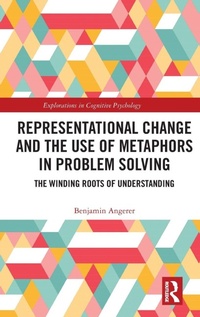
Representational Change and the Use of Metaphors in Problem Solving
The Winding Roots of Understanding
1st Edition
Published on 7. July 2023
Book
Hardback
216 pages
978-1-032-32136-3 (ISBN)
Description
This book addresses a longstanding impasse in problem solving research: if structured mental representations of problems are required for solving them, how do those arise and, if needed, change? The book argues that established theories underestimate this question due to methodological requirements.
Proposing to momentarily suspend these requirements, including the focus on well-defined puzzle tasks, the book suggests to alternatively conduct exploratory studies with more complex, open-ended problems. It presents a qualitative case study of participants working for several days on a mental paper folding task designed to challenge them to construct their own representations. Charting their use of gestures, metaphors, and ever more complex descriptions, it carefully traces the chronology of their thinking. Combining in-depth empirical investigation with theory-building, the book proposes a framework of problem solving that goes beyond established models, accommodating associative, motivational, and affective factors.
This book will be of great interest to researchers, academics, and postgraduate students in the fields of cognitive science, psychology, philosophy of mind and cognition, and cognitive artificial intelligence.
Proposing to momentarily suspend these requirements, including the focus on well-defined puzzle tasks, the book suggests to alternatively conduct exploratory studies with more complex, open-ended problems. It presents a qualitative case study of participants working for several days on a mental paper folding task designed to challenge them to construct their own representations. Charting their use of gestures, metaphors, and ever more complex descriptions, it carefully traces the chronology of their thinking. Combining in-depth empirical investigation with theory-building, the book proposes a framework of problem solving that goes beyond established models, accommodating associative, motivational, and affective factors.
This book will be of great interest to researchers, academics, and postgraduate students in the fields of cognitive science, psychology, philosophy of mind and cognition, and cognitive artificial intelligence.
More details
Series
Language
English
Place of publication
London
United Kingdom
Publishing group
Taylor & Francis Ltd
Target group
College/higher education
Academic and Postgraduate
Illustrations
81 s/w Abbildungen, 14 s/w Photographien bzw. Rasterbilder, 67 s/w Zeichnungen, 47 s/w Tabellen
47 Tables, black and white; 67 Line drawings, black and white; 14 Halftones, black and white; 81 Illustrations, black and white
Dimensions
Height: 240 mm
Width: 161 mm
Thickness: 17 mm
Weight
508 gr
ISBN-13
978-1-032-32136-3 (9781032321363)
Copyright in bibliographic data and cover images is held by Nielsen Book Services Limited or by the publishers or by their respective licensors: all rights reserved.
Schweitzer Classification
Other editions
Additional editions
Benjamin Angerer
Representational Change and the Use of Metaphors in Problem Solving
The Winding Roots of Understanding
Book
10/2024
1st Edition
Routledge
€63.50
Shipment within 10-20 days
Benjamin Angerer
Representational Change and the Use of Metaphors in Problem Solving
The Winding Roots of Understanding
E-Book
07/2023
1st Edition
Routledge
€55.49
Available for download
Benjamin Angerer
Representational Change and the Use of Metaphors in Problem Solving
The Winding Roots of Understanding
E-Book
07/2023
1st Edition
Routledge
€55.49
Available for download
Person
Benjamin Angerer is Research Associate at the Institutes of Philosophy, Computer Science, and Centre for Digital Education, University of Osnabrueck, Germany.
Content
1. Introduction 2. Problem-solving research and its struggle with representational change 3. Metaphors to the rescue? 4. The domain of iterated mental paper folding 5. A single case of learning how to represent folds 6. Back to theory 7. Associations, routines, and transient spaces: sketches of a new framework 8. Conclusion