

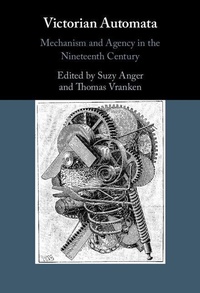
Victorian Automata
Mechanism and Agency in the Nineteenth Century
Published on 28. March 2024
Book
Hardback
360 pages
978-1-009-10027-4 (ISBN)
Description
The relationship between lifelike machines and mechanistic human behaviour provoked both fascination and anxiety in Victorian culture. This collection is the first to examine the widespread cultural interest in automata - both human and mechanical - in the nineteenth century. It was in the Victorian period that industrialization first met information technology, and that theories of physical and mental human automatism became essential to both scientific and popular understandings of thought and action. Bringing together essays by a multidisciplinary group of leading scholars, this volume explores what it means to be human in a scientific and industrial age. It also considers how Victorian inquiry and practices continue to shape current thought on race, creativity, mind, and agency. This title is part of the Flip it Open programme and may also be available Open Access. Check our website Cambridge Core for details.
Reviews / Votes
'This fascinating and thoroughly readable collection invites us into the longer histories of our own encounters with driverless cars and artificial intelligence. Revealing just how central the automaton was to nineteenth-century intellectual life, these wide-ranging essays make an invaluable - and timely - contribution to our understanding of the period, from its theories of consciousness, racial difference, and labour, to its debates over instinct and agency.' Tina Young Choi, Professor of English, York University 'Like us, Victorians confronted new machines that seemed to do things only humans could do. What did automata mean for that earlier technological and cultural age? This outstanding collection contributes revealing new critical perspectives and topics - including detective fiction, hypnotism, and law; gender, evolution, and race - to the tortuous history of human-machine relations.' John Tresch, Professor of History of Art, Science, and Folk Practice, Warburg Institute, University of London 'Suzy Anger, Thomas Vranken, and their collaborators make a much needed contribution to the field that has sometimes facetiously been dubbed 'automaton studies.' Offering a wide range of case studies and insights, they succeed simultaneously in portraying what is distinctive about automata and automatism in the Victorian age, and in inviting us to tackle time-honoured questions about humans, machines, volition, and coercion.' Heidi Voskuhl, Associate Professor of History of Science, University of Pennsylvania 'An impressive volume of essays that explore the many guises of automata in the nineteenth century ... This is an engaging and highly readable collection with much of interest for those in the field.' Jessica Thomas, The British Society for Literature and ScienceMore details
Language
English
Place of publication
Cambridge
United Kingdom
Product notice
sewn/stitched
Cloth over boards
Illustrations
Worked examples or Exercises
Dimensions
Height: 229 mm
Width: 152 mm
Thickness: 21 mm
Weight
649 gr
ISBN-13
978-1-009-10027-4 (9781009100274)
Copyright in bibliographic data and cover images is held by Nielsen Book Services Limited or by the publishers or by their respective licensors: all rights reserved.
Schweitzer Classification
Other editions
Additional editions
E-Book
03/2024
Cambridge University Press
€123.99
Available for download
Persons
Content
List of figures; List of contributors; Introduction: the Victorian automata/automatism schema Suzy Anger; An afterthought on Victorian automata as afterthought (and signifier) Thomas Vranken; Part I. Mechanical Automata: 1. The mimetic faculty at work: the golden age of automata Kara Reilly; 2. Black steam: patents, portals, and the counter-histories of the Victorian android Edward Jones-Imhotep and Alexander Offord; 3. A short history of human-automata interaction Simone Natale; Part II. Automatism: 4. The dialectic of automatism and free will Roger Smith; 5. The poetry of conscious automatism Suzy Anger; 6. 'No purpose, heart or mind or will': James Thomson (B. V.) and psychological automatism Tyson Stolte; 7. Creative trollope Linda Austin; 8. Darwin and agency - intention or automatism? George Levine; Part III. Literary Genre and Popular Fiction: 9. The automaton detective: Victorian reverberations Thomas Vranken and Stephen Knight; 10. 'A doll, a dummy, a nothing!': the criminal mesmerist, his automaton-subject, and debates on criminal responsibility in Richard Marsh Shuhita Bhattacharjee; 11. The invasion of the white mind: race, automatism, and mental hierarchy in the late-nineteenth century Aren Roukema; Part IV. Interactions: 12. Sublime puppets versus uncanny automata: artificial beings in nineteenth-century literature Minsoo Kang; 13. The strange career of topsy: the problem of automata in the age of slave emancipation Chris Dingwall; 14. George Eliot among the machines Sally Shuttleworth; 15. A disembodied voice, yet the voice of a human soul: decadent automacy in L'Eve Future Richard Menke; Index.