

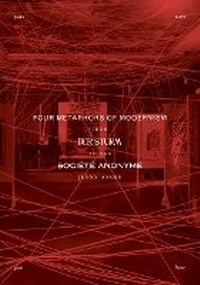
Four Metaphors of Modernism
From Der Sturm to the Societe Anonyme
Published on 20. February 2018
Book
Hardback
320 pages
978-1-5179-0321-3 (ISBN)
Description
Exploring the significance of metaphor in modern art
"Where do the roots of art lie?" asked Der Sturm founder Herwarth Walden. "In the people? Behind the mountains? Behind the planets. He who has eyes to hear, feels." Walden's Der Sturm-the journal, gallery, performance venue, press, theater, bookstore, and art school in Berlin (1910-1932)-has never before been the subject of a book-length study in English. Four Metaphors of Modernism positions Der Sturm at the center of the avant-garde and as an integral part of Euro-American modern art, theory, and practice.
Jenny Anger traces Walden's aesthetic and intellectual roots to Franz Liszt and Friedrich Nietzsche-forebears who led him to embrace a literal and figurative mixing of the arts. She then places Der Sturm in conversation with New York's SociEtE Anonyme (1920-1950), an American avant-garde group modeled on Der Sturm and founded by Katherine Sophie Dreier, Marcel Duchamp, and Man Ray. Working against the tendency to examine artworks and artist groups in isolation, Anger underscores the significance of both organizations to the development and circulation of international modernism.
Focusing on the recurring metaphors of piano, glass, water, and home, Four Metaphors of Modernism interweaves a historical analysis of these two prominent organizations with an aesthetic analysis of the metaphors that shaped their practices, reconceiving modernism itself. Presented here is a modernism that is embodied, gendered, multisensory, and deeply committed to metaphor and a restoration of abstraction's connection with the real.
"Where do the roots of art lie?" asked Der Sturm founder Herwarth Walden. "In the people? Behind the mountains? Behind the planets. He who has eyes to hear, feels." Walden's Der Sturm-the journal, gallery, performance venue, press, theater, bookstore, and art school in Berlin (1910-1932)-has never before been the subject of a book-length study in English. Four Metaphors of Modernism positions Der Sturm at the center of the avant-garde and as an integral part of Euro-American modern art, theory, and practice.
Jenny Anger traces Walden's aesthetic and intellectual roots to Franz Liszt and Friedrich Nietzsche-forebears who led him to embrace a literal and figurative mixing of the arts. She then places Der Sturm in conversation with New York's SociEtE Anonyme (1920-1950), an American avant-garde group modeled on Der Sturm and founded by Katherine Sophie Dreier, Marcel Duchamp, and Man Ray. Working against the tendency to examine artworks and artist groups in isolation, Anger underscores the significance of both organizations to the development and circulation of international modernism.
Focusing on the recurring metaphors of piano, glass, water, and home, Four Metaphors of Modernism interweaves a historical analysis of these two prominent organizations with an aesthetic analysis of the metaphors that shaped their practices, reconceiving modernism itself. Presented here is a modernism that is embodied, gendered, multisensory, and deeply committed to metaphor and a restoration of abstraction's connection with the real.
Reviews / Votes
"Four Metaphors of Modernism is a tour de force demonstration of the centrality of metaphor to the modernist project both in Europe and America. Through comparative analysis, Jenny Anger charts the surprising aesthetic and philosophical continuities informing two key modernist ventures."-Mark Antliff, Duke University"The book not only brings together various strands of scholarship with brand new archival research, it is also the first major effort to systematically trace the connections between the German Der Sturm and the American SociEtE Anonyme. Jenny Anger's highly original and engaging instigation of connections between these two key modernist institutions is particularly noteworthy for the author's nuanced discussion of gender, which builds on her earlier published work and will no doubt further cement her reputation as a major contributor within this area."-Anna Brzyski, University of Kentucky
More details
Language
English
Place of publication
Minnesota
United States
Target group
Professional and scholarly
Illustrations
99
Dimensions
Height: 254 mm
Width: 178 mm
Thickness: 38 mm
ISBN-13
978-1-5179-0321-3 (9781517903213)
Copyright in bibliographic data and cover images is held by Nielsen Book Services Limited or by the publishers or by their respective licensors: all rights reserved.
Schweitzer Classification
Person
Jenny Anger is professor of art history at Grinnell College. She is author of Paul Klee and the Decorative in Modern Art.
Content
Overture
Act 1. Piano
Act 2. Water
Act 3. Glass
Act 4. Home
Reprise
Acknowledgments
Notes
Bibliography
Index
Act 1. Piano
Act 2. Water
Act 3. Glass
Act 4. Home
Reprise
Acknowledgments
Notes
Bibliography
Index