

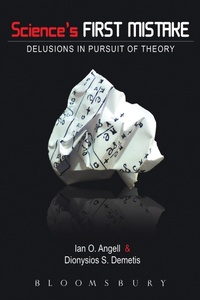
Science's First Mistake
Delusions in Pursuit of Theory
Published on 13. September 2012
Book
Paperback/Softback
256 pages
978-1-78093-233-0 (ISBN)
Description
This book is available as open access through the Bloomsbury Open Access programme and is available on www.bloomsburycollections.com.
Taking examples from across the natural and social sciences, this ambitious book examines the deep-seated assumptions that underpin the discovery of knowledge, and claims that all scientific methods are delusions in pursuit of theory. Using Systems Theory, in particular the concept of self-reference, the book argues that the process of observing tricks the human mind into developing a self-consistent description of itself; and a belief in the certainty of a causal 'reality'. Our theories and ways of thinking about the world around us are, in fact, distinct from the 'reality' being observed. This fresh, audacious work makes an important contribution to the study of scientific method, and takes readers out of the comfort zone of their perceived scientific certainty.
Taking examples from across the natural and social sciences, this ambitious book examines the deep-seated assumptions that underpin the discovery of knowledge, and claims that all scientific methods are delusions in pursuit of theory. Using Systems Theory, in particular the concept of self-reference, the book argues that the process of observing tricks the human mind into developing a self-consistent description of itself; and a belief in the certainty of a causal 'reality'. Our theories and ways of thinking about the world around us are, in fact, distinct from the 'reality' being observed. This fresh, audacious work makes an important contribution to the study of scientific method, and takes readers out of the comfort zone of their perceived scientific certainty.
Reviews / Votes
A very interesting and important book. * Professor Guy Fitzgerald, Brunel University, UK * Excellent and ground breaking. Very well written. Engaging. It is a much needed and original contribution, which will become a key reference in contemporary academic social sciences thinking. * Professor Fernando Ilharco, Universidade Catolica Portuguesa, Lisbon * The questions posed by the authors in their book are important. They are also a good reminder to constantly consider the dialectic between knowledge, authority, and its relationship with certainty. * New York Journal of Books *More details
Language
English
Place of publication
London
United Kingdom
Publishing group
Bloomsbury Publishing PLC
Target group
College/higher education
Illustrations
None
Dimensions
Height: 234 mm
Width: 156 mm
Thickness: 14 mm
Weight
395 gr
ISBN-13
978-1-78093-233-0 (9781780932330)
Copyright in bibliographic data and cover images is held by Nielsen Book Services Limited or by the publishers or by their respective licensors: all rights reserved.
Schweitzer Classification
Other editions
Additional editions
E-Book
07/2010
1st Edition
Bloomsbury Academic
€31.99
Available for download
Persons
Ian O. Angell is Professor Emeritus at the London School of Economics. His many publications include The New Barbarian Manifesto: How to survive the information age.
Dionysios S. Demetis is a Member of the Scientific Board of the Geolab Institute at the Ionian University, Greece.
Dionysios S. Demetis is a Member of the Scientific Board of the Geolab Institute at the Ionian University, Greece.
Content
List of Figures
Preface to the New in Paperback edition
Preface
1. Introduction
2. Divination and Theory Construction
3. Delusion
4.Individual Allusions Contra Sensory Overload
5. Patterns of Categorical Delusions
6. Tidy Minds, Technology, and the Myth of Control
7. Systems Theory
8. On the Premises of Observation
9. The Frame of Observation & the Functional Differentiation of Science
10. Higher Order Observations
11. Asymmetry and Self-Reference
12. Collapsing Systems
13. The 'Reality' of the Real
Epilogue: Science's First Mistake
Notes
References
Index
Preface to the New in Paperback edition
Preface
1. Introduction
2. Divination and Theory Construction
3. Delusion
4.Individual Allusions Contra Sensory Overload
5. Patterns of Categorical Delusions
6. Tidy Minds, Technology, and the Myth of Control
7. Systems Theory
8. On the Premises of Observation
9. The Frame of Observation & the Functional Differentiation of Science
10. Higher Order Observations
11. Asymmetry and Self-Reference
12. Collapsing Systems
13. The 'Reality' of the Real
Epilogue: Science's First Mistake
Notes
References
Index