

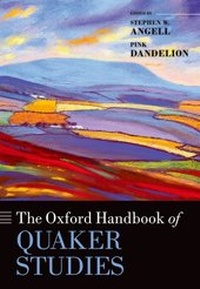
The Oxford Handbook of Quaker Studies
Published on 26. September 2013
Book
Hardback
666 pages
978-0-19-960867-6 (ISBN)
Description
Quakerism began in England in the 1650s. George Fox, credited as leading the movement, had an experience of 1647 in which he felt he could hear Christ directly and inwardly without the mediation of text or minister. Convinced of the authenticity of this experience and its universal application, Fox preached a spirituality in which potentially all were ministers, all part of a priesthood of believers, a church levelled before the leadership of God. Quakers are a fascinating religious group both in their original 'peculiarity' and in the variety of reinterpretations of the faith since. The way they have interacted with wider society is a basic but often unknown part of British and American history. This handbook charts their history and the history of their expression as a religious community.
This volume provides an indispensable reference work for the study of Quakerism. It is global in its perspectives and interdisciplinary in its approach whilst offering the reader a clear narrative through the academic debates. In addition to an in-depth survey of historical readings of Quakerism, the handbook provides a treatment of the group's key theological premises and its links with wider Christian thinking. Quakerism's distinctive ecclesiastical forms and practices are analysed, and its social, economic, political, and ethical outcomes examined. Each of the 37 chapters considers broader religious, social, and cultural contexts and provides suggestions for further reading and the volume concludes with an extensive bibliography to aid further research.
This volume provides an indispensable reference work for the study of Quakerism. It is global in its perspectives and interdisciplinary in its approach whilst offering the reader a clear narrative through the academic debates. In addition to an in-depth survey of historical readings of Quakerism, the handbook provides a treatment of the group's key theological premises and its links with wider Christian thinking. Quakerism's distinctive ecclesiastical forms and practices are analysed, and its social, economic, political, and ethical outcomes examined. Each of the 37 chapters considers broader religious, social, and cultural contexts and provides suggestions for further reading and the volume concludes with an extensive bibliography to aid further research.
Reviews / Votes
[A] landmark achievement in its comprehensiveness and nuance. It demonstrates Quakerism to be a diverse and complex religion that is constantly changing and interacting with external pressures, and it shows Quaker Studies to be a cutting-edge and active field of scholarship. * Quaker Religious Thought * An indispensable resource for anyone interested in the academic study of Qakerism. Essential. * J. H. Sniegocki, Choice, *More details
Series
Language
English
Place of publication
Oxford
United Kingdom
Target group
College/higher education
Professional and scholarly
Dimensions
Height: 254 mm
Width: 175 mm
Thickness: 42 mm
Weight
1314 gr
ISBN-13
978-0-19-960867-6 (9780199608676)
Copyright in bibliographic data and cover images is held by Nielsen Book Services Limited or by the publishers or by their respective licensors: all rights reserved.
Schweitzer Classification
Other editions
Additional editions
Stephen W. Angell | Pink Dandelion
The Oxford Handbook of Quaker Studies
E-Book
09/2013
1st Edition
OUP eBook
€24.99
Available for download
Stephen W. Angell | Pink Dandelion
The Oxford Handbook of Quaker Studies
E-Book
09/2013
1st Edition
OUP eBook
€24.99
Available for download
Persons
Content
I: HISTORY OF QUAKERISM; II: QUAKER THEOLOGY AND SPIRITUALITY; III: QUAKER WITNESS; IV: QUAKER EXPRESSION