

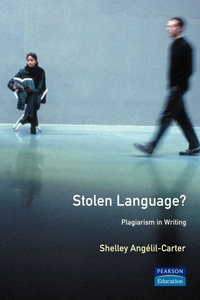
Stolen Language?
Plagiarism in Writing
2nd Edition
Published on 24. May 2000
Book
Paperback/Softback
160 pages
978-0-582-31999-8 (ISBN)
Description
'Stolen Language?' uncovers the reasons why students plagiarize, and explains what can be done about it. It challenges the concepts of original authorship and ownership of language and shows that plagiarism is a complex and contested subject.
Reviews / Votes
'By taking what may appear to be an uncontested, 'natural' concept, plagiarism, and teasing out its contradictions, this author provides useful insights for sociolinguists.' Gail Stygall, University of Washington, Journal of Sociolinguistics 6/3, 2002.More details
Series
Edition
2. Auflage
Language
English
Place of publication
London
United Kingdom
Publishing group
Taylor & Francis Ltd
Target group
Professional and scholarly
Dimensions
Height: 234 mm
Width: 156 mm
Thickness: 9 mm
Weight
251 gr
ISBN-13
978-0-582-31999-8 (9780582319998)
Copyright in bibliographic data and cover images is held by Nielsen Book Services Limited or by the publishers or by their respective licensors: all rights reserved.
Schweitzer Classification
Other editions
Additional editions
Book
01/2017
1st Edition
Routledge
€205.80
Shipment within 10-20 days
E-Book
06/2014
1st Edition
Routledge
€92.49
Available for download
E-Book
06/2014
1st Edition
Routledge
€92.49
Available for download
Person
Shelley Angelil-Carter is a freelance writer and lecturer based in South Africa.
Content
Acknowledgements
1. Introduction: An Overture
PART I: DANCING A THEORETICAL STANCE
2. Discourses and Access: Dancers in the Wings
3. Plagiarism, "Originality" and Copyright: A Striptease
4. Plagiarism and Referencing Across Genres: Different moves to different tunes
5. The development of the student writer: from mimic to master
PART II: A MULTIVOICED TEXT: THE CHORUS
6. Introduction to Part II
7. Plagiarism and referencing as communicated in a departmental handbook: a discourse analysis
8. The Role of Referencing
9. Consequences of the practice of referencing and the monitoring of plagiarism
10. Plagiarism in the developing writer - what's really happening?
11. Developing authorial voice using multiple sources - difficulties and successes
PART III: CONCLUSION
12. A pedagogy for plagiarism and referencing: a finale
Appendix 1: A Collaborative Research Process
Appendix 2: Previous Educational Writing Experience
Appendix 3: Outline of Interview Questions
Appendix 4: Quotations from The Council Chronicle
References
1. Introduction: An Overture
PART I: DANCING A THEORETICAL STANCE
2. Discourses and Access: Dancers in the Wings
3. Plagiarism, "Originality" and Copyright: A Striptease
4. Plagiarism and Referencing Across Genres: Different moves to different tunes
5. The development of the student writer: from mimic to master
PART II: A MULTIVOICED TEXT: THE CHORUS
6. Introduction to Part II
7. Plagiarism and referencing as communicated in a departmental handbook: a discourse analysis
8. The Role of Referencing
9. Consequences of the practice of referencing and the monitoring of plagiarism
10. Plagiarism in the developing writer - what's really happening?
11. Developing authorial voice using multiple sources - difficulties and successes
PART III: CONCLUSION
12. A pedagogy for plagiarism and referencing: a finale
Appendix 1: A Collaborative Research Process
Appendix 2: Previous Educational Writing Experience
Appendix 3: Outline of Interview Questions
Appendix 4: Quotations from The Council Chronicle
References