

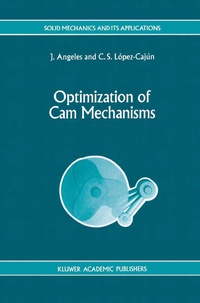
Optimization of Cam Mechanisms
Published on 31. August 1991
Book
Hardback
XV, 259 pages
978-0-7923-1355-7 (ISBN)
Description
1. 1 Preliminary Concepts A cam mechanism is a mechanical system consisting of three basic components: a driving element, called the cam; a driven element, termed the follower; and a fixed frame. Sometimes, an intermediate element is introduced between the cam and the follower with the purpose of improving the mechanism performance. This element is called the roller because function is to produce a pure-rolling relative motion be tween the cam and the follower. The purpose ofa cam mechanism is the transmission of power or information. In applications concerning power transmission, the main good to be transmitted is force or torque; in applications ofinformation transmission, the main good transmitted takes the form of motion signals. Most modern appli cations of cam mechanisms, to be described shortly, are of the former type. Cam mechanisms used for information transmission were traditionally found in measuring instruments. With the advent ofmodern microprocessor-based hardware, this typeof application is becoming less common. Nevertheless, cam mechanisms are still used in a wide spectrum of applications, especially in automatic machines and instruments, textile machinery, computers, printing presses, food-processing equipment, internal combustion engines, control systems, and photographic equipment (Prenzel, 1989). In the design of cam mechanisms, the engineer performs several activities, namely, task definition, synthesis, analysis, optimization, and dynamic simulation. These tasks do not always follow this order. In fact, some loops may appear in the foregoing tasks, such as those illustrated in Fig. 1. 1. 1.
Reviews / Votes
' It is an excellent reference book, which should be valuable for design engineers and libraries of technical books. ' Appl. Mech. Rev. 45:9 1992More details
Series
Edition
1991 ed.
Language
English
Place of publication
Dordrecht
Netherlands
Target group
College/higher education
Professional and scholarly
Research
Illustrations
XV, 259 p.
Dimensions
Height: 241 mm
Width: 160 mm
Thickness: 20 mm
Weight
588 gr
ISBN-13
978-0-7923-1355-7 (9780792313557)
DOI
10.1007/978-94-011-3572-6
Schweitzer Classification
Other editions
Additional editions
J. Angeles | C.S. López-Cajún
Optimization of Cam Mechanisms
Book
10/2012
Springer
€213.99
Shipment within 15-20 days
Content
1 Introduction.- 2 The Displacement Program.- 3 Cam Profile Geometry.- 4 Optimization of Planar Cam Mechanisms with Flat-Face Followers.- 5 Optimization of Planar Cam Mechanisms with Roller-Followers.- 6 An Introduction to Spatial Cams.- 7 Kinematic Analysis of Cam Mechanisms.- 8 Computation of The Geometric Properties of Cams.- 9 The Computer-Aided Drafting and Manufacture of Cams.- References.- Appendix A Polynomial Coefficients.- Appendix B Review Problems.- 1. Introduction.- 2. Review Problems.