

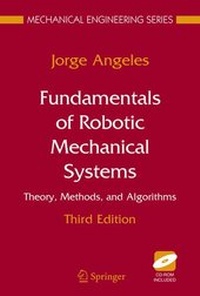
Fundamentals of Robotic Mechanical Systems
Theory, Methods, and Algorithms
3rd Edition
Published on 4. December 2006
Book
Hardback
XXVI, 550 pages
978-0-387-29412-4 (ISBN)
Description
Modern robotics dates from the late 1960s, when progress in the development of microprocessors made possible the computer control of a multiaxial manipulator. Since then, robotics has evolved to connect with many branches of science and engineering, and to encompass such diverse fields as computer vision, artificial intelligence, and speech recognition.
This book deals with robots-such as remote manipulators, multifingered hands, walking machines, flight simulators, and machine tools-that rely on mechanical systems to perform their tasks. It aims to establish the foundations on which the design, control and implementation of the underlying mechanical systems are based. The treatment assumes familiarity with some calculus, linear algebra, and elementary mechanics; however, the elements of rigid-body mechanics and of linear transformations are reviewed in the first chapters, making the presentation self-contained. An extensive set of exercises is included.
Topics covered include: kinematics and dynamics of serial manipulators with decoupled architectures; trajectory planning; determination of the angular velocity and angular acceleration of a rigid body from point data; inverse and direct kinematics manipulators; dynamics of general parallel manipulators of the platform type; and the kinematics and dynamics of rolling robots. Since the publication of the previous edition there have been numerous advances in both the applications of robotics (including in laprascopy, haptics, manufacturing, and most notably space exploration) as well as in the theoretical aspects (for example, the proof that Husty's 40th-degree polynomial is indeed minimal - mentioned as an open question in the previous edition). This new edition has been revised and updated throughout to include these new
Reviews / Votes
From the reviews of the third edition:
"The principal aim of this book is to serve as a textbook for a robotics course and as a reference for practicing engineers. It may be used also by an audience that ranges from junior undergraduates to doctoral students. . the book has the nice feature that the different chapters are quite independent and may serve as a guide to various important problems in robotics. Each chapter offers a lot of examples and exercises, which is the most significant . of the book." (Clementina D. Mladenova, Mathematical Reviews, Issue 2009 c)
More details
Series
Edition
3rd ed. 2007
Language
English
Place of publication
New York
United States
Target group
Professional and scholarly
Graduate
Edition type
Revised edition
Product notice
Laminated cover
Illustrations
XXVI, 550 p.
1, black & white illustrations
Dimensions
Height: 23.5 cm
Width: 15.5 cm
Thickness: 31 mm
Weight
2160 gr
ISBN-13
978-0-387-29412-4 (9780387294124)
DOI
10.1007/978-0-387-34580-2
Schweitzer Classification
Other editions
New editions
Book
12/2013
4th Edition
Springer
€139.09
Shipment within 10-15 days
Previous edition
Book
10/2002
2nd Edition
Springer
€85.59
Article exhausted; check for reprint
Content
An Overview of Robotic Mechanical Systems.- Mathematical Background.- Fundamentals of Rigid-Body Mechanics.- Geometry of Decoupled Serial Robots.- Kinetostatics of Serial Robots.- Trajectory Planning: Pick-and-Place Operations.- Dynamics of Serial Robotic Manipulators.- Special Topics in Rigid-Body Kinematics.- Geometry of General Serial Robots.- Kinematics of Alternative Robotic Mechanical Systems.- Trajectory Planning: Continuous-Path Operations.- Dynamics of Complex Robotic Mechanical Systems.