

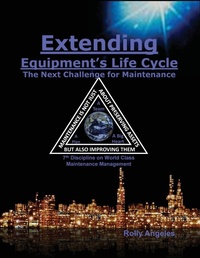
Extending Equipment's Life Cycle - The Next Challenge for Maintenance
7th Discipline on World Class Maintenance Management
7th Edition
Published on 31. July 2022
Book
Paperback/Softback
340 pages
979-8-88526-007-7 (ISBN)
Description
The objective of any maintenance program in industries is to take care of the Equipment's Total Life Cycle at the most reasonable cost with compliance to quality, safety, and the environment. To perform this we need the following;
Upgrade the skills and knowledge of our maintenance people
Sustain equipment reliability by doing the correct maintenance
Improve design weaknesses in the equipment
Reduced the cost of doing maintenance
This means that before we can even sustain and preserve our equipment and assets, we need to provide our maintenance people with the knowledge to develop their skills to do their job correctly, but it does not stop from here. Sustaining and preserving the equipment is merely the beginning. Maintenance must also understand their equipment, especially on those parts, spares, and items with inherent design weaknesses, and improve them. Doing this will definitely reduce the cost of doing maintenance.
This book is written based on the Author's personal experience on how to make it possible to extend the Total Life Cycle of the equipment so that we can operate and maintain them at the least amount to own the asset. The study of the life cycle is simply the sum of both the Initial and the Running Cost of the equipment. While the initial cost is easy to see as it is always given, the running cost is not but it can still be projected. This book also explains how to integrate the pillar of TPM IFCA or Initial Flow Control Activities to shorten the vertical start-up time of the equipment. Some of the highlights of this book include the following;
Why Life Cycle Costing is Important for Industries
No Equipment is Perfect by Design
Why Equipment Can No Longer be Used?
The Six Conditions for Equipment's Initial Flow Control Activities
Why Cheap Is Expensive
Why Do Equipment fail and What Can be Done About It?
Human Errors Explained
When Maintenance Errors Cost Lives
Maintenance and Non-Maintenance Errors
Reducing Human Errors in Maintenance
Strategies to Reduce Equipment's Maintenance Costs
A Deeper Meaning of Reliability
Why Reliability is Everybody's Responsibility
Difference Between the East and the West Approach to Improvements
Industries Problems Can Go Beyond Equipment Losses
Detailed Steps in Monitoring Equipment Life Cycle
Cost Cutting the Wrong Way to Save on Maintenance Costs
The Challenge with Maintenance
And More . . .
More details
Series
Edition
7th Discipline on World Class Maintenance Management ed.
Language
English
Product notice
Paperback (trade)
Unsewn / adhesive bound
Dimensions
Height: 280 mm
Width: 216 mm
Thickness: 19 mm
Weight
857 gr
ISBN-13
979-8-88526-007-7 (9798885260077)
Copyright in bibliographic data and cover images is held by Nielsen Book Services Limited or by the publishers or by their respective licensors: all rights reserved.
Schweitzer Classification
Person
Rolly is a seasoned international maintenance and reliability consultant with over 30 years of solid experience in the field. He has been invited to different countries and has conducted reliability and maintenance training in United Arab Emirates, Qatar, India, Malaysia, Indonesia, Brunei, Thailand, Nigeria, Bangladesh, South Africa, China, and Botswana. His maintenance training portfolio includes maintenance and reliability courses on TPM, Lubrication, Tribology, Condition-Based Maintenance, RCM, RCFA, TPM Planned Maintenance, Autonomous Maintenance 7 Steps, World Class Maintenance Management, The 12 Disciplines, Oil Contamination Control, Maintenance Indices, and KPI's, Maintenance and Reliability Management Strategies and much more. Rolly previously worked with Amkor Technology Philippines as a TPM Senior Engineer, an industry engaged in manufacturing Integrated Circuit products and spearheaded their Planned Maintenance organization, composed of maintenance managers and engineers. He was also responsible for dramatically reducing unplanned breakdowns in their TPM Journey and RCM implementation on their Facilities AHU units and substation equipment.
Rolly is currently working as an independent reliability and maintenance consultant. Rolly is a graduate of Mechanical Engineering from Mapua Institute of Technology in the Philippines, batch 1985, and passed the licensure board examination the following year in 1986. With 30 years of solid experience, he had worked in various industries from shipping, woodworking, foundry, cast-iron machining, assembly lines, semiconductor manufacturing, and the mining industry. Here, he gained hands-on experience and understanding of TPM and RCM, respectively, a strategy from both the west and the east. His last corporate employment was in 2002, where he worked as a technical training specialist at Lepanto Consolidated Mining Industry. In 2005, Rolly retired early from the industry and decided to establish his own consulting business, RSA Reliability and Maintenance Consultancy Firm, where he dedicates his time and passion for working as an independent reliability and maintenance consultant. He provides in-house training, consultation, and facilitation to different maintenance and reliability best practices.