

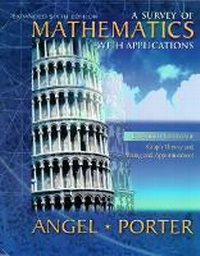
A Survey of Mathematics with Applications
Expanded Sixth Edition
6th Edition
Published on 3. April 2001
Book
Hardback
837 pages
978-0-201-70308-5 (ISBN)
Description
This expanded sixth edition of the Angel/Porter text contains two additional chapters, "Graph Theory" and "Voting and Apportionment". This best-selling text balances solid mathematical coverage with a comprehensive overview of mathematical ideas as they relate to varied disciplines. This text provides an appreciation of mathematics, highlighting mathematical history, applications of mathematics to the arts and sciences across cultures and introduces students to the uses of technology in mathematics. It is an ideal book for students who require a general overview of mathematics, especially those majoring in the liberal arts, elementary education, the social sciences, business, nursing and allied health fields.
More details
Edition
6th edition
Language
English
Place of publication
United States
Publishing group
Pearson Education (US)
Target group
Professional and scholarly
Weight
1000 gr
ISBN-13
978-0-201-70308-5 (9780201703085)
Copyright in bibliographic data and cover images is held by Nielsen Book Services Limited or by the publishers or by their respective licensors: all rights reserved.
Schweitzer Classification
Other editions
New editions
Allen R. Angel | Christine D. Abbott | Dennis Runde
A Survey of Mathematics with Applications
Expanded Edition
Book
03/2004
7th Edition
Pearson
€54.46
Article exhausted; check for reprint
Content
(All chapters conclude with a "Chapter Summary", "Review Exercises", a "Chapter Test", and "Group Projects".)
1. Critical Thinking Skills.
Inductive Reasoning.
Estimation.
Problem Solving.
2. Sets.
Set Concepts.
Subsets.
Venn Diagrams and Set Operations.
Venn Diagrams with Three Sets and Verification of Equality of Sets.
Applications of Sets.
Infinite Sets.
3. Logic.
Statements and Logical Connectives.
Truth Tables for Negation, Conjunction, and Disjunction.
Truth Tables for the Conditional and Biconditional.
Equivalent Statements.
Symbolic Arguments.
Euler Diagrams and Syllogistic Arguments.
4. Systems of Numeration.
Additive, Multiplicative, and Ciphered Systems of Numeration.
Place-Value or Positional-Value Numeration Systems.
Other Bases.
Computation in Other Bases.
Early Computational Methods.
5. Number Theory and The Real Number System.
Number Theory.
The Integers.
The Rational Numbers.
The Irrational Numbers and the Real Number System.
Real Numbers and Their Properties.
Rules of Exponents and Scientific Notation.
Arithmetic and Geometric Sequences.
Fibonacci Sequence.
6. Algebra, Graphs, and Functions.
Order of Operations.
Linear Equations in One Variable.
Formulas.
Applications of Linear Equations in One Variable.
Variation.
Linear Inequalities.
Graphing Linear Equations.
Linear Inequalities in Two Variables.
Solving Quadratic Equations by Using Factoring and by Using the Quadratic Formula.
Functions and Their Graphs.
7. Systems of Linear Equations and Inequalities.
Systems of Linear Equations.
Solving Systems of Equations by the Substitution and Addition Methods.
Matrices.
Solving Systems of Equations by Using Matrices.
Systems of Linear Inequalities.
Linear Programming.
8. The Metric System.
Basic Terms and Conversions within the Metric System.
Length, Area, and Volume.
Mass and Temperature.
Dimensional Analysis and Conversions To and from the Metric System.
9. Geometry.
Points, Lines, Planes, and Angles.
Polygons.
Perimeter and Area.
Volume.
The Moebius Strip, Klein Bottle, and Maps.
Non-Euclidean Geometry and Fractal Geometry.
10. Mathematical Systems.
Groups.
Finite Mathematical Systems.
Modular Arithmetic.
11. Consumer Mathematics.
Percent.
Personal Loans and Simple Interest.
Compound Interest.
Installment Buying.
Buying a House with a Mortgage.
12. Probability.
The Nature of Probability.
Theoretical Probability.
Odds.
Expected Value (Expectation).
Tree Diagrams.
Or and And Problems.
Conditional Probability.
The Counting Principle and Permutations.
Combinations.
Solving Probability Problems by Using Combinations.
Binomial Probability Formula.
13. Statistics.
Sampling Techniques.
The Misuses of Statistics.
Frequency Distributions.
Statistical Graphs.
Measures of Central Tendency.
Measures of Dispersion.
The Normal Curve.
Linear Correlation and Regression.
14. Graph Theory.
Graphs, Paths, and Circuits.
Euler Paths and Euler Circuits.
Hamilton Paths and Hamilton Circuits.
Trees.
15. Voting and Apportionment.
Voting Systems.
Flaws of Voting.
Apportionment Methods.
Flaws of the Apportionment Methods.
1. Critical Thinking Skills.
Inductive Reasoning.
Estimation.
Problem Solving.
2. Sets.
Set Concepts.
Subsets.
Venn Diagrams and Set Operations.
Venn Diagrams with Three Sets and Verification of Equality of Sets.
Applications of Sets.
Infinite Sets.
3. Logic.
Statements and Logical Connectives.
Truth Tables for Negation, Conjunction, and Disjunction.
Truth Tables for the Conditional and Biconditional.
Equivalent Statements.
Symbolic Arguments.
Euler Diagrams and Syllogistic Arguments.
4. Systems of Numeration.
Additive, Multiplicative, and Ciphered Systems of Numeration.
Place-Value or Positional-Value Numeration Systems.
Other Bases.
Computation in Other Bases.
Early Computational Methods.
5. Number Theory and The Real Number System.
Number Theory.
The Integers.
The Rational Numbers.
The Irrational Numbers and the Real Number System.
Real Numbers and Their Properties.
Rules of Exponents and Scientific Notation.
Arithmetic and Geometric Sequences.
Fibonacci Sequence.
6. Algebra, Graphs, and Functions.
Order of Operations.
Linear Equations in One Variable.
Formulas.
Applications of Linear Equations in One Variable.
Variation.
Linear Inequalities.
Graphing Linear Equations.
Linear Inequalities in Two Variables.
Solving Quadratic Equations by Using Factoring and by Using the Quadratic Formula.
Functions and Their Graphs.
7. Systems of Linear Equations and Inequalities.
Systems of Linear Equations.
Solving Systems of Equations by the Substitution and Addition Methods.
Matrices.
Solving Systems of Equations by Using Matrices.
Systems of Linear Inequalities.
Linear Programming.
8. The Metric System.
Basic Terms and Conversions within the Metric System.
Length, Area, and Volume.
Mass and Temperature.
Dimensional Analysis and Conversions To and from the Metric System.
9. Geometry.
Points, Lines, Planes, and Angles.
Polygons.
Perimeter and Area.
Volume.
The Moebius Strip, Klein Bottle, and Maps.
Non-Euclidean Geometry and Fractal Geometry.
10. Mathematical Systems.
Groups.
Finite Mathematical Systems.
Modular Arithmetic.
11. Consumer Mathematics.
Percent.
Personal Loans and Simple Interest.
Compound Interest.
Installment Buying.
Buying a House with a Mortgage.
12. Probability.
The Nature of Probability.
Theoretical Probability.
Odds.
Expected Value (Expectation).
Tree Diagrams.
Or and And Problems.
Conditional Probability.
The Counting Principle and Permutations.
Combinations.
Solving Probability Problems by Using Combinations.
Binomial Probability Formula.
13. Statistics.
Sampling Techniques.
The Misuses of Statistics.
Frequency Distributions.
Statistical Graphs.
Measures of Central Tendency.
Measures of Dispersion.
The Normal Curve.
Linear Correlation and Regression.
14. Graph Theory.
Graphs, Paths, and Circuits.
Euler Paths and Euler Circuits.
Hamilton Paths and Hamilton Circuits.
Trees.
15. Voting and Apportionment.
Voting Systems.
Flaws of Voting.
Apportionment Methods.
Flaws of the Apportionment Methods.