

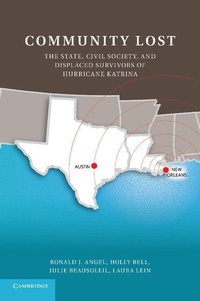
Community Lost
The State, Civil Society, and Displaced Survivors of Hurricane Katrina
Published on 20. February 2014
Book
Paperback/Softback
250 pages
978-0-521-17616-3 (ISBN)
Description
Neither government programs nor massive charitable efforts responded adequately to the human crisis that was Hurricane Katrina. In this study, the authors use extensive interviews with Katrina evacuees and reports from service providers to identify what helped or hindered the reestablishment of the lives of hurricane survivors who relocated to Austin, Texas. Drawing on social capital and social network theory, the authors assess the complementary, and often conflicting, roles of FEMA, other governmental agencies and a range of non-governmental organizations in addressing survivors' short- and longer-term needs. While these organizations came together to assist with immediate emergency needs, even collectively they could not deal with survivors' long-term needs for employment, affordable housing and personal records necessary to rebuild lives. Community Lost provides empirical evidence that civil society organizations cannot substitute for an efficient and benevolent state, which is necessary for society to function.
Reviews / Votes
'The authors of Community Lost provide a timely and stimulating analysis of the social costs of welfare state retrenchment. Their detailed study of Katrina survivors displaced in Austin, Texas (whose experience they plausibly argue is representative of other survivors), provides a powerful indictment of the human suffering wrought by the retrenchment of the welfare state. Likewise they show the bankruptcy and inadequacy of private, nonprofit efforts to meet human need in a disaster, despite their good intentions. In this cautionary tale, the authors also provide a glimpse of the human toll that will be produced if the current bipartisan effort to slash the last remnants of the welfare state is implemented.' John Arena, Social Service Review 'Highly recommended.' ChoiceMore details
Language
English
Place of publication
Cambridge
United Kingdom
Target group
College/higher education
Professional and scholarly
Product notice
Paperback (trade)
Illustrations
2 Line drawings, unspecified
Dimensions
Height: 229 mm
Width: 152 mm
Thickness: 14 mm
Weight
368 gr
ISBN-13
978-0-521-17616-3 (9780521176163)
Copyright in bibliographic data and cover images is held by Nielsen Book Services Limited or by the publishers or by their respective licensors: all rights reserved.
Schweitzer Classification
Other editions
Additional editions
Ronald J. Angel | Holly Bell | Julie Beausoleil
Community Lost
The State, Civil Society, and Displaced Survivors of Hurricane Katrina
E-Book
04/2012
1st Edition
Cambridge University Press
€26.49
Available for download
Ronald J. Angel | Holly Bell | Julie Beausoleil
Community Lost
The State, Civil Society, and Displaced Survivors of Hurricane Katrina
Book
03/2012
Cambridge University Press
€72.40
Shipment within 15-20 days
Persons
Ronald J. Angel is Professor of Sociology at the University of Texas, Austin. Holly Bell is Research Scientist at the Center for Social Work Research in the School of Social Work at the University of Texas, Austin. Julie Beausoleil is an Affiliate Research Associate with the Center for Social Work Research in the School of Social Work at the University of Texas Austin. Laura Lein is Dean and Katherine Reebel Collegiate Professor of Social Work and Professor of Anthropology at the University of Michigan.
Content
1. After the storm: the state, civil society, and the response to Katrina; 2. An emerging methodology for a crisis situation; 3. Life before the storm: the old community; 4. Evacuation and arrival in Austin; 5. The limited transportability of social capital; 6. NGOs and the grassroots response; 7. The state and basic welfare: housing, employment, and identification; 8. Health care and the limitations of society; 9. The new social contract: the state, civil society, and social capital.