

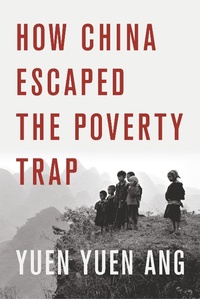
How China Escaped the Poverty Trap
Published on 6. September 2016
Book
Hardback
344 pages
978-1-5017-0020-0 (ISBN)
Description
WINNER OF THE 2017 PETER KATZENSTEIN BOOK PRIZE
"BEST OF BOOKS IN 2017" BY FOREIGN AFFAIRS
WINNER OF THE 2018 VIVIAN ZELIZER PRIZE BEST BOOK AWARD IN ECONOMIC SOCIOLOGY
"How China Escaped the Poverty Trap truly offers game-changing ideas for the analysis and implementation of socio-economic development and should have a major impact across many social sciences."
- Zelizer Best Book in Economic Sociology Prize Committee
Acclaimed as "game changing" and "field shifting," How China Escaped the Poverty Trap advances a new paradigm in the political economy of development and sheds new light on China's rise.
How can poor and weak societies escape poverty traps? Political economists have traditionally offered three answers: "stimulate growth first," "build good institutions first," or "some fortunate nations inherited good institutions that led to growth."
Yuen Yuen Ang rejects all three schools of thought and their underlying assumptions: linear causation, a mechanistic worldview, and historical determinism. Instead, she launches a new paradigm grounded in complex adaptive systems, which embraces the reality of interdependence and humanity's capacity to innovate.
Combining this original lens with more than 400 interviews with Chinese bureaucrats and entrepreneurs, Ang systematically reenacts the complex process that turned China from a communist backwater into a global juggernaut in just 35 years. Contrary to popular misconceptions, she shows that what drove China's great transformation was not centralized authoritarian control, but "directed improvisation"-top-down directions from Beijing paired with bottom-up improvisation among local officials.
Her analysis reveals two broad lessons on development. First, transformative change requires an adaptive governing system that empowers ground-level actors to create new solutions for evolving problems. Second, the first step out of the poverty trap is to "use what you have"-harnessing existing resources to kick-start new markets, even if that means defying first-world norms.
Bold and meticulously researched, How China Escaped the Poverty Trap opens up a whole new avenue of thinking for scholars, practitioners, and anyone seeking to build adaptive systems.
"BEST OF BOOKS IN 2017" BY FOREIGN AFFAIRS
WINNER OF THE 2018 VIVIAN ZELIZER PRIZE BEST BOOK AWARD IN ECONOMIC SOCIOLOGY
"How China Escaped the Poverty Trap truly offers game-changing ideas for the analysis and implementation of socio-economic development and should have a major impact across many social sciences."
- Zelizer Best Book in Economic Sociology Prize Committee
Acclaimed as "game changing" and "field shifting," How China Escaped the Poverty Trap advances a new paradigm in the political economy of development and sheds new light on China's rise.
How can poor and weak societies escape poverty traps? Political economists have traditionally offered three answers: "stimulate growth first," "build good institutions first," or "some fortunate nations inherited good institutions that led to growth."
Yuen Yuen Ang rejects all three schools of thought and their underlying assumptions: linear causation, a mechanistic worldview, and historical determinism. Instead, she launches a new paradigm grounded in complex adaptive systems, which embraces the reality of interdependence and humanity's capacity to innovate.
Combining this original lens with more than 400 interviews with Chinese bureaucrats and entrepreneurs, Ang systematically reenacts the complex process that turned China from a communist backwater into a global juggernaut in just 35 years. Contrary to popular misconceptions, she shows that what drove China's great transformation was not centralized authoritarian control, but "directed improvisation"-top-down directions from Beijing paired with bottom-up improvisation among local officials.
Her analysis reveals two broad lessons on development. First, transformative change requires an adaptive governing system that empowers ground-level actors to create new solutions for evolving problems. Second, the first step out of the poverty trap is to "use what you have"-harnessing existing resources to kick-start new markets, even if that means defying first-world norms.
Bold and meticulously researched, How China Escaped the Poverty Trap opens up a whole new avenue of thinking for scholars, practitioners, and anyone seeking to build adaptive systems.
Reviews / Votes
China's transformation cannot be attributed to a single cause; rather, it arose from a contingent, interactive process-Ang calls it 'directed improvisation.' She formalizes this insight which has the potential to influence future studies of institutional and economic change beyond China.(Foreign Affairs) While adaptive approaches to development have become new buzzwords, Yuen Yuen's work brings rigor to this conversation.... This analytical lens has enormous potential for thinking through the adaptive challenge, whether at the national level, subnational level or sectoral level.
(The World Bank) The book combines methodological rigour, employing a complexity perspective hitherto unknown in standard political economy analyses... with rich original empirical data drawn from more than 400 interviews.... This is an important book with a bold thesis that, at its most ambitious, demands a rethinking of the history and evolution of capitalism.... In terms of policy implications, Ang's thesis has the potential to upend much that the global development establishment holds dear.
(The Straits Times) How China Escaped the Poverty Trap... is an original and insightful take on what is perhaps the biggest development puzzle of my lifetime.
(Building State Capability Blog) This book is a triumph, opening a window onto the political economy of China's astonishing rise that takes as its starting point systems and complexity. Its lessons apply far beyond China's borders.
(Oxfam Blog) Ang provides specialists and nonspecialists alike with a fresh inside-the-black-box account of how the Chinese state... has actually practiced (not merely preached) innovation, problem solving, and effective implementation.... Future studies of bureaucratic life in China and elsewhere must reckon seriously with Ang's account.
(Governance) As if explaining modern Chinese economic development was not enough of a challenge, Ang has two even loftier goals. The first is methodological. She expresses a frustration with political science's causality obsession and modeling approaches that deliver isolated snapshots of complex processes.... Ang's second ambition is to apply this coevolutionary schema to how we understand economic development generally.
(Perspectives on Politics) This book is an invaluable addition to the scholarship on the political economy of development.
(Pacific Affairs) How China Escaped the Poverty Trap is an innovative account to explain why China has economically developed in spite - or because - of its low-quality institutions. It is both a theoretically original and empirically rich study of Chinese economic development and required reading for those who want to understand China's and our own future.
(VoegelinView) The author has certainly filled the gaps in the literature on the political-economic analysis of China's historic transformation from a low-income to a middle-income country through adoption of a co-evolutionary approach to development. Overall, this interesting book goes deeper beneath the broad political-economic surface of Chinese society. It should appeal not only to researchers on Chinese society, but also to practising political economists.
(Ecoomic Record)
More details
Series
Language
English
Place of publication
Ithaca
United States
Product notice
Paper over boards
Illustrations
11 halftones, 1 map, 15 tables, 24 charts - 11 Halftones, black and white
Dimensions
Height: 236 mm
Width: 159 mm
Thickness: 27 mm
Weight
642 gr
ISBN-13
978-1-5017-0020-0 (9781501700200)
Copyright in bibliographic data and cover images is held by Nielsen Book Services Limited or by the publishers or by their respective licensors: all rights reserved.
Schweitzer Classification
Other editions
Additional editions
Yuen Yuen Ang
How China Escaped the Poverty Trap
E-Book
09/2016
Cornell University Press
€21.49
Available for download
Person
Yuen Yuen Ang is an Andrew Carnegie Fellow and the inaugural recipient of the Theda Skocpol Prize for Emerging Scholar, awarded by the American Political Science Association.
Content
Introduction: How Did Development Actually Happen?
Part 1 FRAMEWORK AND BUILDING BLOCKS
1. Mapping Coevolution
2. Directed Improvisation
Part 2 DIRECTION
3. Balancing Variety and Uniformity
4. Franchising the Bureaucracy
Part 3 IMPROVISATION
5. From Building to Preserving Markets
6. Connecting First Movers and Laggards
Conclusion: How Development Actually Happened Beyond China
Appendix A: Steps for Mapping Coevolution
Appendix B: Interviews
Part 1 FRAMEWORK AND BUILDING BLOCKS
1. Mapping Coevolution
2. Directed Improvisation
Part 2 DIRECTION
3. Balancing Variety and Uniformity
4. Franchising the Bureaucracy
Part 3 IMPROVISATION
5. From Building to Preserving Markets
6. Connecting First Movers and Laggards
Conclusion: How Development Actually Happened Beyond China
Appendix A: Steps for Mapping Coevolution
Appendix B: Interviews