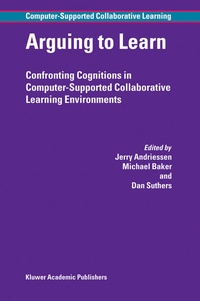
Arguing to Learn: Confronting Cognitions in Computer-Supported Collaborative Learning Environments
focuses on how new pedagogical scenarios, task environments and communication tools within Computer-Supported Collaborative Learning (CSCL) environments can favour collaborative and productive confrontations of ideas, evidence, arguments and explanations, or
arguing to learn
.
This book is the first that has assembled the work of internationally renowned scholars on argumentation-related CSCL research. All chapters present in-depth analyses of the processes by which the interactive confrontation of cognitions can lead to collaborative learning, on the basis of a wide variety of theoretical models, empirical data and Internet-based tools.
Series
Edition
Language
Place of publication
Target group
Professional and scholarly
Research
Illustrations
Dimensions
Height: 241 mm
Width: 160 mm
Thickness: 20 mm
Weight
ISBN-13
978-1-4020-1382-9 (9781402013829)
DOI
10.1007/978-94-017-0781-7
Schweitzer Classification
Table of Contens.- 1 Argumentation, Computer Support, and the Educational Context of Confronting Cognitions.- 2 Representational Guidance for Collaborative Inquiry.- 3 Computer-Mediated Argumentative Interactions for the Co-Elaboration of Scientific Notions.- 4 Argumentation as Negotiation in Electronic Collaborative Writing.- 5 Constructive Discussions through Electronic Dialogue.- 6 Using CMC to Develop Argumentation Skills in Children with a 'Literacy Deficit'.- 7 Designing External Representations to Support Solving Wicked Problems.- 8 Elaborating New Arguments through a CSCL Script.- 9 The Blind and the Paralytic: Supporting Argumentation in Everyday and Scientific Issues.- 10 CSCL, Argumentation, and Deweyan Inquiry: Argumentation is Learning.