

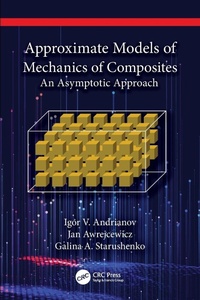
Approximate Models of Mechanics of Composites
An Asymptotic Approach
1st Edition
Published on 26. June 2025
Book
Paperback/Softback
351 pages
978-1-032-48834-9 (ISBN)
Description
Approximate Models of Mechanics of Composites: An Asymptotic Approach is an essential guide to constructing asymptotic models and mathematical methods to correctly identify the mechanical behavior of composites. It provides methodology for predicting and evaluating composite behavior in various structures, leading to accurate mathematical and physical assessments.
The book estimates the error of approximations through comparing asymptotic solutions with the results of numerical and analytical solutions to gain a holistic view of the data. The authors have developed asymptotic models based on mathematical and physical rigorous approaches, which include three-phase models of fibrous composites, a modernized three-phase composite model with cylindrical inclusions, and models of two-dimensional composites of hexagonal structure. Also covered are two-phase models of composites related to the Maxwell formula and a percolation transition model for elastic problems based on the self-consistency method and Pade approximations. By obtaining analytical expressions to effectively characterize composite materials, their physical and geometric parameters can be accurately assessed.
This book suits engineers and students working in material science, mechanical engineering, physics, and mathematics, as well as composite materials in industries such as construction, transport, aerospace, and chemical engineering.
The book estimates the error of approximations through comparing asymptotic solutions with the results of numerical and analytical solutions to gain a holistic view of the data. The authors have developed asymptotic models based on mathematical and physical rigorous approaches, which include three-phase models of fibrous composites, a modernized three-phase composite model with cylindrical inclusions, and models of two-dimensional composites of hexagonal structure. Also covered are two-phase models of composites related to the Maxwell formula and a percolation transition model for elastic problems based on the self-consistency method and Pade approximations. By obtaining analytical expressions to effectively characterize composite materials, their physical and geometric parameters can be accurately assessed.
This book suits engineers and students working in material science, mechanical engineering, physics, and mathematics, as well as composite materials in industries such as construction, transport, aerospace, and chemical engineering.
More details
Language
English
Place of publication
London
United Kingdom
Publishing group
Taylor & Francis Ltd
Target group
College/higher education
Professional and scholarly
Postgraduate, Professional Practice & Development, and Professional Reference
Illustrations
269 s/w Abbildungen, 269 s/w Zeichnungen, 26 s/w Tabellen
26 Tables, black and white; 269 Line drawings, black and white; 269 Illustrations, black and white
Dimensions
Height: 234 mm
Width: 156 mm
Thickness: 20 mm
Weight
559 gr
ISBN-13
978-1-032-48834-9 (9781032488349)
Copyright in bibliographic data and cover images is held by Nielsen Book Services Limited or by the publishers or by their respective licensors: all rights reserved.
Schweitzer Classification
Other editions
Additional editions
Igor V. Andrianov | Jan Awrejcewicz | Galina A. Starushenko
Approximate Models of Mechanics of Composites
An Asymptotic Approach
Book
06/2023
1st Edition
CRC Press
€176.90
Shipment within 10-20 days
Igor V. Andrianov | Jan Awrejcewicz | Galina A. Starushenko
Approximate Models of Mechanics of Composites
An Asymptotic Approach
E-Book
06/2023
1st Edition
CRC Press
€56.49
Available for download
Igor V. Andrianov | Jan Awrejcewicz | Galina A. Starushenko
Approximate Models of Mechanics of Composites
An Asymptotic Approach
E-Book
06/2023
1st Edition
CRC Press
€56.49
Available for download
Persons
Igor Andrianov is currently at RWTH Aachen University, Germany, and has 25 years of experience in mathematics, applied mechanics and mechanics of solids. His research interests include asymptotic approaches, nonlinear dynamics, composite materials, and theory of plates and shells.
Jan Awrejcewicz is Head of the Department of Automation, Biomechanics and Mechatronics at Lodz University of Technology. His research interests lie in the area of mechanics, materials science, biomechanics, applied mathematics, with a main focus of nonlinear processes. He is author of over 1,000 papers and 55 books. He is Editor-in-Chief of 3 international journals and member of the Editorial Boards of 90 international journals.
Galina Starushenko gained her Ph.D. in Structural Mechanics. She is now Professor of Information Technology and Information Systems at Dnipro University of Technology, Ukraine. She has 38 years of research experience in applied mathematics and solid mechanics. Her research interests include asymptotic approaches and composite materials.
Jan Awrejcewicz is Head of the Department of Automation, Biomechanics and Mechatronics at Lodz University of Technology. His research interests lie in the area of mechanics, materials science, biomechanics, applied mathematics, with a main focus of nonlinear processes. He is author of over 1,000 papers and 55 books. He is Editor-in-Chief of 3 international journals and member of the Editorial Boards of 90 international journals.
Galina Starushenko gained her Ph.D. in Structural Mechanics. She is now Professor of Information Technology and Information Systems at Dnipro University of Technology, Ukraine. She has 38 years of research experience in applied mathematics and solid mechanics. Her research interests include asymptotic approaches and composite materials.
Content
1. Introduction. 2. Mathematical Approaches. 3. Three Phase Composite Model. 4. Lubrication Approach. 5. Using of Asymptotically Equivalent Functions for Analysis of Composite Structures. 6. Construction of Corrections to the Maxwell Formula.