

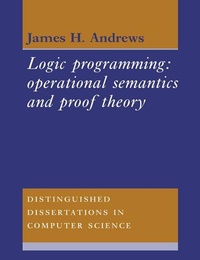
Logic Programming
Operational Semantics and Proof Theory
Published on 19. August 2004
Book
Paperback/Softback
120 pages
978-0-521-60754-4 (ISBN)
Description
Dr Andrews here provides a homogeneous treatment of the semantics (operational and logical) of both theoretical and practical logic programming languages. He shows how the rift between theory and practice in logic programming can be bridged. This is achieved by precisely characterizing the way in which 'depth-first' search for solutions to a logical formula - the usual strategy in most practical languages - is incomplete. Languages that perform 'breadth-first' searches reflect more closely the theory underlying logic programming languages. Researchers interested in logic programming or semantics, as well as artificial intelligence search strategies, will want to consult this book as the only source for some essential and new ideas in the area.
Reviews / Votes
"...selected as one of the best PhD dissertations in computer science. Researchers interested in logic programming and semantics will find interesting results in this book, including both theoretical and practical solutions." G. Ciobanu, Computing ReviewsMore details
Series
Language
English
Place of publication
Cambridge
United Kingdom
Target group
Professional and scholarly
Product notice
Paperback (trade)
Illustrations
Worked examples or Exercises
Dimensions
Height: 246 mm
Width: 189 mm
Thickness: 7 mm
Weight
249 gr
ISBN-13
978-0-521-60754-4 (9780521607544)
Copyright in bibliographic data and cover images is held by Nielsen Book Services Limited or by the publishers or by their respective licensors: all rights reserved.
Schweitzer Classification
Other editions
Additional editions
Book
12/1992
Cambridge University Press
€55.71
Article exhausted; check for reprint
Previous edition
Book
12/1992
Cambridge University Press
€55.71
Article exhausted; check for reprint
Person
Content
1. Introduction; 2. Operational semantics; 3. Characterizing parallel systems; 4. Characterizing sequential systems; 5. Approaches to incompleteness; 6. Summary and future directions; Examples; Index of definitions; Index.