

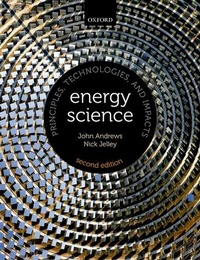
Energy Science
Principles, technologies, and impacts
2nd Edition
Published on 14. March 2013
Book
Paperback/Softback
424 pages
978-0-19-959237-1 (ISBN)
Description
Do renewable energy sources really provide a realistic alternative to fossil fuels? How much power can be obtained from all the various forms of energy? Can global warming be combated with the energy technologies currently available?
Energy Science: Principles, Technologies, and Impacts enables the reader to evaluate the key sources of energy available to us today on the basis of sound, quantitative understanding. Covering renewable, fossil fuel, and nuclear energy sources, the book relates the science behind these sources to the environmental and socioeconomic issues which surround their use to provide a balanced, objective overview. It also explores the practicalities of energy generation, storage, and
transmission, to build a complete picture of energy supply, from wind turbines, nuclear reactors, or hydroelectric dams, to our homes.
Different energy sources have different social, environmental, and economic impacts. The authors use examples and case studies throughout to help the reader make quantitative estimates and critically assess the information to hand in order to reach a well-rounded, informed view of the relative merits and drawbacks of the energy sources available.
The problems with current and future energy use and supply extend globally; Energy Science: Principles, Technologies, and Impacts introduces the potential solutions that science can offer, within a framework that encourages the critical assessment of the pros and cons of each.
Online Resource Centre:
The Online Resource Centre to accompany Energy Systems features:
For students:
? Multiple choice questions to check your understanding as you progress through the text
For registered adopters of the book:
? Figures from the book available to download, to facilitate lecture preparation
? Solutions to end of chapter questions, to aid marking and assessment
Energy Science: Principles, Technologies, and Impacts enables the reader to evaluate the key sources of energy available to us today on the basis of sound, quantitative understanding. Covering renewable, fossil fuel, and nuclear energy sources, the book relates the science behind these sources to the environmental and socioeconomic issues which surround their use to provide a balanced, objective overview. It also explores the practicalities of energy generation, storage, and
transmission, to build a complete picture of energy supply, from wind turbines, nuclear reactors, or hydroelectric dams, to our homes.
Different energy sources have different social, environmental, and economic impacts. The authors use examples and case studies throughout to help the reader make quantitative estimates and critically assess the information to hand in order to reach a well-rounded, informed view of the relative merits and drawbacks of the energy sources available.
The problems with current and future energy use and supply extend globally; Energy Science: Principles, Technologies, and Impacts introduces the potential solutions that science can offer, within a framework that encourages the critical assessment of the pros and cons of each.
Online Resource Centre:
The Online Resource Centre to accompany Energy Systems features:
For students:
? Multiple choice questions to check your understanding as you progress through the text
For registered adopters of the book:
? Figures from the book available to download, to facilitate lecture preparation
? Solutions to end of chapter questions, to aid marking and assessment
Reviews / Votes
Review from previous edition A major strength of this book is its format, as it guides the reader through each energy type with a gradual building of knowledge. * The Higher Education Academy * As educators what we need is a good source of information to examine competing ideas and to show students what sort of questions need to be asked. This is a very useful text. Its value lies in the degree to which the science of energy is inter-linked with issues of safety, environment etc. For those aiming to deal with this area in more detail than normally found, this is a very good place to start. * Ecological and Environmental Education, February 2007 *More details
Edition
2nd Revised edition
Language
English
Place of publication
Oxford
United Kingdom
Target group
College/higher education
Advanced undergraduates and beginning graduates studying energy science as part of a wider physics, environmental science, or engineering programme.
Edition type
Revised edition
Illustrations
170 line illustrations and photographs
Dimensions
Height: 247 mm
Width: 189 mm
Thickness: 20 mm
Weight
817 gr
ISBN-13
978-0-19-959237-1 (9780199592371)
Copyright in bibliographic data and cover images is held by Nielsen Book Services Limited or by the publishers or by their respective licensors: all rights reserved.
Schweitzer Classification
Other editions
Previous edition
Book
01/2007
Oxford University Press
€43.32
Article exhausted; check for reprint
Persons
John Andrews, Visiting Fellow at Bristol University, and Nick Jelley, Professor of Physics at the University of Oxford and Fellow of Lincoln College
Content
1. Introduction ; 2. Thermal energy ; 3. Energy from fossil fuels ; 4. Essential fluid mechanics for energy conversion ; 5. Hydropower, tidal power, and wave power ; 6. Wind Power ; 7. Solar energy ; 8. Biomass ; 9. Energy from fission ; 10. Energy from fusion ; 11. Electricity and energy storage ; 12. Energy and society