

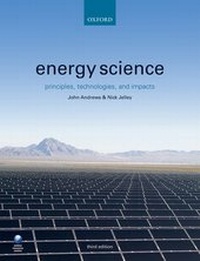
Energy Science
Principles, Technologies, and Impacts
3rd Edition
Published on 15. June 2017
Book
Paperback/Softback
528 pages
978-0-19-875581-4 (ISBN)
Description
The only book to successfully integrate social, economic and environmental considerations with an accessible, quantitative approach to energy science.
Energy Science introduces the latest energy technologies, explaining the physical principles underlying technology and discussing their environmental, economic, and social impacts. Covering fossil fuels, renewable, and nuclear energy, the text enables students to evaluate the key sources of energy available, and introduces potential solutions to the energy problems facing us today.
A core text in the field, Energy Science is full of topical case studies and examples using current data to highlight the practical application of relevant theory.Discussion questions throughout the text encourage the development of deep critical thinking skills, ensuring that students are properly equipped to approach the energy challenges that lie ahead.
Energy Science is accompanied by an Online Resource Centre which features:
For Students:
-Auto-marked multiple choice questions to accompany each chapter
-Curated links to online sources of further information
For Lecturers:
-Figures from the book: available to download for use in lectures
-A solutions manual for end-of-chapter questions
-A complete set of customizable PowerPoint slides to use as the basis for lectures, or as hand-outs in class
Energy Science introduces the latest energy technologies, explaining the physical principles underlying technology and discussing their environmental, economic, and social impacts. Covering fossil fuels, renewable, and nuclear energy, the text enables students to evaluate the key sources of energy available, and introduces potential solutions to the energy problems facing us today.
A core text in the field, Energy Science is full of topical case studies and examples using current data to highlight the practical application of relevant theory.Discussion questions throughout the text encourage the development of deep critical thinking skills, ensuring that students are properly equipped to approach the energy challenges that lie ahead.
Energy Science is accompanied by an Online Resource Centre which features:
For Students:
-Auto-marked multiple choice questions to accompany each chapter
-Curated links to online sources of further information
For Lecturers:
-Figures from the book: available to download for use in lectures
-A solutions manual for end-of-chapter questions
-A complete set of customizable PowerPoint slides to use as the basis for lectures, or as hand-outs in class
Reviews / Votes
This book covers major conventional and sustainable energy technologies with special emphasis on the pros and cons of each energy sources as well as case studies on energy technologies that have been exploited around the world... This book focuses more on mathematical methods and fundamental principles of physics and chemistry. * Do Gyun Lee (Incheon National University, South Korea), Australasian Journal of Environmental Management *More details
Edition
3rd Revised edition
Language
English
Place of publication
Oxford
United Kingdom
Target group
College/higher education
Edition type
Revised edition
Dimensions
Height: 250 mm
Width: 204 mm
Thickness: 26 mm
Weight
997 gr
ISBN-13
978-0-19-875581-4 (9780198755814)
Copyright in bibliographic data and cover images is held by Nielsen Book Services Limited or by the publishers or by their respective licensors: all rights reserved.
Schweitzer Classification
Other editions
New editions
Book
11/2021
4th Edition
Oxford University Press
€67.00
Shipment within 15-20 days
Persons
Content
1: An Introduction to Energy Science
2: Thermal, fluid and chemical energy principles
3: Energy from fossil fuels
4: Biomass
5: Thermal, solar thermal and geothermal energy
6: Hydropower, tidal power, and wave power
7: Wind power
8: Photovoltaics
9: Nuclear Energy
10: Energy storage and distribution
11: Energy demand in buildings, industry and transport
12: Energy and society
2: Thermal, fluid and chemical energy principles
3: Energy from fossil fuels
4: Biomass
5: Thermal, solar thermal and geothermal energy
6: Hydropower, tidal power, and wave power
7: Wind power
8: Photovoltaics
9: Nuclear Energy
10: Energy storage and distribution
11: Energy demand in buildings, industry and transport
12: Energy and society