

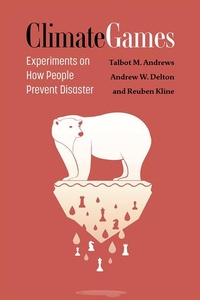
Climate Games
Experiments on How People Prevent Disaster
Published on 5. March 2024
Book
Paperback/Softback
216 pages
978-0-472-05663-7 (ISBN)
Description
Can humanity work together to mitigate the effects of climate change? Climate Games argues we can. This book brings together a decade and a half of experimentation, conducted by researchers around the world, which shows that people can and will work together to prevent disasters like climate change. These experiments, called economic games, put money on the line to create laboratory disasters. Participants must work together by spending a bit of money now to prevent themselves from losing even more money in the future. Will people sacrifice their own money to prevent disaster? Can people make wise decisions? And can people decide wisely on behalf of others? The answer is a resounding yes.
Yet real climate change is a complex social dilemma involving the world's nearly eight billion inhabitants. In the real world, the worst effects of climate change are likely to be felt by developing countries, while most of the decisions will be made by rich, industrialized countries. And while the world as a whole would be better off if all nations reduced their greenhouse gas emissions, any given nation could decide it would be even better off if it continued emitting and let other nations take care of the problem. These disaster experiments test how real people respond to climate change's unique constellation of challenges and deliver a positive message: People will prevent disaster.
Yet real climate change is a complex social dilemma involving the world's nearly eight billion inhabitants. In the real world, the worst effects of climate change are likely to be felt by developing countries, while most of the decisions will be made by rich, industrialized countries. And while the world as a whole would be better off if all nations reduced their greenhouse gas emissions, any given nation could decide it would be even better off if it continued emitting and let other nations take care of the problem. These disaster experiments test how real people respond to climate change's unique constellation of challenges and deliver a positive message: People will prevent disaster.
Reviews / Votes
"Gracefully written, Climate Games explores ways to design solutions to the core problems of climate change." -- Rick K. Wilson, Rice University "Climate Games aims to understand how we can tackle climate change disasters by employing economic games and experiments. Andrews, Delton, and Kline simplify complicated issues on climate, game theory, and experimental methodology and are able to deliver research design, its significance, and the outcomes. -- Doruk Iris, Sogang University "The heart of the book focuses on a series of experiments the authors conducted to determine how people react to various climate-related hazards of indeterminate impact and variable cost to communities and individuals. Summing up: recommended. Undergraduates through faculty; professionals." -- CHOICEMore details
Language
English
Place of publication
Ann Arbor
United States
Target group
Professional and scholarly
Illustrations
28 figures, 11 tables
Dimensions
Height: 151 mm
Width: 230 mm
Thickness: 16 mm
Weight
330 gr
ISBN-13
978-0-472-05663-7 (9780472056637)
Copyright in bibliographic data and cover images is held by Nielsen Book Services Limited or by the publishers or by their respective licensors: all rights reserved.
Schweitzer Classification
Persons
Talbot M. Andrews is Assistant Professor of Political Science at the University of Connecticut.
Andrew W. Delton is Associate Professor in the Department of Political Science and the College of Business at Stony Brook University.
Reuben Kline is Associate Professor of Political Science at Stony Brook University.
Andrew W. Delton is Associate Professor in the Department of Political Science and the College of Business at Stony Brook University.
Reuben Kline is Associate Professor of Political Science at Stony Brook University.
Content
Acknowledgements
Chapter 1 - Understanding the Challenges of Climate Change
Chapter 2 - Creating Worlds in the Lab
Chapter 3 - Dealing with Risk and Uncertainty
Chapter 4 - Deciding for Others
Chapter 4 Technical Appendix
Chapter 5 - Flirtin' with (Self-Created) Disaster
Chapter 6 - Trusting Each Other
Chapter 6 Technical Appendix
Chapter 7 - Looking Beyond the Lab
Bibliography
Chapter 1 - Understanding the Challenges of Climate Change
Chapter 2 - Creating Worlds in the Lab
Chapter 3 - Dealing with Risk and Uncertainty
Chapter 4 - Deciding for Others
Chapter 4 Technical Appendix
Chapter 5 - Flirtin' with (Self-Created) Disaster
Chapter 6 - Trusting Each Other
Chapter 6 Technical Appendix
Chapter 7 - Looking Beyond the Lab
Bibliography