

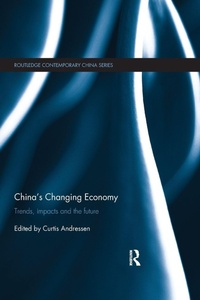
China's Changing Economy
Trends, Impacts and the Future
1st Edition
Published on 10. January 2019
Book
Paperback/Softback
264 pages
978-0-367-02672-1 (ISBN)
Description
One of the most dramatic events in the global economy over the past few decades has been the rise of China as a global economic power. From humble beginnings in the late 1970s, the policy shift in China from a planned to market economy has led to economic growth of tremendous speed.
This book examines the changes taking place in China's economy today and the impacts of these changes in China and abroad. The central theme is that the rapid economic growth has come at a cost, as many problems have emerged as a result in China's economy and society, including a dramatic rich-poor gap, labour issues, problems in the banking sector and severe inflation in the cost of housing, as well as challenges with respect to China's external trade. The Chinese government recognizes these problems and is taking steps to rebalance its economy and society. The book takes a political economy perspective in order to investigate the interplay between the political system in China and the way in which the economy is structured, and the manner in which economic changes take place. Demonstrating that in order for China to achieve sustained economic growth and social improvement it must undertake serious policy changes, it also highlights that if countries are going to deal with China in a stable and productive manner, a thorough understanding of key contemporary developments in that country is vital.
Covering a range of the most pertinent issues facing China today, this book will be of interest to students and scholars of Chinese Economics, Economic Development and Political Economy.
This book examines the changes taking place in China's economy today and the impacts of these changes in China and abroad. The central theme is that the rapid economic growth has come at a cost, as many problems have emerged as a result in China's economy and society, including a dramatic rich-poor gap, labour issues, problems in the banking sector and severe inflation in the cost of housing, as well as challenges with respect to China's external trade. The Chinese government recognizes these problems and is taking steps to rebalance its economy and society. The book takes a political economy perspective in order to investigate the interplay between the political system in China and the way in which the economy is structured, and the manner in which economic changes take place. Demonstrating that in order for China to achieve sustained economic growth and social improvement it must undertake serious policy changes, it also highlights that if countries are going to deal with China in a stable and productive manner, a thorough understanding of key contemporary developments in that country is vital.
Covering a range of the most pertinent issues facing China today, this book will be of interest to students and scholars of Chinese Economics, Economic Development and Political Economy.
More details
Series
Language
English
Place of publication
London
United Kingdom
Publishing group
Taylor & Francis Ltd
Target group
College/higher education
Illustrations
34 s/w Abbildungen, 34 s/w Zeichnungen, 39 s/w Tabellen
39 Tables, black and white; 34 Line drawings, black and white; 34 Illustrations, black and white
Dimensions
Height: 234 mm
Width: 156 mm
Thickness: 15 mm
Weight
436 gr
ISBN-13
978-0-367-02672-1 (9780367026721)
Copyright in bibliographic data and cover images is held by Nielsen Book Services Limited or by the publishers or by their respective licensors: all rights reserved.
Schweitzer Classification
Other editions
Additional editions
E-Book
05/2016
Routledge
€41.99
Available for download
E-Book
05/2016
Routledge
€41.99
Available for download
Book
05/2016
1st Edition
Routledge
€145.90
Shipment within 10-20 days
Person
Curtis Andressen is Associate Professor in the Department of Social Sciences, Qatar University.
Content
Chapter 1.Introduction Chapter 2. Rising Labor Costs in China: A Problem or an Opportunity? Chapter 3. Geographic labour mobility, workers and family in China and Australia Chapter 4. The Contradictions of Developmentalism and the Chinese Party-State's Goal of Ethnic Harmony: the case of Xinjiang Chapter 5. Spatial Analysis on the Contribution of Industrial Structural Adjustment to Regional Energy Efficiency: A Case Study of 31 Provinces across China Chapter 6. WTO Accession and Efficiency Gains: Evidence from China's Banking Sector Chapter 7. The Faster Things Change, the More They Stay the Same: The Influence of Cultural Norms, Customs and Traditions on Venture Capital in China Chapter 8. Inter-generational Transitions of Family Businesses using Private Equity - Lessons for China and Australia from Chinese Family-Owned Enterprises in Singapore Chapter 9. Confucian Principles to Enhance China's Environmental Governance Chapter 10. The contribution of the Clean Development Mechanism (CDM) towards China's climate change mitigation and sustainable development Chapter 11. Changing Economies for a More Sustainable Future: The Influence of Stakeholders and Environmental Reporting Developments in Transforming Chinese Corporate Practices Chapter 12. Education, Globalisation and Rural Contexts: Learning for Staying, Learning for Leaving or Learning for Choice? Chapter 13. Why Beijing rules the property market - rethinking the role of "five new measures" in regulating the property market under a new era of China's leadership transition Chapter 14. China: Accelerating the Strategic Transformation of Foreign Trade Development Mode Chapter 15. Correlation Analysis of Trade in Services OFDI and Industrial Structure Optimization in China Chapter 16. China: Accelerating the Strategic Transformation of Foreign Trade Development Mode