

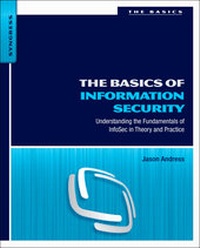
The Basics of Information Security
Understanding the Fundamentals of InfoSec in Theory and Practice
Published on 16. July 2011
Book
Paperback/Softback
208 pages
978-1-59749-653-7 (ISBN)
Description
The Basics of Information Security provides fundamental knowledge of information security in both theoretical and practical aspects. This book is packed with key concepts of information security, such as confidentiality, integrity, and availability, as well as tips and additional resources for further advanced study. It also includes practical applications in the areas of operations, physical, network, operating system, and application security. Complete with exercises at the end of each chapter, this book is well-suited for classroom or instructional use.
The book consists of 10 chapters covering such topics as identification and authentication; authorization and access control; auditing and accountability; cryptography; operations security; physical security; network security; operating system security; and application security. Useful implementations for each concept are demonstrated using real world examples. PowerPoint lecture slides are available for use in the classroom.
This book is an ideal reference for security consultants, IT managers, students, and those new to the InfoSec field.
The book consists of 10 chapters covering such topics as identification and authentication; authorization and access control; auditing and accountability; cryptography; operations security; physical security; network security; operating system security; and application security. Useful implementations for each concept are demonstrated using real world examples. PowerPoint lecture slides are available for use in the classroom.
This book is an ideal reference for security consultants, IT managers, students, and those new to the InfoSec field.
Reviews / Votes
"The book includes illustrations and figures demonstrating key information security ideas, alerts to make the reader aware of particular insights, more advanced details for those wishing to do their own research above and beyond the contents of the book, and real world example summaries pertaining to key terms throughout the book. There is also an accessible bibliography mainly made up of online resources. The exercises at the end of each chapter also make this a good book for a first year security college class...All in all, this book is for those new to information security and for persons who are looking to learn about underlying concepts which underpin what is at the heart of information security in organizations." --Computers and Security"This book is a great primer for anyone who wants to get into cybersecurity. It methodically covers the key principles in a easy to understand flow that builds on itself. I recommend this book for anyone who wants to be able to intelligently discuss cybersecurity at work or in social settings." --Steve Winterfeld, Author of Cyber Warfare and CISSP/PMP
"The Basics of Digital Forensics is extremely easy to read and understand, and tackles the topic in a very broad manner. All in all, it's a perfect book for those who are interested in the subject and for gauging whether they might be interested in finding out more about it in the future." --HelpNetSecurity
"The complexity of Information Security is oftentimes overwhelming to those individuals new to the field. Unfortunately, there are too few resources available that can provide a clear and comprehensive understanding of InfoSec. This book rectifies this shortage and provides readers a comprehensive discussion on what every security professional should know intimately." --Thomas Wilhelm, HackingDojo.com
"Overall, this book follows a logical progression and makes good use of heading and subheadings so that the material is easy to follow; diagrams are included where helpful. Boxouts are also used to good effect - you'll find Alerts for points you need to pay attention to and More Advanced for ones you can skip. The boxouts used towards the end of each chapter for 'Real World' topics allow the author to break out of textbook style and relate the material to a wider context. The chapters then conclude with a Summary followed by Exercises - a list of questions that serve as a check that you have understood the main points covered. No answers are provided so if you are stumped use the index or re-read before moving on. This book is aimed at beginners and is equally suitable as a course text or for self-study. The developer should, of course, have a working knowledge of the topics it covers and this is a good place to start if you need an overview of the basics." --Alex Armstrong, i-Programmer.com
More details
Language
English
Place of publication
Rockland, MA
United States
Target group
College/higher education
Security Consultants, IT Managers, Students, Those new to the InfoSec field
Illustrations
35 illustrations; Illustrations
Dimensions
Height: 235 mm
Width: 191 mm
Weight
390 gr
ISBN-13
978-1-59749-653-7 (9781597496537)
Copyright in bibliographic data and cover images is held by Nielsen Book Services Limited or by the publishers or by their respective licensors: all rights reserved.
Schweitzer Classification
Other editions
New editions
Jason Andress
The Basics of Information Security
Understanding the Fundamentals of InfoSec in Theory and Practice
Book
07/2014
2nd Edition
Syngress
€34.50
Shipment within 15-20 days
Additional editions
Jason Andress
The Basics of Information Security
Understanding the Fundamentals of InfoSec in Theory and Practice
E-Book
07/2011
1st Edition
Syngress
€23.95
Available for download
Person
Jason Andress (CISSP, ISSAP, CISM, GPEN) is a seasoned security professional with a depth of experience in both the academic and business worlds. Presently he carries out information security oversight duties, performing penetration testing, risk assessment, and compliance functions to ensure that critical assets are protected. Jason has taught undergraduate and graduate security courses since 2005 and holds a doctorate in computer science, researching in the area of data protection. He has authored several publications and books, writing on topics including data security, network security, penetration testing, and digital forensics.
Content
Chapter 1. What is Information Security?
Chapter 2. Identification and Authentication
Chapter 3. Authorization and Access control
Chapter 4. Auditing and Accountability
Chapter 5. Cryptography
Chapter 6. Operations Security
Chapter 7. Physical Security
Chapter 8. Network Security
Chapter 9. Operating System Security
Chapter 10. Application Security
Chapter 2. Identification and Authentication
Chapter 3. Authorization and Access control
Chapter 4. Auditing and Accountability
Chapter 5. Cryptography
Chapter 6. Operations Security
Chapter 7. Physical Security
Chapter 8. Network Security
Chapter 9. Operating System Security
Chapter 10. Application Security