

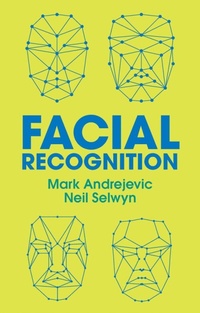
Facial Recognition
1st Edition
Published on 18. August 2022
Book
Paperback/Softback
224 pages
978-1-5095-4733-3 (ISBN)
Description
Facial recognition is set to fundamentally change our experience and understanding of monitoring, surveillance, and privacy. Backed by powerful industry interests, this technology is being integrated into many areas of society - from airports to shopping malls, classrooms to casinos. Despite the promise of security and efficiency, fears are growing that this technology is inherently biased, intrusive, and oppressive, with broad-ranging societal consequences.
In this timely book, Neil Selwyn and Mark Andrejevic provide a critical introduction to facial recognition. Outlining its complex social history and future technical forms, as well as its conceptual and technical underpinnings, the book considers the arguments being advanced for the continued uptake of facial recognition. In assessing these developments, the book argues that we are at the cusp of a generational shift in surveillance technology that will reconfigure our expectations of anonymity in shared and public spaces. Throughout, the book addresses a deceptively simple question: do we really want to live in a world where our face is our ID?
Facial Recognition is essential reading for students and scholars of media and communications studies, surveillance studies, criminology, and sociology, as well as for anyone interested in one of the defining technologies of our times.
In this timely book, Neil Selwyn and Mark Andrejevic provide a critical introduction to facial recognition. Outlining its complex social history and future technical forms, as well as its conceptual and technical underpinnings, the book considers the arguments being advanced for the continued uptake of facial recognition. In assessing these developments, the book argues that we are at the cusp of a generational shift in surveillance technology that will reconfigure our expectations of anonymity in shared and public spaces. Throughout, the book addresses a deceptively simple question: do we really want to live in a world where our face is our ID?
Facial Recognition is essential reading for students and scholars of media and communications studies, surveillance studies, criminology, and sociology, as well as for anyone interested in one of the defining technologies of our times.
More details
Language
English
Place of publication
Oxford
United Kingdom
Target group
Professional and scholarly
Dimensions
Height: 215 mm
Width: 137 mm
Thickness: 19 mm
Weight
302 gr
ISBN-13
978-1-5095-4733-3 (9781509547333)
Copyright in bibliographic data and cover images is held by Nielsen Book Services Limited or by the publishers or by their respective licensors: all rights reserved.
Schweitzer Classification
Other editions
Additional editions
Mark Andrejevic | Neil Selwyn
Facial Recognition
Book
08/2022
1st Edition
Polity Press
€56.00
Shipment within 15-20 days
Mark Andrejevic | Neil Selwyn
Facial Recognition
E-Book
08/2022
1st Edition
Polity Press
€15.99
Available for download
Persons
Mark Andrejevic is Professor at the School of Media, Film, and Journalism, Monash University.
Neil Selwyn is Distinguished Research Professor in the School of Education Culture and Society, Monash University.
Neil Selwyn is Distinguished Research Professor in the School of Education Culture and Society, Monash University.
Content
Acknowledgements
Preface
Chapter 1 Facial recognition - an introduction
Chapter 2 Facial recognition - underpinning concepts and concerns
Chapter 3 Mapping the facial recognition landscape
Chapter 4 Pro-social applications - facial recognition as an everyday 'good'?
Chapter 5 Problematic applications - facial recognition as an inherent harm?
Chapter 6 Facial futures - emerging promises and possible perils
Chapter 7 Making critical sense of facial recognition and society
Epilogue: Facial recognition - so where now?
References
Index
Preface
Chapter 1 Facial recognition - an introduction
Chapter 2 Facial recognition - underpinning concepts and concerns
Chapter 3 Mapping the facial recognition landscape
Chapter 4 Pro-social applications - facial recognition as an everyday 'good'?
Chapter 5 Problematic applications - facial recognition as an inherent harm?
Chapter 6 Facial futures - emerging promises and possible perils
Chapter 7 Making critical sense of facial recognition and society
Epilogue: Facial recognition - so where now?
References
Index