

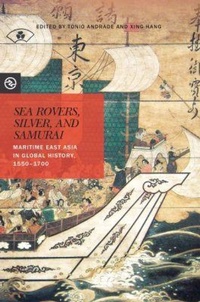
Sea Rovers, Silver, and Samurai
Maritime East Asia in Global History, 1550-1700
Will be published approx. on 29. February 2016
Book
Hardback
472 pages
978-0-8248-5276-4 (ISBN)
Description
Sea Rovers, Silver, and Samurai traces the roots of modern global East Asia by focusing on the contested and fascinating history of its seaways. The East Asian maritime realm, from the Straits of Malacca to the Sea of Japan, has been a core region of international trade for centuries, but it was during the long seventeenth century, from 1550 to 1700, that the velocity and scale of commerce began to increase dramatically. Chinese, Japanese, and Vietnamese smugglers and pirates forged autonomous networks, or in the case of the Zheng family of southeastern China and Taiwan, maritime-focused polities. They competed and cooperated with one another and with ambitious state-builders, such as the Manchu Qing, Tokugawa Japan, the Iberians, and the Dutch.
What happened as all of these peoples, each with their own legal and cultural notions about the seas and seaborne commerce, came into increasing contact? Maritime East Asia was in many ways a zone of contradictions, subject to multiple legal, political, and religious jurisdictions and mediums of communication lost or manipulated in translation among dozens of major languages and countless dialects. Informal networks based upon kinship and patron-client ties mingled uneasily with formal bureaucratic structures and rationalized monopoly organizations. Subsistence-based trade and plunder by destitute fishermen complemented the grand dreams of sea-lords, profit-maximizing entrepreneurs, and imperial contenders. Despite their shifting identities, East Asia's mariners sought to anchor their activities to stable legitimacies and diplomatic traditions found outside the system. On the other hand, outsiders, even those armed with the latest military technology, could never fully impose their values upon the institutional fluidity of maritime East Asia.
This multilateral perspective of a world in flux opens a whole range of contingencies to accepted narratives of the ""rise of the West."" Consider, for example that European mariners, whom we have come to associate with catalyzing globalization and opening oceanic trade routes, were far from the most important actors in East and Southeast Asia. During the period surveyed in these pages, it was the Chinese whose traders carried more in volume and value than any other nation. The authors of this volume offer a new perspective not just on East Asian history but on global history, because the China Seas were key to forging the connections of early globalization, as important as the Atlantic World and the Indian Ocean basin, both of which regions have received far more scholarly attention. The multiplicity of possibilities remains in the twenty-first century, as a resurgent China attempts to reassert its traditional hegemony in competition with other native and outside players.
What happened as all of these peoples, each with their own legal and cultural notions about the seas and seaborne commerce, came into increasing contact? Maritime East Asia was in many ways a zone of contradictions, subject to multiple legal, political, and religious jurisdictions and mediums of communication lost or manipulated in translation among dozens of major languages and countless dialects. Informal networks based upon kinship and patron-client ties mingled uneasily with formal bureaucratic structures and rationalized monopoly organizations. Subsistence-based trade and plunder by destitute fishermen complemented the grand dreams of sea-lords, profit-maximizing entrepreneurs, and imperial contenders. Despite their shifting identities, East Asia's mariners sought to anchor their activities to stable legitimacies and diplomatic traditions found outside the system. On the other hand, outsiders, even those armed with the latest military technology, could never fully impose their values upon the institutional fluidity of maritime East Asia.
This multilateral perspective of a world in flux opens a whole range of contingencies to accepted narratives of the ""rise of the West."" Consider, for example that European mariners, whom we have come to associate with catalyzing globalization and opening oceanic trade routes, were far from the most important actors in East and Southeast Asia. During the period surveyed in these pages, it was the Chinese whose traders carried more in volume and value than any other nation. The authors of this volume offer a new perspective not just on East Asian history but on global history, because the China Seas were key to forging the connections of early globalization, as important as the Atlantic World and the Indian Ocean basin, both of which regions have received far more scholarly attention. The multiplicity of possibilities remains in the twenty-first century, as a resurgent China attempts to reassert its traditional hegemony in competition with other native and outside players.
More details
Series
Language
English
Place of publication
Honolulu, HI
United States
Target group
Professional and scholarly
Product notice
sewn/stitched
Cloth over boards
Illustrations
10 black & white illustrations
Dimensions
Height: 231 mm
Width: 155 mm
Thickness: 33 mm
Weight
794 gr
ISBN-13
978-0-8248-5276-4 (9780824852764)
Copyright in bibliographic data and cover images is held by Nielsen Book Services Limited or by the publishers or by their respective licensors: all rights reserved.
Schweitzer Classification
Other editions
Additional editions
Tonio Andrade | Xing Hang | Anand A. Yang
Sea Rovers, Silver, and Samurai
Maritime East Asia in Global History, 1550-1700
E-Book
03/2016
University of Hawaii Press
€128.95
Available for download
Persons
Tonio Andrade (Editor) Tonio Andrade is professor of history at Emory University.Xing Hang (Editor) Xing Hang is assistant professor of history at Brandeis University.