

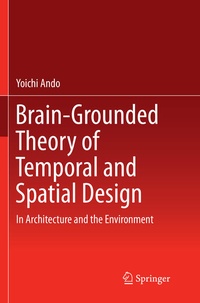
Brain-Grounded Theory of Temporal and Spatial Design
In Architecture and the Environment
Published on 25. April 2018
Book
Paperback/Softback
XXVIII, 185 pages
978-4-431-56722-6 (ISBN)
Description
In this book, brain-grounded theory of temporal and spatial design in architecture and the environment is discussed. The author believes that it is a key to solving such global problems as environmental disorders and severe climate change as well as conflicts that are caused by the ill-conceived notion of "time is money". There are three phases or aspects of a person's life: the physical life, the spiritual or mental life, and the third stage of life, when a person moves from middle age into old age and can choose what he or she wishes to do instead of simply what must be done. This book describes the temporal design of the environment based on the theory of subjective preference, which could make it possible for an individual to realize a healthy life in all three phases. In his previously published work, the present author wrote that the theory of subjective preference has been established for the sound and visual fields based on neural evidence, and that subjective preference is anoverall response of cooperating temporal and spatial factors, associated with the brain's left and right hemispheres, respectively. In this book, based on that theory, some examples are shown for the temporal design of architecture and the environment, which may play important roles in the development of personality, thus inducing creativity. Also discussed is how all individuals may find their own personality and develop it according to the preferred direction of their individual lives.
More details
Edition
Softcover reprint of the original 1st ed. 2016
Language
English
Place of publication
Tokyo
Japan
Target group
Professional and scholarly
Illustrations
29 s/w Abbildungen, 95 farbige Abbildungen
XXVIII, 185 p. 124 illus., 95 illus. in color.
Dimensions
Height: 235 mm
Width: 155 mm
Thickness: 12 mm
Weight
375 gr
ISBN-13
978-4-431-56722-6 (9784431567226)
DOI
10.1007/978-4-431-55891-0
Schweitzer Classification
Other editions
Additional editions
Book
03/2016
Springer
€106.99
Shipment within 10-15 days
Person
Yoichi Ando is an expert in the areas of concert hall acoustics architectural acoustics, brain activities, and environmental design. He has been awarded the AIA Institute Honor, American Institute of Architects in 1995: For 30 years of work developing and applying new theories of concert hall acoustics have helped the way music is heard. A scientist, author, and educator, his achievements are a benefit to both the world of architecture and the world of music. He has also been awarded the "Laurea Honoris Causa" (Dottore ad Honorem) by University of Ferrara, Italy on 12 June 2002, and serves as Editor-In-Chief, of the Journal of Temporal Design in Architecture and the Environment.
Peter Cariani works in the fields of auditory neurophysiology; temporal coding of pitch, timbre, and consonance; neural networks for temporal processing; music perception and cognition.
Peter Cariani works in the fields of auditory neurophysiology; temporal coding of pitch, timbre, and consonance; neural networks for temporal processing; music perception and cognition.
Content
Introduction.- Model of Auditory Brain System.- EEG and MEG Correlates of Visual Subjective Preferences.- Temporal and Spatial Percepts of Sound and Vision.- Theory of Subjective Preference for Sound and Visual Fields.- Preferred Conditions of Temporal and Spatial Factors of Sound Fields.- Subjective Preferences in Vision.- General Theory for Designing Physical Environments Incorporating Spatial and Temporal Factors.- Design Procedures for Matrix Elements Consisting of Discrete Periods and Spatial Ranks.- Studies of Temporal Design for Visual Fields.- Studies on Temporal Design of an Individual House.- Development of the Third Stage (Creative) Life.- Environment Inducing Creations to Build Culture.- Theory of Environmental Design and Escape from Vandalism.- Remarks.