

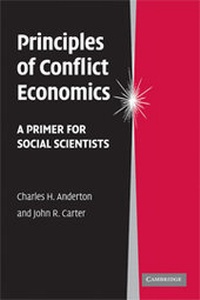
Principles of Conflict Economics
A Primer for Social Scientists
Published on 16. March 2009
Book
Paperback/Softback
344 pages
978-0-521-69865-8 (ISBN)
Description
Conflict economics contributes to an understanding of violent conflict in two important ways. First, it applies economic analysis to diverse conflict activities such as war, arms races, and terrorism, showing how they can be understood as purposeful choices responsive to underlying incentives. Second, it treats appropriation as a fundamental economic activity, joining production and exchange as a means of wealth acquisition. Drawing on a half-century of scholarship, this book presents a primer on the key themes and principles of conflict economics. Although much work in the field is abstract, the book is made accessible to a broad audience of scholars, students and policymakers by relying on historical data, relatively simple graphs and intuitive narratives. In exploring the interdependence of economics and conflict, the book presents current perspectives of conflict economics in novel ways and offers new insights into economic aspects of violence.
Reviews / Votes
'This is the most intuitive and comprehensive book on conflict economics available. The authors are to be commended for showing just how much about conflict can be understood using the basics of production possibilities, consumer choice, and game theory at the principles level. The coverage of conflict data sets is also novel. Anderton and Carter set the mark for establishing conflict economics alongside more traditional undergraduate economic field courses such as labor and industrial organization.' Daniel Arce, University of Texas, Dallas 'A valuable addition to the growing literature on the scientific analysis of conflict, this text is rich in real-world data and applications, and the theoretical material is carefully selected, constructed, and explained.' Jurgen Brauer, Augusta State University 'This is an impressive book. It provides a comprehensive yet accessible synthesis of the growing body of theoretical and empirical research that emphasizes the interdependencies between conflict (within countries and between them) and economic activity.' Michelle R. Garfinkel, University of California, Irvine 'Economics focuses on peaceful exchange, but conflict destroys markets and exchange. This original and scholarly contribution shows how economic principles can be used in the analysis of past, present, and future conflicts. It is a 'must read' for all economists and their students.' Keith Hartley, University of York 'For coverage and clarity, Principles of Conflict Economics is an outstanding book on a topic of utmost importance. The post-Cold War era has brought new security challenges to a more interdependent world; these challenges have captured an increasing share of the world GDP. This book puts these challenges into perspective and is a must-read for anyone interested in understanding twenty-first-century economics and the role of conflict and appropriative behavior. I especially liked the up-to-date empirical examples, which underscore the book's relevance.' Todd Sandler, University of Texas, Dallas 'Principles of Conflict Economics is a book which presents several interesting qualities for readers who are not specialists in the field of defense or peace economics ... a most valuable textbook. It provides a nice synthesis of a growing theoretical and empirical literature which is of high importance for a better understanding of the international relationships in a broad sense.' Yvon Rocaboy, University of RennesMore details
Language
English
Place of publication
Cambridge
United Kingdom
Target group
College/higher education
Product notice
Paperback (trade)
Illustrations
17 Tables, unspecified; 115 Line drawings, unspecified
Dimensions
Height: 228 mm
Width: 151 mm
Thickness: 19 mm
Weight
460 gr
ISBN-13
978-0-521-69865-8 (9780521698658)
Copyright in bibliographic data and cover images is held by Nielsen Book Services Limited or by the publishers or by their respective licensors: all rights reserved.
Schweitzer Classification
Other editions
New editions
Charles H. Anderton | John R. Carter
Principles of Conflict Economics
The Political Economy of War, Terrorism, Genocide, and Peace
Book
04/2019
2nd Edition
Cambridge University Press
€58.20
Shipment within 15-20 days
Additional editions
E-Book
04/2009
1st Edition
Cambridge University Press
€32.49
Available for download
Persons
Charles H. Anderton is Professor of Economics at the College of the Holy Cross, Worcester, Massachusetts, where he has taught since 1986. He coedited the volume Economics of Arms Reduction and the Peace Process with Walter Isard in 1992. A former North American editor of the journal Defence and Peace Economics, Professor Anderton's research has appeared in journals such as Economic Inquiry, Journal of Economic Behavior and Organization, Journal of Conflict Resolution, Conflict Management and Peace Science and Peace Economics, Peace Science, and Public Policy, as well as the Handbook of Defense Economics, Volumes I and II. John R. Carter is Professor of Economics at the College of the Holy Cross, Worcester, Massachusetts, where he has served on the faculty since 1976. A former Chair of the Department of Economics, Professor Carter received the Holy Cross Distinguished Teaching Award in 1992. His research has appeared in journals such as the Review of Economics and Statistics, Journal of Law and Economics, Journal of Economic Perspectives, Journal of Economic Behavior and Organization, Defence and Peace Economics, Journal of Peace Research and Public Choice, as well as the Handbook of Defense Economics, Volume II.
Content
1. Introduction: definition and scope of conflict economics; 2. Production possibilities and the guns versus butter tradeoff; 3. Rational choice and equilibrium; 4. Fundamentals of game theory; 5. A bargaining model of conflict; 6. Conflict between states; 7. Civil war and genocide; 8. Terrorism; 9. Geography and technology of conflict; 10. Arms rivalry, proliferation, and arms control; 11. Military alliances; 12. Conflict success functions and the theory of appropriation possibilities; Appendix A. Statistical methods; Appendix B. A more formal bargaining model of conflict.