

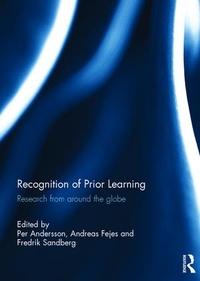
Recognition of Prior Learning
Research from around the globe
1st Edition
Published on 21. September 2015
Book
Hardback
172 pages
978-1-138-95502-8 (ISBN)
Description
Recognition of prior learning (RPL) has emerged in recent decades as an important policy area and policy concept. It is a phenomenon with a certain variation in practices as well as contexts, concepts and conceptions. However, there is a basic idea about giving recognition to prior learning wherever and whenever learning has taken place. Such ideas can be 'materialised' in formal assessment systems providing the basis for recognition, as well as in informal processes where prior learning is made visible and gets recognition.
This book provides a range of empirically and theoretically based contributions from different parts of the world where RPL, or an equivalent, is mobilised as part of educational practices for adults. Discussion in this area often takes place locally. This volume compiles different kinds of contributions to create a broader dialogue among scholars and practitioners, not only on the specific topic of RPL, but also on more general issues faced in educational research. It was originally published as a special issue of the International Journal of Lifelong Education.
This book provides a range of empirically and theoretically based contributions from different parts of the world where RPL, or an equivalent, is mobilised as part of educational practices for adults. Discussion in this area often takes place locally. This volume compiles different kinds of contributions to create a broader dialogue among scholars and practitioners, not only on the specific topic of RPL, but also on more general issues faced in educational research. It was originally published as a special issue of the International Journal of Lifelong Education.
Reviews / Votes
"The book title is captivating and raises expectations of exhaustive discussion of Recognition of Prior Learning (RPL), a practice aimed at enhancing lifelong learning through recognition of credits or granting advanced standing, and accreditation/validation of knowledge and skills acquired through informal and non-formal settings for personal development, social justice and economic development...to a greater extent this has been achieved through case studies from Australia, Canada, Portugal, South Africa, Sweden and the UK".- Fred Gennings Wanyavinkhumbo Msiska, Centre for Open and Distance Learning, Mzuzu University, Private Bag 201, Luwinga, Mzuzu, Malawi, UNESCO Institute for Lifelong LearningMore details
Language
English
Place of publication
London
United Kingdom
Publishing group
Taylor & Francis Ltd
Target group
College/higher education
Professional and scholarly
Postgraduate, Professional, and Undergraduate
Dimensions
Height: 246 mm
Width: 174 mm
Weight
498 gr
ISBN-13
978-1-138-95502-8 (9781138955028)
Copyright in bibliographic data and cover images is held by Nielsen Book Services Limited or by the publishers or by their respective licensors: all rights reserved.
Schweitzer Classification
Other editions
Additional editions
Per Andersson | Andreas Fejes | Fredrik Sandberg
Recognition of Prior Learning
Research from around the globe
E-Book
10/2017
1st Edition
Routledge
€69.99
Available for download
Per Andersson | Andreas Fejes | Fredrik Sandberg
Recognition of Prior Learning
Research from around the globe
E-Book
10/2017
1st Edition
Routledge
€69.99
Available for download
Per Andersson | Andreas Fejes | Fredrik Sandberg
Recognition of Prior Learning
Research from around the globe
Book
08/2017
1st Edition
Routledge
€81.89
Shipment within 10-20 days
Persons
Per Andersson is Professor of Education in Linkoeping University, Sweden. His main research interests are recognition of prior learning, and the professional development of adult and vocational teachers. He is co-editor (with Judy Harris) of the book Re-theorising the Recognition of Prior Learning (2006).
Andreas Fejes is Professor and Chair of Adult Education Research as well as Pro-Dean for Research and Doctoral Studies at the Faculty of Educational Sciences, Linkoeping University, Sweden. He has published extensively on issues pertaining to adult education, and is one of the founding editors of the European Journal for Research on the Education and Learning of Adults.
Fredrik Sandberg is Senior Lecturer at Linkoeping University, Sweden. His main research interests are in adult learning and recognition of prior learning. He has published several papers on recognition of prior learning in journals such as British Educational Research Journal and Adult Education Quarterly. ?
Andreas Fejes is Professor and Chair of Adult Education Research as well as Pro-Dean for Research and Doctoral Studies at the Faculty of Educational Sciences, Linkoeping University, Sweden. He has published extensively on issues pertaining to adult education, and is one of the founding editors of the European Journal for Research on the Education and Learning of Adults.
Fredrik Sandberg is Senior Lecturer at Linkoeping University, Sweden. His main research interests are in adult learning and recognition of prior learning. He has published several papers on recognition of prior learning in journals such as British Educational Research Journal and Adult Education Quarterly. ?
Content
1. Introduction: Introducing research on recognition of prior learning 2. Developing professional learning and identity through the recognition of experiential learning at doctoral level 3. The Portuguese case of RPL new practices and new adult educators: some tensions and ambivalences in the framework of new public policies 4. Recognition of prior learning: exploring the 'knowledge question' 5. The politics of recognition: critical discourse analysis of recent PLAR policies for immigrant professionals in Canada 6. Love, rights and solidarity in the recognition of prior learning (RPL) 7. Converting RPL into academic capital: lessons from Australian universities 8. Portfolios and meaning-making in the assessment of prior learning 9. Agreement in assessment of prior learning related to higher education: an examination of interrater and intrarater reliability 10. Translating validation of prior learning in practice