

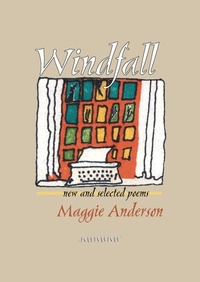
Windfall
New and Selected Poems
Published on 2. March 2000
Book
Paperback/Softback
120 pages
978-0-8229-5719-5 (ISBN)
Description
Windfall includes poems from three previous books by Maggie Anderson, along with a generous selection of new work. In this collection we can see over two decades of the growth of a poet memorable for the clarity, strength, and urgency of her voice. Anderson's poems entangle a language, a history, and a group of belongings, and she is both at home and a foreigner in the places she invokes. Every place in these poems seems inhabitable, yet the tensions of these deceptively quiet lines develop out of the clear reluctance or inability of the poet to sit still. Maggie Anderson writes out of deep grief for the political losses of work and money, of life and limb and home in our dangerous times. She remembers and witnesses, and she also speaks eloquently for our private griefs-the loss of family, vitality and self. These poems do not shout; we listen as if following a whisper in the dark. A counterpoint to the sorrows in these poems is a complex and often joyous music, as well as a wry, sometimes self-deprecating humor which saves the work from solemnity. Her rhythms are diverse and intricate; they move deftly from fiddle whine to saxophone, from fugue to blues.
Reviews / Votes
Maggie Anderson's wonderful collection of new and selected poems, Windfall, possesses a huge, spellbinding, honed acuity and aesthetic certainty. Always cutting to the quick of modern flux, her poems elevate the natural brilliance of small things in our lives, urban and pastoral, or at the heart of a shifting emotional landscape. Windfall tells an extended story without sacrificing the lyricism of good poetry. Direct and spare, this volume hits the mark. We can be thankful for this windfall. * Yusef Komunyakaa * Maggie Anderson has been a poet of energy and wisdom, of conscience and courage, since her earliest work. In this new collection I am particularly impressed by the cropped force of poems like Knife, The Sleep Writer, and the Black Dog poems, which chillingly convey private and public worlds of terror and control. Caught between the oppositions of decorum and lawlessness, indolence and rigor, spiced by secrecy and appetite, Anderson is a poet who confronts loss and dread and, like the black dog, despite the grey fog, stands up. * Alicia Suskin Ostriker * Maggie Anderson writes a serious, surmising poetry, a poetry knowledgeable of image and music, pieces of energy on a taut string, and shining sanity. * Gwendolyn Brooks * I love the voice I hear in Maggie Anderson's poems. I love the rhythm, and the knowledge, and the power. She has made a new world come to life. She has, through memory and passion, helped keep the world itself alive. * Gerald Stern * Anderson is confident, lyrical and compassionate, a poet who writes about memory and loss with passion and clarity. The music of regret often allows Anderson a lyricism that is almost classical in its purity. * <i>Pittsburgh Post-Gazette</i> * Anderson's poems have a gentle feel but contain a deep intensity; they move slowly, quietly, and need to be absorbed over time. . . . There is an exploration here of the heart that is rare, desperately needed in today's world, and universal to us all. * <i>Lambda Book Report</i> * Somehow the author has managed to capture the exact cadence of a summer afternoon and press it into the pages of this book. * <i>The Lesbian Review of Books</i> * The book highlights continuities in Anderson's work, both in style and subject matter. . . . Anderson's consistently clear, quiet voice may cause the reader not to note the artistry at work here, which I imagine would be perfectly fine with Anderson, as what these poems most aim for is not virtuosity but a connection with the reader, as between peers. . . . Anderson's art is in the precision with which she invokes her territory, the present moment. * <i>Arts & Letters</i> * Anderson writes powerful, seemingly simple poems of deep lyric intensity. Her poetry is concerned less with narative fact or sequence than with emotional or metaphysical truths; and her images parlay those truths...I love how Anderson attempts to define poetry, hr own relations to the work and her work itself through metaphor - and such metapoetics is one of the reasons why I am grateful for "Windfall. * <i>Poetry International</i> * A poet with a keen eye who adeptly reveals to us what and how she sees as a poet of memory and metaphor who graciously takes the time to write it down for us. * <i>poetrybootcamp.com</i> *More details
Series
Language
English
Place of publication
Pittsburgh PA
United States
Target group
College/higher education
Product notice
Paperback (trade)
Illustrations
port.
Dimensions
Height: 214 mm
Width: 152 mm
Thickness: 9 mm
Weight
200 gr
ISBN-13
978-0-8229-5719-5 (9780822957195)
Copyright in bibliographic data and cover images is held by Nielsen Book Services Limited or by the publishers or by their respective licensors: all rights reserved.
Schweitzer Classification
Other editions
Additional editions
Person
Maggie Anderson is the author of three previous collections of poetry, Years That Answer, Cold Comfort, and A Space Filled with Moving, editor of Hill Daughter: New and Selected Poems of Louise McNeill, and co-editor of A Gathering of Poets, and Learning by Heart: Contemporary American Poetry about School, Maggie Anderson has received awards from the National Endowment for the Arts, the Ohio Arts Council, the Pennsylvania Council on the Arts, and the MacDowell Colony. She teaches creative writing at Kent State University where she directs the Wick Poetry Program and edits the Wick Poetry Series through the Kent State University Press.