

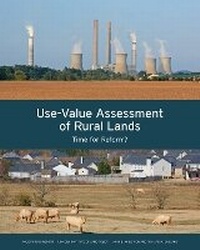
Use-Value Assessment of Rural Lands - Time for Reform?
Time for Reform?
Will be published approx. on 24. November 2015
Book
Paperback/Softback
48 pages
978-1-55844-339-6 (ISBN)
Description
Use-value assessment (UVA) is the practice of valuing rural land according to its current use rather than its market value to reduce property taxes for rural land owners in the United States. This tax preference amounts to tens of billions of dollars annually.
Originally created to slow the loss of farms, ranches, and forestland caused by urbanization, the reality is that UVA is a blunt policy instrument that provides tax benefits to all eligible landowners, with very little impact on the number of acres being developed. UVA undermines the integrity of the property tax system as a mechanism to fund local public goods and services. Eligibility requirements are often lax, withdrawal penalties are mild or nonexistent, and assessment methods are subject to biased manipulation. Fundamentally, UVA programs are not fulfilling their intended purposes.
This report describes the history and design features of state UVA programs, explains the theoretical underpinnings of land valuation, and surveys empirical studies of UVA implementation and impacts.
It also identifies the weaknesses of UVA programs and proposes the following set of policy reforms to make the programs more effective and fair:
Design eligibility rules to ensure that only parcels serving UVA statutory goals can participate.Adopt state guidelines for assessors that provide accurate UVA estimation methods.Create appropriate penalty provisions for land removed from rural or agricultural use.Restructure UVA programs to reduce tax inequities and provide valuable benefits to society as a whole.This report was preceded by the book Use-Value Assessment of Rural Land in the United States, published in 2014.
Originally created to slow the loss of farms, ranches, and forestland caused by urbanization, the reality is that UVA is a blunt policy instrument that provides tax benefits to all eligible landowners, with very little impact on the number of acres being developed. UVA undermines the integrity of the property tax system as a mechanism to fund local public goods and services. Eligibility requirements are often lax, withdrawal penalties are mild or nonexistent, and assessment methods are subject to biased manipulation. Fundamentally, UVA programs are not fulfilling their intended purposes.
This report describes the history and design features of state UVA programs, explains the theoretical underpinnings of land valuation, and surveys empirical studies of UVA implementation and impacts.
It also identifies the weaknesses of UVA programs and proposes the following set of policy reforms to make the programs more effective and fair:
Design eligibility rules to ensure that only parcels serving UVA statutory goals can participate.Adopt state guidelines for assessors that provide accurate UVA estimation methods.Create appropriate penalty provisions for land removed from rural or agricultural use.Restructure UVA programs to reduce tax inequities and provide valuable benefits to society as a whole.This report was preceded by the book Use-Value Assessment of Rural Land in the United States, published in 2014.
More details
Language
English
Place of publication
Cambridge
United States
Target group
Professional and scholarly
Interest Age: Up to 99 years
Product notice
Paperback (trade)
Illustrations
color photos and figures throughout
Dimensions
Height: 254 mm
Width: 203 mm
Thickness: 4 mm
Weight
172 gr
ISBN-13
978-1-55844-339-6 (9781558443396)
Copyright in bibliographic data and cover images is held by Nielsen Book Services Limited or by the publishers or by their respective licensors: all rights reserved.
Schweitzer Classification
Persons
John E. Anderson is the Baird family professor of economics at the University of Nebraska-Lincoln College of Business. He has advised government agencies in the United States and around the world, including the president's Council of Economic Advisers in Washington, DC, from 2005 to 2006. He was a visiting fellow at the Lincoln Institute of Land Policy.
Richard W. England is professor of economics at the University of New Hampshire-Durham. His research and public speaking focus on property taxation, land development, conservation, and housing markets. Together with Richard F. Dye, he edited Land Value Taxation: Theory, Evidence, and Practice (2009). He was a visiting fellow at the Lincoln Institute of Land Policy.
Richard W. England is professor of economics at the University of New Hampshire-Durham. His research and public speaking focus on property taxation, land development, conservation, and housing markets. Together with Richard F. Dye, he edited Land Value Taxation: Theory, Evidence, and Practice (2009). He was a visiting fellow at the Lincoln Institute of Land Policy.