

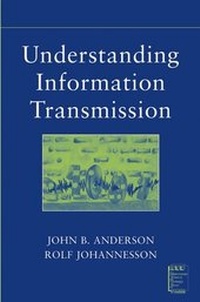
Understanding Information Transmission
Published on 24. March 2005
Book
Paperback/Softback
320 pages
978-0-471-67910-3 (ISBN)
Description
Understanding Information Transmission introduces you to the entire field of information technology. In this consumer handbook and introductory student resource, seven chapters span the gamut of the field--the nature, storage, transmission, networking, and protection of information. In addition to the science and technology, this book brings the subject alive by presenting the amazing history of information technology, profiling incredible inventions and fascinating inventors, and their dramatic impact on society. Features include problem sets, key points, suggested reading, review appendices, and a full chapter on mathematical methods. Private and public funding of information technology continues to grow at staggering rates. Learn what's behind this race to be the biggest, brightest, and fastest in the field with Understanding Information Transmission.
More details
Product info
Paperback
Series
Edition
1. Auflage
Language
English
Place of publication
United States
Publishing group
John Wiley & Sons Inc
Target group
Professional and scholarly
Product notice
Paperback (trade)
Unsewn / adhesive bound
Dimensions
Height: 234 mm
Width: 156 mm
Thickness: 18 mm
Weight
491 gr
ISBN-13
978-0-471-67910-3 (9780471679103)
Schweitzer Classification
Other editions
Additional editions
John B. Anderson | Rolf Johnnesson
Understanding Information Transmission
E-Book
01/2006
Wiley-IEEE Press
€74.99
Available for download
Persons
JOHN B. ANDERSON holds the Ericsson Chair in Digital Communications at Lund University, Sweden. He was formerly a professor at Rensselaer Polytechnic Institute. He is a Fellow of the IEEE and is a recipient of the Humboldt Research Prize and the IEEE Third Millennium Medal. His research and consulting practice concentrates on communication algorithms and bandwidth-efficient coding.
ROLF JOHANNESSON is Professor of Information Theory at Lund University, Sweden, and a Fellow of the IEEE. He was awarded the honor of Professor, honoris causa, from the Institute for Information Transmission Problems, Russian Academy of Sciences. His research interests include information theory, error-correcting codes, and cryptography.
Content
1. Introduction.
First Ideas and Some History.
1.1 What is Communication?
1.2 Why Digital Communication?
1.3 Some History.
1.4 Conclusions.
Bibliography.
2. Mathematical Methods of Information Transmission.
Why Sinusoids?
2.1 Linear, Time-Invariant (LTI) Systems.
2.2 On the Importance of Being Sinusoidal.
2.3 The Fourier Transform.
2.4 What is Bandwidth?
2.5 Discrete-time Systems.
2.6 Conclusions.
Bibliography.
Problems.
3. Information Sources.
What is Out There to be Sent?
3.1 What is Text?
3.2 What is Speech?
3.3 What is Music?
3.4 What is an Image?
3.5 What is Video?
3.6 Conclusion.
Bibliography.
Problems.
4. Transmission Methods.
How is Information Sent?
4.1 Communication Channels.
4.2 Analog Modulation.
4.3 Digital Modulation.
4.4 FM Stereo, Television and a Little About Electronics.
4.5 Conclusions.
Bibliography.
Problems.
5. Information Theory and Cooling.
What did Shannon Promise?
5.1 Information Theory--a Primer.
5.2 Methods of Source Coding.
5.3 Methods of Channel Coding.
5.4 Trellis Coded Modulation.
5.5 Conclusions.
Bibliography.
Problems.
6. Cryptology.
FUBSWRORJB??
6.1 Fundamentals of Cryptosystems.
6.2 Caesar and Vigenère Ciphers.
6.3 The Vernam Cipher and Perfect Secrecy.
6.4 Stream Ciphers.
6.5 Block Ciphers.
6.6 Cryptomachines During World War II.
6.7 Two-key Cryptography.
6.8 Conclusion.
Bibliography.
Problems.
7. Communication Networks.
Let's get Connected.
7.1 An Overview of Information Networks.
7.2 Circuit Switching: The Telephone Net.
7.3 Mobile Telephony.
7.4 The Internet.
Bibliography.
Appendix A. Complex Numbers.
Appendix B. Sinusoids and Circuit Theory.
Appendix C. Probability Theory--a Primer.
Index.
About the Authors.