

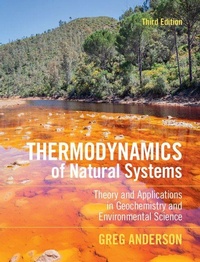
Thermodynamics of Natural Systems
Theory and Applications in Geochemistry and Environmental Science
3rd Edition
Published on 27. April 2017
Book
Hardback
428 pages
978-1-107-17521-1 (ISBN)
Description
Thermodynamics deals with energy levels and energy transfers between states of matter, and is therefore fundamental to all branches of science. This new edition provides an accessible introduction to the subject, specifically tailored to the interests of Earth and environmental science students. Beginning at an elementary level, the first four chapters explain all necessary concepts via a simple graphical approach. Throughout the rest of the book, the author emphasizes the importance of field observations and demonstrates that, despite being derived from idealized circumstances, thermodynamics is crucial to understanding ore formation, acid mine drainage, and other real-world geochemical and geophysical problems. Exercises now follow each chapter, with answers provided at the end of the book. An associated website includes extra chapters and password-protected answers to additional problems. This textbook is ideal for undergraduate and graduate students studying geochemistry and environmental science.
Reviews / Votes
'The beauty and power of this book is how Greg Anderson shows us, in rigorous yet practical and pictorial terms, how we can learn about the fundamental behaviour of our complex planet from classical thermodynamics alone. Anderson conveys this ... with fervor, with humor and with many calculated examples - which all emphasize that asking the right question is the key to meaningful simplification, and to answers that capture the essence of complex natural systems.' Christoph A. Heinrich, Eidgenoessische Technische Hochschule Zuerich, Switzerland 'Thermodynamics is one of the most universal scientific disciplines ... But being so universal also requires it to be introduced and taught very differently to students in such diverse fields of science. This 3rd edition is a really welcome and timely book in this context. The book introduces and discusses the most important concepts of equilibrium thermodynamics in their specific applications to geological and environmental sciences. The author has made particular efforts to only use minimum necessary formal mathematical apparatus to present the thermodynamic laws and relationships. However, this is carefully done without any oversimplification or loss of physical accuracy ... The textbook can be recommended as a very good introductory course in thermodynamics for undergraduate geoscience and environmental science students.' Andrey G. Kalinichev, Ecole des Mines de Nantes, FranceMore details
Edition
3rd Revised edition
Language
English
Place of publication
Cambridge
United Kingdom
Target group
Professional and scholarly
College/higher education
Edition type
Revised edition
Illustrations
141 Halftones, black and white
Dimensions
Height: 260 mm
Width: 208 mm
Thickness: 28 mm
Weight
1143 gr
ISBN-13
978-1-107-17521-1 (9781107175211)
Copyright in bibliographic data and cover images is held by Nielsen Book Services Limited or by the publishers or by their respective licensors: all rights reserved.
Schweitzer Classification
Other editions
Additional editions
Greg Anderson
Thermodynamics of Natural Systems
Theory and Applications in Geochemistry and Environmental Science
E-Book
05/2017
3rd Edition
Cambridge University Press
€64.99
Available for download
Greg Anderson
Thermodynamics of Natural Systems
Theory and Applications in Geochemistry and Environmental Science
E-Book
04/2017
Cambridge University Press
€55.49
Available for download
Previous edition
G. M. Anderson
Thermodynamics of Natural Systems
Book
08/2009
2nd Edition
Cambridge University Press
€74.39
Article exhausted; check for reprint
Person
Greg Anderson is Professor Emeritus in the Department of Earth Sciences at the University of Toronto. He began his career as a mining engineer and exploration geologist before becoming interested in geochemistry. After completing his Ph.D. at Toronto, he spent five years at Pennsylvania State University doing experimental work on mineral solubilities. Afterward, he returned to Toronto, where he has since divided his time between studies of mineral systems, lead-zinc ore deposits, and theoretical geochemistry. He is the co-author of two other textbooks for Earth scientists, and in 2000 was awarded the Past Presidents' Medal (now named the Peacock Medal) by the Mineralogical Association of Canada for contributions to geochemistry.
Content
Preface; 1. What is thermodynamics?; 2. Defining our terms; 3. The First Law of Thermodynamics; 4. The Second Law of Thermodynamics; 5. Getting data; 6. Some simple applications; 7. Solutions; 8. Fugacity and activity; 9. The equilibrium constant; 10. Rock-water systems; 11. Redox reactions; 12. Phase diagrams; 13. Affinity and extent of reaction; Appendix A. Constants and numerical values; Appendix B. Standard state properties; Appendix C. Answers to exercises; References; Index; Online material: real solutions; The phase rule; Equations of state; Solid solutions; Electrolyte solutions; The Van't Hoff equilibrium box; Topics in mathematics.