

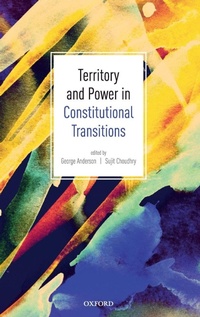
Territory and Power in Constitutional Transitions
Published on 12. March 2019
Book
Hardback
480 pages
978-0-19-883654-4 (ISBN)
Description
This collection of essays surveys the full range of challenges that territorial conflicts pose for constitution-making processes and constitutional design. It provides seventeen in-depth case studies of countries going through periods of intense constitutional engagement in a variety of contexts: small distinct territories, bi-communal countries, highly diverse countries with many politically salient regions, and countries where territorial politics is important but secondary to other bases for political mobilization. Specific examples are drawn from Iraq, Kenya, Cyprus, Nigeria, South Africa, Sri Lanka, the UK (Scotland), Ukraine, Bolivia, India, Spain, Yemen, Nepal, Ethiopia, Indonesia (Aceh), the Philippines (Mindanao), and Bosnia-Herzegovina.
While the volume draws significant normative conclusions, it is based on a realist view of the complexity of territorial and other political cleavages (the country's "political geometry"), and the power configurations that lead into periods of constitutional engagement. Thematic chapters on constitution-making processes and constitutional design draw original conclusions from the comparative analysis of the case studies and relate these to the existing literature, both in political science and comparative constitutional law. This volume is essential reading for scholars of federalism, consociational power-sharing arrangements, asymmetrical devolution, and devolution more generally. The combination of in-depth case studies and broad thematic analysis allows for analytical and normative conclusions that will be of major relevance to practitioners and advisors engaged in constitutional design.
While the volume draws significant normative conclusions, it is based on a realist view of the complexity of territorial and other political cleavages (the country's "political geometry"), and the power configurations that lead into periods of constitutional engagement. Thematic chapters on constitution-making processes and constitutional design draw original conclusions from the comparative analysis of the case studies and relate these to the existing literature, both in political science and comparative constitutional law. This volume is essential reading for scholars of federalism, consociational power-sharing arrangements, asymmetrical devolution, and devolution more generally. The combination of in-depth case studies and broad thematic analysis allows for analytical and normative conclusions that will be of major relevance to practitioners and advisors engaged in constitutional design.
Reviews / Votes
This collection is highly impressive in both its breadth and depth. Local knowledge and theoretical sophistication combine to make this essential reading for scholars and practitioners interested in constitutions, federalism, territorial cleavages, and peace. The synthetic conclusion shows just how far we can advance knowledge through collaboration across national and disciplinary boundaries. We need more studies like this. * Nancy Bermeo, Professor Emeritus, Princeton University and Nuffield Professor of Comparative Politics Emeritus, University of Oxford * Territory and Power in Constitutional Transitions provides path-breaking analysis of conflicts rooted in territorial identity along with building blocks for academic theorists and wise counsel to practitioners. Drawing on a vast range of cases, the volume provides useful generalizations regarding how territorial interests are mobilized by geography, political history, and power, and how constitutional processes and design can sometimes succeed despite intense mobilization of territorial interests. It provides both hope and essential reading for anyone seeking peaceful, stable, and fair outcomes in territorially divided societies. * Roderick M. Hills Jr., William T. Comfort III Professor of Law, New York University School of Law * In its wide-ranging exploration of how constitutions help promote peace, stability and inclusion in deeply divided societies, this volume combines rich theoretical analysis with in-depth constitutional case-studies. Contributions from leading constitutional scholars and practitioners give it an impressive scope, with seventeen country cases studies. The insights it generates are both fresh and compelling. It deserves the widest possible audience. * Rosalind Dixon, Professor of Law, University of New South Wales, Faculty of Law; co-President, International Society of Public Law * While comparative constitutionalism is the stock in trade of conflict resolution practitioners, too often this is not accompanied by an understanding of the underlying logic and political dynamics that inform or limit constitutional options. It is here that Territory and Power in Constitutional Transitions makes an outstanding and invaluable contribution to our understanding of the logic of possible options for constitutional processes and design, especially in a context of territorial cleavages. * Nicholas Haysom, Special Representative of the United Nations Secretary General, Somalia * This compendium offers a unique perspective on a dizzying range of political and violent conflicts in societies rent by territorial cleavages. It leaves us with optimism about how constitutional processes may make such conflicts tractable. While each chapter captures the inescapable logic of institutional and political context, the editors painstakingly, and with great nuance, elaborate a general framework for understanding how divided societies might achieve reconstitution and even coexistence and integration. Territory and Power in Constitutional Transitions epitomizes what scholarship on comparative constitutional development should strive to achieve. * Cristina M. Rodriguez, Leighton Homer Surbeck Professor of Law, Yale Law School * This remarkable contribution to the understanding of contemporary Libya doubles as a primer on violent conflict and its societal ramifications, and invites reexamination of other cases of mass civil violence. Recommended for larger college libraries and collections supporting international and conflict studies. * Choice *More details
Language
English
Place of publication
Oxford
United Kingdom
Target group
Professional and scholarly
Dimensions
Height: 240 mm
Width: 161 mm
Thickness: 30 mm
Weight
872 gr
ISBN-13
978-0-19-883654-4 (9780198836544)
Copyright in bibliographic data and cover images is held by Nielsen Book Services Limited or by the publishers or by their respective licensors: all rights reserved.
Schweitzer Classification
Other editions
Additional editions
George Anderson | Sujit Choudhry
Territory and Power in Constitutional Transitions
E-Book
03/2019
1st Edition
OUP eBook
€56.99
Available for download
George Anderson | Sujit Choudhry
Territory and Power in Constitutional Transitions
E-Book
03/2019
1st Edition
OUP eBook
€49.99
Available for download
Persons
George Anderson is former deputy minister (permanent secretary) in the Canadian government and subsequently CEO of the Forum of Federations. He has been a member of the Standby Team of Experts in the UN's Department of Political Affairs and consulted extensively around the world. He is currently a fellow at the Centre for Democracy and Diversity at Queen's University, Kingston, Canada, and has had earlier resident fellowships at Harvard and New York universities.
Sujit Choudhry is an internationally recognized authority on comparative constitutional law, and has been an advised on constitution building, governance, and rule of law processes for over 20 years, including in Egypt, Jordan, Libya, Nepal, South Africa, Sri Lanka, Tunisia, Ukraine and Yemen. He founded and directs the Center for Constitutional Transitions (CT).
Sujit Choudhry is an internationally recognized authority on comparative constitutional law, and has been an advised on constitution building, governance, and rule of law processes for over 20 years, including in Egypt, Jordan, Libya, Nepal, South Africa, Sri Lanka, Tunisia, Ukraine and Yemen. He founded and directs the Center for Constitutional Transitions (CT).
Content
- 1: Gustavo Bonifaz Moreno and George Gray Molina: Territorial Cleavages and the Bolivian Constitutional Transition
- 2: Marie-Joelle Zahar: Bosnia and Herzegovina
- 3: Neophytos Loizides and John McGarry: The 2002-2004 Annan Plan in Cyprus: An Attempted UN-Mediated Constitutional Transition
- 4: Assefa Fiseha: Emergence and Transformation of Territorially Based Cleavages and Constitutional Responses in Ethiopia
- 5: Harihar Bhattacharyya: States Reorganization and the Accommodation of Ethno-Territorial Cleavages in India
- 6: Zaid Al-Ali: Dealing with Territorial Cleavages in Constitutional Transitions in Iraq
- 7: Jacques Bertrand: Indonesia: "Special Autonomy" for Aceh and Papua
- 8: Yash Ghai and Jill Cottrell: Constitutional Transitions and Territorial Cleavages: the Kenyan Case
- 9: Mara Malagodi: "Godot has Arrived!" Federal Restructuring in Nepal
- 10: Rotimi Suberu: Nigeria's Permanent Constitutional Transition: Military Rule, Civilian Instability, and the Unending Search for Democratic "True Federalism" in a Deeply Divided Society
- 11: Bryony Lau: The Philippines: Peace talks and autonomy in Mindanao
- 12: Nico Steytler: The Withering away of Politically Salient Territorial Cleavages in South Africa and the Emergence of Watermark Ethnic Federalism
- 13: César Colino, Luis Moreno, and Angustias Hombrado: Spain: Constitutional Transition through Gradual Accommodation of Territories
- 14: Asanga Welikala: Sri Lanka's Failed Peace Process and the Continuing Challenge of Ethno-Territorial Cleavages
- 15: Stephen Tierney: After the Scottish Independence Referendum: Towards a Federal Moment for the United Kingdom?
- 16: Lucan Way: Dealing with Territorial Cleavages: The Rise and Fall of Ukraine's Faustian Bargain
- 17: George Anderson: Yemen's Failed Constitutional Transition
- 18: Cheryl Saunders: Processes of Constitutional Transitions in the Face of Territorial Cleavages
- 19: Tom Ginsburg: Constitutional Design and Territorial Cleavages
- 20: George Anderson and Sujit Choudhry: Territorial Cleavages and Constitutional Transitions: Political Mobilization, Constitution-Making Processes, and Constitutional Design