

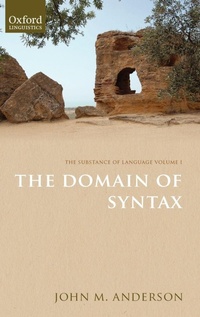
The Substance of Language Volume I: The Domain of Syntax
Published on 20. October 2011
Book
Hardback
448 pages
978-0-19-960831-7 (ISBN)
Description
The Substance of Language
Volume I: The Domain of Syntax
Volume II: Morphology, Paradigms, and Periphrases
Volume III: Phonology-Syntax Analogies
John M. Anderson
The three volumes of The Substance of Language collectively overhaul linguistic theory from phonology to semantics and syntax to pragmatics and offer a full account of how the form/function relationship works in language. Each explores the consequences for the investigation of language of a conviction that all aspects of linguistic structure are grounded in the non-linguistic mental faculties on which language imposes its own structure. The first and third look at how syntax and phonology are fed by a lexical component that includes morphology and which unites representations in the two planes. The second examines the way morphology is embedded in the lexicon as part of the expression of the lexicon-internal relationships of words.
The Domain of Syntax explores the consequences for syntax of assuming that language is grounded in cognition and perception. It shows that syntax is characterized by a set of categories based on distinctions in what the categories are perceived to represent. The first part of the book traces the twentieth-century development of anti-notionalism, culminating in the assumption that syntax is autonomous. The author then looks at syntactic phenomena, many involving the fundamental notion of finiteness. He considers whether the appeal to grounding permits a lexicalist approach that would allow syntax to dispense not only with structural mutations such as category-change and 'empty categories' but with universal grammar itself.
The many detailed proposals of John Anderson's fine trilogy are derived from an over-arching conception of the nature of linguistic knowledge that is in turn based on the grounding of syntax in semantics and the grounding of phonology in phonetics, both convincingly subsumed under the notion of cognitive salience. The Substance of Language is a major contribution to linguistic theory and the history of linguistic thought.
Volume I: The Domain of Syntax
Volume II: Morphology, Paradigms, and Periphrases
Volume III: Phonology-Syntax Analogies
John M. Anderson
The three volumes of The Substance of Language collectively overhaul linguistic theory from phonology to semantics and syntax to pragmatics and offer a full account of how the form/function relationship works in language. Each explores the consequences for the investigation of language of a conviction that all aspects of linguistic structure are grounded in the non-linguistic mental faculties on which language imposes its own structure. The first and third look at how syntax and phonology are fed by a lexical component that includes morphology and which unites representations in the two planes. The second examines the way morphology is embedded in the lexicon as part of the expression of the lexicon-internal relationships of words.
The Domain of Syntax explores the consequences for syntax of assuming that language is grounded in cognition and perception. It shows that syntax is characterized by a set of categories based on distinctions in what the categories are perceived to represent. The first part of the book traces the twentieth-century development of anti-notionalism, culminating in the assumption that syntax is autonomous. The author then looks at syntactic phenomena, many involving the fundamental notion of finiteness. He considers whether the appeal to grounding permits a lexicalist approach that would allow syntax to dispense not only with structural mutations such as category-change and 'empty categories' but with universal grammar itself.
The many detailed proposals of John Anderson's fine trilogy are derived from an over-arching conception of the nature of linguistic knowledge that is in turn based on the grounding of syntax in semantics and the grounding of phonology in phonetics, both convincingly subsumed under the notion of cognitive salience. The Substance of Language is a major contribution to linguistic theory and the history of linguistic thought.
More details
Series
Language
English
Place of publication
Oxford
United Kingdom
Target group
College/higher education
Dimensions
Height: 240 mm
Width: 161 mm
Thickness: 28 mm
Weight
831 gr
ISBN-13
978-0-19-960831-7 (9780199608317)
Copyright in bibliographic data and cover images is held by Nielsen Book Services Limited or by the publishers or by their respective licensors: all rights reserved.
Schweitzer Classification
Person
John M. Anderson is Emeritus Professor of English Language at the University of Edinburgh. He has been a visiting professor at universities in Denmark, Poland, Greece, and Spain. His books include The Grammar of Case (CUP, 1971); Old English Phonology (with Roger Lass, CUP, 1975); Principles of Dependency Phonology (with Colin J. Ewen, CUP, 1987); A Notional Theory of Syntactic Categories (CUP, 1997); Modern Grammars of Case (OUP, 2006); and The Grammar of Names (OUP, 2007).
Content
PART I: THE SUBSTANCE OF SYNTAX; PART II: WHAT IS AND IS NOT SYNTAX; PART III: A NOTIONAL THEORY OF FINITENESS