

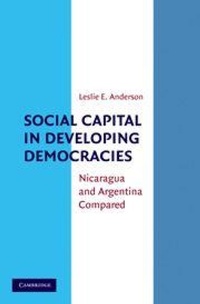
Social Capital in Developing Democracies
Nicaragua and Argentina Compared
Published on 8. March 2010
Book
Hardback
344 pages
978-0-521-19274-3 (ISBN)
Description
Drawing on extensive field work in Nicaragua and Argentina, as well as public opinion and elite data, Leslie E. Anderson's Social Capital in Developing Democracies explores the contribution of social capital to the process of democratization and the limits of that contribution. Anderson finds that in Nicaragua, strong, positive, bridging social capital has enhanced democratization while in Argentina the legacy of Peronism has created bonding and non-democratic social capital that perpetually undermines the development of democracy. Faced with the reality of an anti-democratic form of social capital, Anderson suggests that Argentine democracy is developing on the basis of an alternative resource - institutional capital. Anderson concludes that social capital can and does enhance democracy under historical conditions that have created horizontal ties among citizens, but that social capital can also undermine democratization where historical conditions have created vertical ties with leaders and suspicion or non-cooperation among citizens.
Reviews / Votes
"This book provides a masterful analysis of political development in the cases of Argentina and Nicaragua. The analysis links citizen participation and institutional development in a novel way that shows how mass movements can establish enduring patterns of relationships between citizens and the state. The writing demonstrates the great depth of Leslie E. Anderson's knowledge of the two countries and the strength of her command of the political and historical literature on them."- Lisa Baldez, Dartmouth College "An unconventional comparison . . . chock-full of surprising and original arguments about the origins and varieties of social capital and the lasting legacies of nineteenth-century state-making."
- Nancy Bermeo, Nuffield College, University of Oxford "In this excellent book, Leslie Anderson provides an engaging account - and offers a compelling explanation - of the differences in the history, character, and quality of political development in Nicaragua and Argentina. The analysis is both straightforward and clear and at the same time rich and complex. The juxtaposition of the familiar concept of social capital with that of 'institutional' capital as alternative underpinnings for democratization in the two countries is particularly insightful and provocative. The extensive and careful research, which includes several types of empirical evidence, and the accompanying interpretation Anderson offers makes the book a particularly intriguing intellectual statement. It should appeal to a wide range of readers, within and beyond political science, interested in the social and structural factors that shape democracy in various contexts."
- Rodney E. Hero, University of Notre Dame "Anderson's careful comparative politics of Argentina and Nicaragua avoids facile answers. Do economic development and social capital foster democracy? Not necessarily, as the reader discovers in these theoretically sharp, empirically girded - but artful - case studies."
- Michael S. Lewis-Beck, University of Iowa "Anderson examines political attitudes and political behavior in Nicaragua and Argentina from the 1990s through 2007 via archival research, interviews, and public opinion surveys. Anderson's empirical analyses mix municipal surveys in Bello Horizonts, Nicaragua, and La Matanza, Argentina, with national surveys conducted as part of the Latinobarometer series. Recommended."
- C.H. Blake, James Madison University, Choice
More details
Language
English
Place of publication
Cambridge
United Kingdom
Target group
Professional and scholarly
Illustrations
8 Tables, unspecified; 26 Halftones, unspecified; 1 Line drawings, unspecified
Dimensions
Height: 240 mm
Width: 161 mm
Thickness: 24 mm
Weight
711 gr
ISBN-13
978-0-521-19274-3 (9780521192743)
Copyright in bibliographic data and cover images is held by Nielsen Book Services Limited or by the publishers or by their respective licensors: all rights reserved.
Schweitzer Classification
Other editions
Additional editions
E-Book
05/2010
1st Edition
Cambridge University Press
€24.99
Available for download
Book
03/2010
Cambridge University Press
€45.70
Shipment within 15-20 days
E-Book
03/2010
1st Edition
Cambridge University Press
€26.99
Available for download
Person
Leslie E. Anderson is a University of Florida Research Foundation Professor of Political Science at the University of Florida. She is a scholar of democracy, popular politics and protest, and democratic development. Professor Anderson is also the author of The Political Ecology of the Modern Peasant: Calculation and Community and Learning Democracy: Citizen Engagement and Electoral Choice in Nicaragua, 1990-2001 (with Lawrence C. Dodd), in addition to multiple journal articles.
Content
1. Introduction; Part I. Creating Social Capital: People I Have Known: The Human Face of Popular Politics: 2. Creating 'we': Sandinismo and bridging social capital; 3. Creating 'us' and 'them': Peronism and bonding social capital; Part II. An Empirical Examination of the Argument: 4. A tale of two neighborhoods: social capital in Nicaragua and Argentina; 5. Political capital in Nicaragua and Argentina: political activism and political values; 6. Political capital in Nicaragua and Argentina: democratic institutions and procedures; Part III. Making Democracy Work Without Social Capital: Institutional Capital: 7. If you build it they will come; 8. Conclusion.