

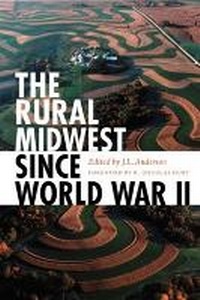
The Rural Midwest Since World War II
Published on 1. February 2014
Book
Paperback/Softback
335 pages
978-0-87580-694-5 (ISBN)
Description
J.L. Anderson seeks to change the belief that the Midwest lacks the kind of geographic coherence, historical issues, and cultural touchstones that have informed regional identity in the American South, West, and Northeast. The goal of this illuminating volume is to demonstrate uniqueness in a region that has always been amorphous and is increasingly so. Midwesterners are a dynamic people who shaped the physical and social landscapes of the great midsection of the nation, and they are presented as such in this volume that offers a general yet informed overview of the region after World War II.
The contributors-most of whom are Midwesterners by birth or residence-seek to better understand a particular piece of rural America, a place too often caricatured, misunderstood, and ignored. However, the rural landscape has experienced agricultural diversity and major shifts in land use. Farmers in the region have successfully raised new commodities from dairy and cherries to mint and sugar beets. The region has also been a place where community leaders fought to improve their economic and social well-being, women redefined their roles on the farm, and minorities asserted their own version of the American Dream.
The rural Midwest is a regional melting pot, and contributors to this volume do not set out to sing its praises or, by contrast, assume the position of Midwestern modesty and self-deprecation. The essays herein rewrite the narrative of rural decline and crisis, and show through solid research and impeccable scholarship that rural Midwesterners have confronted and created challenges uniquely their own.
The contributors-most of whom are Midwesterners by birth or residence-seek to better understand a particular piece of rural America, a place too often caricatured, misunderstood, and ignored. However, the rural landscape has experienced agricultural diversity and major shifts in land use. Farmers in the region have successfully raised new commodities from dairy and cherries to mint and sugar beets. The region has also been a place where community leaders fought to improve their economic and social well-being, women redefined their roles on the farm, and minorities asserted their own version of the American Dream.
The rural Midwest is a regional melting pot, and contributors to this volume do not set out to sing its praises or, by contrast, assume the position of Midwestern modesty and self-deprecation. The essays herein rewrite the narrative of rural decline and crisis, and show through solid research and impeccable scholarship that rural Midwesterners have confronted and created challenges uniquely their own.
Reviews / Votes
An essential contribution to understanding the history of Iowa and the rural Midwest.(The Annals of Iowa) A collection that works, which is surely something that any Midwesterner can appreciate.
(The Michigan Historical Review) The Rural Midwest Since World War II marks a significant contribution to the revival of Midwestern regional history. Anderson's work is sure to spark greater interest in and more research into this region's recent history.
(Kansas History)
More details
Language
English
Place of publication
United States
Publishing group
Cornell University Press
Product notice
Paperback (trade)
Dimensions
Height: 229 mm
Width: 152 mm
Thickness: 19 mm
Weight
907 gr
ISBN-13
978-0-87580-694-5 (9780875806945)
Copyright in bibliographic data and cover images is held by Nielsen Book Services Limited or by the publishers or by their respective licensors: all rights reserved.
Schweitzer Classification
Other editions
Additional editions
J. L. Anderson
The Rural Midwest Since World War II
E-Book
02/2014
Northern Illinois University Press
€13.49
Available for download
Person
J.L. Anderson is associate professor of history at Mount Royal University in Calgary, Alberta. He earned his PhD at Iowa State University and is the author of Industrializing the Corn Belt.